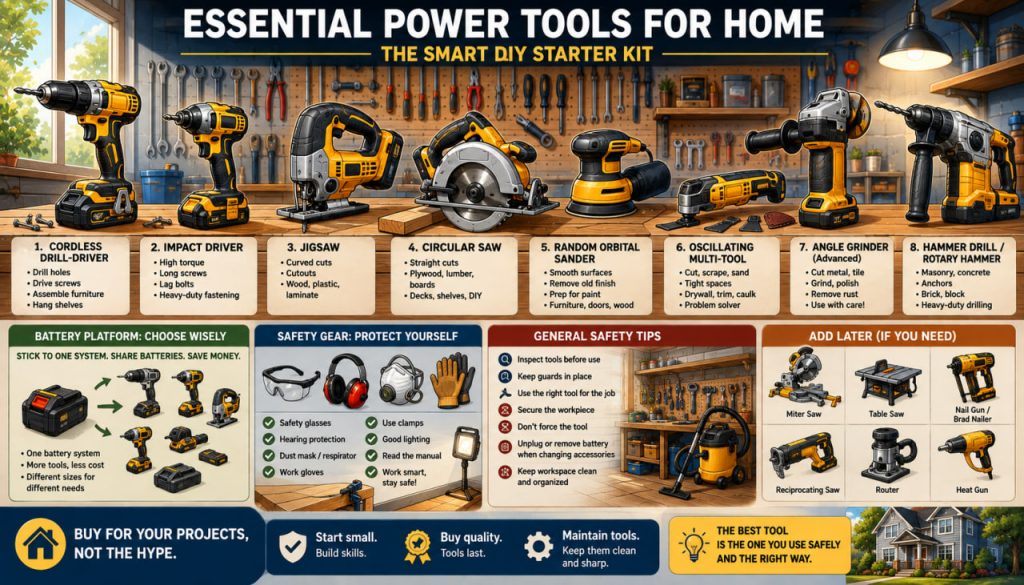
A good home tool kit does not need to look like a professional workshop. Most homeowners do not need every saw, grinder, nailer, and specialty machine on the market. What they need is a practical set of reliable power tools that can handle common repairs, furniture assembly, small renovations, drilling, cutting, sanding, and maintenance.
The smartest approach is simple: buy tools based on real tasks, not advertising hype.
For most homes, the essential power tool list starts with a cordless drill-driver, then expands depending on whether you do woodworking, repairs, gardening, apartment maintenance, or renovation work.
Start With the Most Important Tool: A Cordless Drill-Driver
If you buy only one power tool for the home, make it a cordless drill-driver.
It can drill holes and drive screws. That makes it useful for assembling furniture, hanging shelves, installing curtain rods, mounting hooks, repairing cabinets, tightening hardware, and doing basic DIY projects.
Look for:
- 18V or 20V battery platform
- Variable speed trigger
- Adjustable clutch
- Keyless chuck
- Built-in work light
- Two batteries if possible
- Comfortable grip
The adjustable clutch matters because it helps prevent over-tightening screws and damaging furniture, drywall, or hardware.
A drill-driver is the foundation of almost every home power tool kit.
Add an Impact Driver for Heavy Screwing
An impact driver looks similar to a drill, but it is designed for driving screws and bolts with more torque.
It is especially useful for:
- Deck screws
- Long wood screws
- Lag bolts
- Outdoor structures
- Dense timber
- Repetitive fastening
For light apartment tasks, a drill-driver may be enough. But if you build furniture, repair fences, work with wood, or often drive large screws, an impact driver saves time and wrist strain.
A popular setup is a cordless drill-driver plus impact driver combo kit using the same battery platform.
A Jigsaw Is the Best First Saw for Many Homes
A jigsaw is one of the most beginner-friendly cutting tools.
It can make straight cuts, curved cuts, cutouts, and rough shaping cuts in wood, plywood, laminate, plastic, and sometimes thin metal with the correct blade.
Use it for:
- Cutting shelves
- Trimming panels
- Making holes in countertops
- Craft projects
- Cutting curves
- Small repairs
A circular saw is faster for long straight cuts, but a jigsaw is often more versatile for small home projects.
For beginners, a jigsaw is usually safer and easier to control than larger saws.
Circular Saw: Essential for Bigger DIY Projects
If you plan to build shelves, workbenches, garden boxes, subfloors, decking, or plywood furniture, a circular saw becomes very useful.
It is designed for fast, straight cuts through wood and sheet materials.
Choose a circular saw if you regularly cut:
- Plywood
- OSB
- Lumber
- Boards
- Fence materials
- Decking
For accuracy, use a straightedge guide or track-style guide. Never remove the blade guard, and always support the material properly.
OSHA emphasizes that hand and power tools require special attention to safety because they can create serious hazards when used incorrectly.
Random Orbital Sander for Smooth Finishing
A random orbital sander is the easiest sanding tool for most homeowners.
It removes old finish, smooths rough wood, prepares surfaces for paint, and improves the look of DIY projects. Unlike simple sheet sanders, it moves in a random circular pattern, reducing visible sanding marks.
It is useful for:
- Furniture restoration
- Doors
- Shelves
- Wooden tables
- Painted surfaces
- Small renovation jobs
Use dust extraction when possible. Fine dust can irritate the lungs and cover the entire room if you work indoors without control.
A sander makes amateur projects look much more professional.
Oscillating Multi-Tool: The Problem Solver
An oscillating multi-tool is not always the first tool people buy, but it often becomes one of the most useful.
It uses rapidly vibrating attachments for cutting, scraping, sanding, and trimming in tight spaces.
It can help with:
- Cutting drywall
- Trimming door frames
- Removing old caulk
- Scraping adhesive
- Cutting nails or small metal pieces
- Making plunge cuts
- Repairing flooring
This is the tool you reach for when no other tool fits.
For home repairs, an oscillating multi-tool is the ultimate “how do I even reach that?” solution.
Angle Grinder: Powerful but Not for Everyone
An angle grinder is useful for cutting metal, grinding rust, sharpening tools, cleaning welds, cutting tile, and removing stubborn material.
However, it is also one of the more dangerous common power tools. The wheel spins at extremely high speed, and incorrect discs, poor handling, or missing guards can cause serious injury.
Buy one only if you truly need to cut or grind metal, masonry, or tile.
Use:
- Eye protection
- Face shield when appropriate
- Hearing protection
- Gloves suitable for the task
- Correct wheel type
- Tool guard
- Firm two-hand grip
An angle grinder is not a casual beginner tool. Respect it or avoid it.
When You Need a Rotary Hammer or Hammer Drill
For concrete, brick, and masonry, an ordinary drill may struggle.
A hammer drill adds a percussion action while drilling. A rotary hammer is stronger and better for serious masonry work.
Use a hammer drill for:
- Mounting shelves on brick walls
- Installing anchors
- Drilling into concrete blocks
- Light masonry work
Use a rotary hammer for:
- Frequent concrete drilling
- Larger holes
- Heavy-duty anchors
- Chipping tasks with the right mode
For apartment living, a compact hammer drill may be enough. For renovation work in concrete buildings, a rotary hammer can save enormous effort.
Battery Platform: Choose Carefully
Cordless tools are convenient, but batteries are expensive. This is why many homeowners should choose one brand and battery platform, then stay with it.
The goal is to share batteries between tools.
A practical home battery setup includes:
- One compact battery for light work
- One or two larger batteries for longer use
- A charger
- Tools from the same voltage family
Avoid buying random cordless tools from many incompatible systems unless there is a strong reason.
The battery platform is often more important than the individual tool.
Safety Gear Is Not Optional
Power tools are useful because they multiply force. That also means mistakes happen faster.
At minimum, every home workshop should have:
- Safety glasses
- Hearing protection
- Dust mask or respirator
- Work gloves where appropriate
- Clamps
- Extension cord rated for the tool
- Good lighting
- First-aid kit
NIOSH warns that exposure to hazardous noise can lead to significant hearing loss, and power tools are among common sources of dangerous noise.
The U.S. Consumer Product Safety Commission also works to reduce unreasonable risks of injury from consumer products, including products with electrical, fire, chemical, and mechanical hazards.
The most important accessory for any power tool is the right safety habit.
Expert Perspective
Professional safety guidance from OSHA consistently emphasizes that tool hazards must be recognized and controlled through proper equipment, correct use, inspection, guarding, and personal protective equipment. OSHA’s hand and power tool resources are designed for workplaces, but the principles apply strongly at home: inspect tools before use, keep guards in place, use the correct tool for the job, and avoid unsafe shortcuts.
For homeowners, this expert advice translates into one practical rule: buy fewer tools, learn them properly, and use them safely every time.
The Best Starter Power Tool Kit for Home
For most households, a smart starter kit looks like this:
- Cordless drill-driver
- Impact driver
- Jigsaw
- Random orbital sander
- Oscillating multi-tool
- Hammer drill or rotary hammer if you have masonry walls
- Work light
- Vacuum or dust extractor
- Safety glasses, hearing protection, and clamps
After that, add tools only when a real project requires them.
A circular saw is excellent for woodworking. An angle grinder is valuable for metal and masonry. A nailer is useful for trim work. A table saw or miter saw makes sense only if woodworking becomes a serious hobby.
The best power tool collection is not the biggest one. It is the one that matches your home, your skills, and your projects.
Interesting Facts
- A cordless drill-driver is often the most-used power tool in a home.
- Impact drivers are excellent for screws but not ideal for delicate drilling.
- Jigsaws can cut curves, while circular saws are better for long straight cuts.
- Random orbital sanders reduce visible sanding marks better than many basic sanders.
- Battery compatibility can save more money over time than buying the cheapest individual tool.
- Many tool injuries happen during small “quick” jobs when people skip safety glasses or clamps.
- Hearing protection matters because some power tools can reach noise levels high enough to damage hearing.
Glossary
- Cordless Drill-Driver — A battery-powered tool used for drilling holes and driving screws.
- Impact Driver — A high-torque fastening tool designed for driving screws and bolts.
- Jigsaw — A saw with a narrow moving blade used for curves, cutouts, and small cuts.
- Circular Saw — A saw with a round blade designed for fast straight cuts.
- Random Orbital Sander — A sanding tool that moves in a random circular pattern to create smoother finishes.
- Oscillating Multi-Tool — A tool that uses vibrating attachments for cutting, sanding, scraping, and trimming.
- Angle Grinder — A powerful tool used for grinding, cutting, and polishing metal, masonry, or tile.
- Hammer Drill — A drill with a percussion action for masonry and brick.
- Rotary Hammer — A heavy-duty masonry drilling tool stronger than a hammer drill.
- Battery Platform — A family of cordless tools that share the same batteries and chargers.