In space, not every star evolves alone.
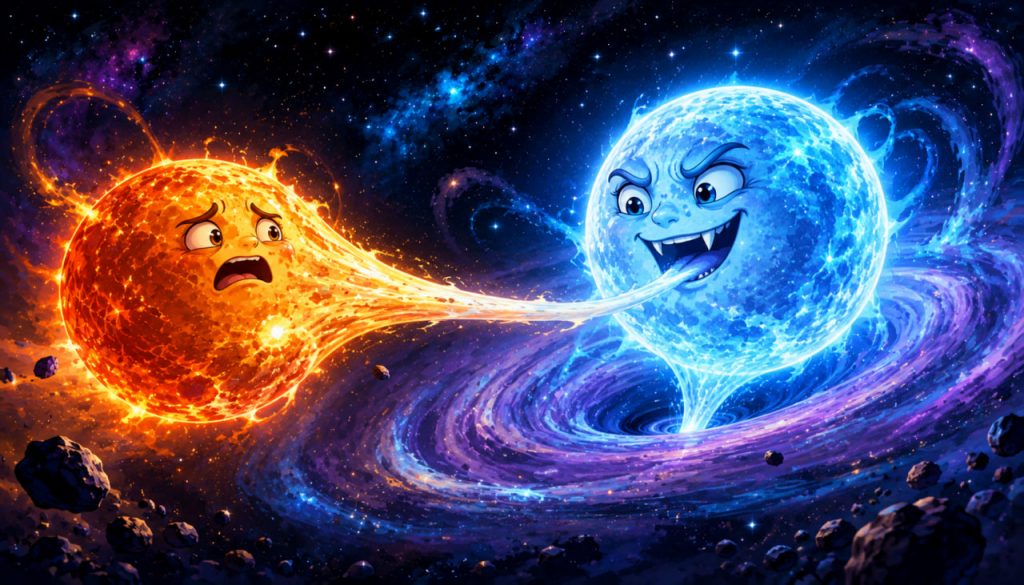
Many stars live in pairs, locked together by gravity. When two stars orbit close enough, one can begin pulling gas from the other. This dramatic process has inspired one of astronomy’s most memorable nicknames: vampire stars.
A vampire star is not a supernatural object. It is a real type of interacting star system where one star steals material from a companion. In some cases, the stolen gas makes the receiving star look younger, hotter, brighter, or more energetic than it should.
Astronomers study vampire stars because they reveal how stars age, how binary systems evolve, and how some of the universe’s most powerful stellar explosions begin.
What Are Vampire Stars?
“Vampire star” is an informal term used for stars that draw material from a nearby companion.
This usually happens in a binary star system, where two stars orbit around a shared center of mass. If the stars are close enough, gravity can pull gas from one star onto the other.
The process is called mass transfer.
The star losing material is often an older, swollen star. The star gaining material can become hotter, brighter, faster-spinning, or more massive.
The result is a cosmic exchange of life: one star fades while another appears rejuvenated.
This is why astronomers sometimes describe these systems as stellar vampires.
Why Binary Stars Make This Possible
A single star evolves mainly according to its mass. It burns hydrogen, changes structure, expands, and eventually becomes a white dwarf, neutron star, or black hole depending on its original size.
Binary stars are different.
In a close binary system, one star’s evolution can directly change the other star’s future. When the larger or faster-evolving star expands into a red giant, its outer layers may reach a gravitational boundary called the Roche lobe.
If the star overflows this boundary, gas can stream toward the companion.
That stream may fall directly onto the other star or form a spinning disk called an accretion disk.
NASA explains that in many nova-producing systems, a white dwarf pulls material from a close companion, and that material can swirl into an accretion disk around the white dwarf before triggering explosive events.
Blue Stragglers: The Classic Vampire Stars
One of the most famous examples of vampire-like stellar behavior is the blue straggler.
Blue stragglers are strange stars found in old star clusters. They appear hotter, bluer, and younger than the surrounding stars, even though they should have aged along with the rest of the cluster.
In an old cluster, the most massive blue stars should already have burned out. When astronomers still find blue, bright stars there, something unusual must have happened.
The NASA/ESA Hubble team describes blue stragglers as “rejuvenated” stars and explains that one formation pathway involves a lower-mass star acting like a vampire, siphoning fresh hydrogen from a more massive companion.
Blue stragglers are not truly young. They often only look young because they gained new fuel from another star.
That stolen hydrogen can make them burn hotter and shine more brightly.
Two Ways to Create a Blue Straggler
Astronomers usually discuss two main routes for forming blue stragglers.
The first is mass transfer. In this scenario, one star drains gas from its companion. The receiving star gains mass and becomes hotter and bluer.
The second is stellar collision or merger. In dense star clusters, two stars may collide or spiral together and combine into one more massive star.
ESA/Hubble describes these two formation models clearly: one involves stars colliding, while the “vampire” model involves one star draining hydrogen from another in a binary pair.
Both pathways can produce a star that looks too young for its environment.
White Dwarfs: Small Stars with Dangerous Appetites
Not all vampire stars become blue stragglers.
Some of the most dramatic vampire systems involve a white dwarf pulling material from a companion star.
A white dwarf is the dense remnant left after a Sun-like star has exhausted its fuel and shed its outer layers. It is roughly Earth-sized but can contain a mass comparable to the Sun.
When a white dwarf sits close to another star, its gravity can steal gas. That gas collects on or around the white dwarf, heating up as it falls inward.
This can produce:
- Bright X-ray emission
- Accretion disks
- Novae
- Super-outbursts
- In some cases, Type Ia supernovae
NASA has described a “vampire star system” observed by the Kepler space telescope, where material stripped from a companion formed an accretion disk as it spiraled toward a white dwarf.
A white dwarf vampire can be small, but it can create enormous cosmic fireworks.
Novae: When a Vampire Star Erupts
A nova happens when a white dwarf steals hydrogen-rich gas from its companion and accumulates enough material on its surface.
As pressure and temperature rise, nuclear fusion can ignite explosively in the stolen layer.
The star suddenly brightens, sometimes by thousands of times, then gradually fades again.
This does not usually destroy the white dwarf. The system may repeat the process if mass transfer continues.
NASA describes a nova as an outburst in a close binary system, where a white dwarf’s gravity pulls material from a companion star.
In a nova, the vampire star does not die. It flares after feeding.
Type Ia Supernovae: When Feeding Goes Too Far
Sometimes the consequences are far more violent.
If a white dwarf gains too much mass, it may approach a critical limit. Under the right conditions, the white dwarf can undergo a thermonuclear explosion known as a Type Ia supernova.
These explosions are extremely bright and important for astronomy because they help scientists measure cosmic distances.
However, the exact pathways to Type Ia supernovae are still studied. Some may involve a white dwarf stealing matter from a normal companion. Others may involve two white dwarfs merging.
Vampire-like mass transfer is one possible route to one of the universe’s most important stellar explosions.
Are Vampire Stars Rare?
Vampire stars are unusual, but binary star systems are common.
Many stars in the Milky Way are part of multiple-star systems. Not every binary becomes a vampire system because the stars must be close enough for mass transfer.
Dense star clusters are especially interesting because stars are packed closer together. In those crowded environments, interactions, close binaries, and collisions become more likely.
Hubble observations have found blue stragglers in several stellar environments, including globular clusters and even the ancient bulge of the Milky Way. NASA reported that Hubble detected rare blue straggler stars in the Milky Way’s central bulge, where such youthful-looking stars were unexpected.
How Astronomers Detect Vampire Stars
Astronomers do not see a star “biting” another star directly in a literal sense. Instead, they look for evidence.
Important clues include:
- A star that is too blue or bright for its age
- Rapid rotation caused by gained material
- Chemical traces from deeper stellar layers
- Periodic dimming in binary systems
- Ultraviolet or X-ray emission
- Accretion disks
- A white dwarf companion
Some blue stragglers show signs that their surface material came from the deep interior of another star. ESO reported that unusual surface abundance patterns in some blue stragglers indicated material from inside a parent star, supporting the mass-transfer explanation.
The crime scene is written in light. By studying spectra, brightness changes, and orbital motion, astronomers reconstruct how one star fed on another.
Expert Perspective
Astronomer Robert Mathieu of the University of Wisconsin–Madison has been closely associated with research on blue stragglers and binary stars in clusters. NASA’s Hubble coverage of “born again” stars highlights how blue stragglers in ancient clusters can be explained by binary interaction, with one star gaining matter and becoming hotter and bluer while the companion evolves into a white dwarf.
This expert view is important because it turns the vampire-star idea from a colorful nickname into a serious scientific model.
Vampire stars are evidence that stellar evolution is not always solitary. In close binaries, one star can rewrite the life story of another.
Why Vampire Stars Matter
Vampire stars help scientists understand much more than strange stellar behavior.
They are connected to major questions in astrophysics:
- How do binary stars evolve?
- How do stars gain or lose mass?
- Why do some stars appear younger than they are?
- What causes novae and supernovae?
- How do dense star clusters change over time?
- How do compact objects interact with normal stars?
These systems also remind us that space is dynamic. Stars are not fixed lanterns scattered in the dark. They move, age, collide, merge, feed, and sometimes explode.
A vampire star is a dramatic example of gravity turning companionship into transformation.
Interesting Facts
- Vampire stars are usually part of binary systems.
- Blue stragglers can look younger than the star clusters they belong to.
- A star can become hotter and bluer after gaining hydrogen from a companion.
- White dwarfs can steal gas and create novae.
- Some vampire-like systems may eventually produce Type Ia supernovae.
- Accretion disks can become extremely hot and emit X-rays.
- Dense star clusters are good places to find unusual stellar interactions.
- The term “vampire star” is informal, but the science behind it is real.
- Astronomers can detect stellar feeding by studying light, spectra, rotation, and orbital motion.
Glossary
- Vampire Star — An informal term for a star that pulls material from a companion star.
- Binary Star System — A system of two stars orbiting a shared center of mass.
- Mass Transfer — The movement of gas from one star to another in a close binary system.
- Blue Straggler — A star in an old cluster that appears unusually blue, hot, and young.
- White Dwarf — A dense stellar remnant left after a Sun-like star exhausts its fuel.
- Accretion Disk — A rotating disk of gas and dust falling toward a compact object.
- Roche Lobe — The gravitational boundary around a star in a binary system; material can transfer if the star overflows it.
- Nova — A sudden brightening caused by explosive nuclear burning on a white dwarf’s surface.
- Type Ia Supernova — A powerful thermonuclear explosion involving a white dwarf.
- Stellar Merger — The process in which two stars combine into one object.
- Globular Cluster — A dense, ancient group of stars orbiting a galaxy.
- Spectrum — The separated light from an object, used to study its composition, motion, and temperature.