Light feels simple because we experience it every day. Sunlight warms the skin, screens glow, lasers cut metal, and stars shine across space. But in modern physics, light is not just brightness. It is made of quantum particles called photons.
This raises a fascinating question: if matter has antimatter, should light have “anti-light”? Are there particles called antiphotons that are opposite to ordinary photons?
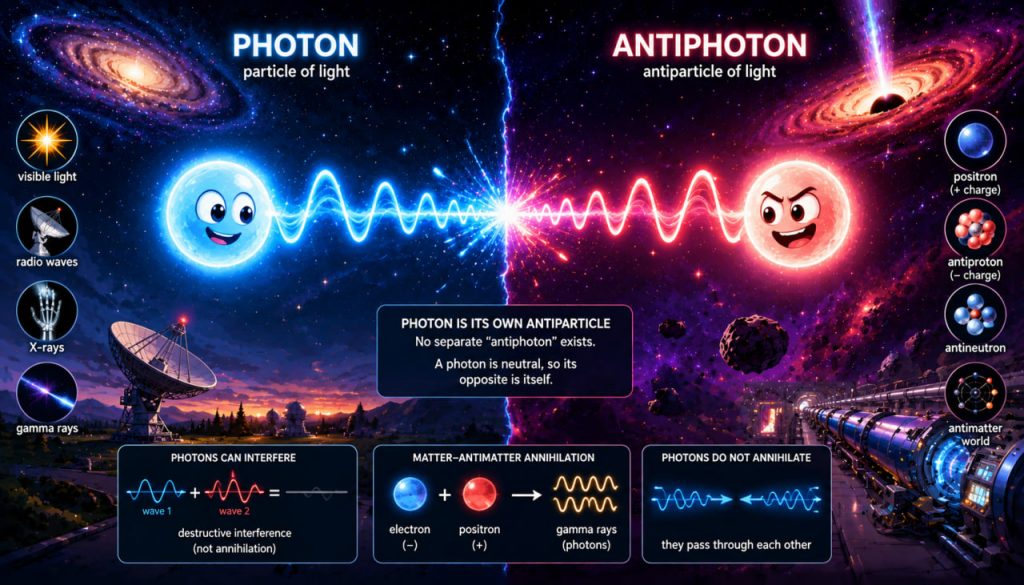
The short scientific answer is: a photon is its own antiparticle. In standard particle physics, there is no separate, distinct antiphoton waiting on the other side of light. The “antiphoton” is simply the photon itself.
That answer sounds strange at first, but it reveals something deep about antimatter, charge, symmetry, and the nature of light.
What Is a Photon?
A photon is the quantum particle of electromagnetic radiation.
In simple terms, photons are the particles associated with:
- Visible light
- Radio waves
- Microwaves
- Infrared radiation
- Ultraviolet radiation
- X-rays
- Gamma rays
All of these are forms of electromagnetic radiation. They differ mainly by wavelength, frequency, and energy.
A red photon has less energy than a violet photon. A gamma-ray photon has far more energy than a visible-light photon. But they are all photons.
A photon has no electric charge and no rest mass. It always travels at the speed of light in a vacuum, and it carries energy, momentum, and angular momentum.
The photon is also the force carrier of electromagnetism, one of the four fundamental forces of nature. CERN’s educational material describes the photon as the particle that carries the electromagnetic force.
What Is an Antiparticle?
An antiparticle is a particle counterpart with the same mass as the original particle but opposite values for certain properties, especially electric charge.
The electron has an antiparticle called the positron. The electron has negative electric charge, while the positron has positive electric charge.
A proton has an antiproton. A neutron has an antineutron. Even though a neutron is electrically neutral overall, its internal quark structure has an antimatter counterpart.
When a particle meets its antiparticle, they can annihilate, converting their mass into energy. CERN explains that contact between a particle and its antiparticle can lead to annihilation, producing energy and other particles.
This is why the idea of an antiphoton seems natural.
If electrons have positrons, and protons have antiprotons, should photons have antiphotons?
Why the Photon Is Its Own Antiparticle
The key reason is that the photon has no electric charge.
For charged particles, the antiparticle clearly has the opposite charge. An electron is negative; a positron is positive. A proton is positive; an antiproton is negative.
A photon has zero electric charge. The opposite of zero is still zero.
But the issue is deeper than charge alone. In quantum field theory, particles are described by fields and symmetries. A particle and its antiparticle may be distinct if the relevant quantum properties change under charge conjugation. For the photon, the electromagnetic field has the right symmetry structure for the photon to be self-conjugate, meaning it is identical to its own antiparticle.
OpenStax’s college physics text states this directly: every particle has an antimatter counterpart, although some particles, such as the photon, are their own antiparticles.
So an antiphoton is not a different particle. It is the same particle viewed through the language of antimatter symmetry.
Does That Mean “Anti-Light” Exists?
Not in the way people often imagine.
There is no separate beam of anti-light that cancels ordinary light because it is made of antiphotons. A beam of photons and a beam of “antiphotons” would simply be beams of photons.
However, light can interfere with light.
Two light waves can meet in such a way that their electric and magnetic fields partially or completely cancel in certain regions. This is called destructive interference. It may look like light is being canceled, but it is not antimatter annihilation.
Interference is not the same as matter-antimatter annihilation.
In interference, electromagnetic waves combine according to their phase. In annihilation, a particle and its antiparticle transform into other particles or radiation.
Can Photons Annihilate Each Other?
Ordinary photons do not annihilate each other like electron-positron pairs.
Two photons can pass through each other in everyday conditions with almost no interaction. This is why beams of light can cross without scattering like billiard balls.
At extremely high energies, photon-photon interactions can happen through quantum effects. For example, two high-energy photons can create an electron and a positron if enough energy is available and conservation laws are satisfied. This is related to pair production.
But that is not a photon meeting an antiphoton and disappearing.
Photons are unusual because their antiparticle identity does not create a separate opposite partner.
They are already their own counterpart.
Why Matter-Antimatter Annihilation Produces Photons
One reason people imagine antiphotons is that matter-antimatter annihilation often produces photons.
For example, when an electron and a positron annihilate, they commonly produce gamma-ray photons. These photons carry away energy and momentum.
This can make it seem as if photons are “made from annihilation” and therefore should also have antimatter versions.
But photons are not antimatter. They are neutral radiation quanta that can be produced in many ways:
- Atoms changing energy levels
- Hot objects emitting thermal radiation
- Charged particles accelerating
- Nuclear transitions
- Matter-antimatter annihilation
- High-energy astrophysical events
A photon produced by an antimatter process is still an ordinary photon.
There is no visible difference between a photon created by matter and a photon created by antimatter.
Are There Other Particles That Are Their Own Antiparticles?
Yes.
The photon is not the only particle that can be its own antiparticle.
Certain neutral bosons can be self-conjugate. CERN educational material notes that some electrically neutral bosons, including the photon and the Z boson, are their own antiparticles.
The neutral pion is another well-known example in particle physics.
There is also a famous open question about neutrinos. Physicists do not yet know whether neutrinos are their own antiparticles. If they are, they would be Majorana particles, named after the Italian physicist Ettore Majorana.
This is one reason the photon is conceptually important. It gives students and science readers a clear example of a particle whose antimatter counterpart is not separate.
Expert Perspective
Physicist Richard Feynman helped shape modern understanding of quantum electrodynamics, the theory describing how light and matter interact. The Feynman Lectures use particle-antiparticle examples to show that neutral particles can sometimes be their own antiparticles, including cases such as the neutral pion.
In modern particle physics education, the photon is one of the cleanest examples of this principle. It shows that “antiparticle” does not always mean “a separate object with an opposite personality.” Sometimes the antiparticle is mathematically and physically the same particle.
This is a powerful reminder that quantum physics does not always match everyday intuition.
Why the Word “Antiphoton” Can Be Misleading
The word “antiphoton” is not usually useful in mainstream physics because it suggests a distinct particle.
For electrons, “positron” is useful because the antiparticle is observably different. It bends the opposite way in a magnetic field, has opposite charge, and interacts differently with matter.
For photons, there is no separate photon-like particle with opposite electric charge because photons have no electric charge.
If someone says “antiphoton,” the most accurate interpretation is usually:
the antiparticle of the photon, which is the photon itself.
The term is technically understandable but physically redundant.
It names something that is not separate from ordinary light.
Could Future Physics Change This?
The statement that the photon is its own antiparticle is part of the current Standard Model of particle physics.
The Standard Model has been tested with extraordinary precision, but physicists still know it is incomplete. It does not fully explain gravity, dark matter, dark energy, or why the universe contains so much more matter than antimatter.
Still, any future theory would have to explain why photons behave as neutral electromagnetic force carriers with the properties we observe.
There is currently no experimental evidence for a separate antiphoton.
Based on known physics, light does not have an opposite antimatter version. Light is already its own antimatter counterpart.
Why This Question Matters
The idea of antiphotons may sound like science fiction, but it leads directly into some of the deepest ideas in physics.
It touches on:
- The difference between matter and radiation
- The meaning of antimatter
- Electric charge and symmetry
- Quantum fields
- Particle-antiparticle annihilation
- The structure of the Standard Model
It also shows why words can be tricky in science.
“Anti” does not always mean dark, destructive, or opposite in a visual sense. In particle physics, it refers to specific quantum properties. When those properties do not create a distinct partner, the particle may be its own antiparticle.
There are no particles opposite to light in the ordinary antimatter sense. The photon is both light and its own anti-light.
Interesting Facts
- The photon is the particle of light and all electromagnetic radiation.
- A photon has no electric charge and no rest mass.
- The antiparticle of the photon is the photon itself.
- Electron-positron annihilation often produces gamma-ray photons.
- A photon produced by antimatter is still an ordinary photon.
- Light can cancel locally through destructive interference, but that is not antimatter annihilation.
- Some neutral particles, such as the photon and Z boson, are their own antiparticles.
- Scientists are still investigating whether neutrinos may be their own antiparticles.
- The word “antiphoton” is rarely used because it does not describe a separate particle.
Glossary
- Photon — The quantum particle of electromagnetic radiation, including visible light, radio waves, X-rays, and gamma rays.
- Antiparticle — A counterpart particle with the same mass but opposite values for certain quantum properties, such as electric charge.
- Antimatter — Matter made of antiparticles, such as positrons and antiprotons.
- Self-Conjugate Particle — A particle that is identical to its own antiparticle.
- Electric Charge — A fundamental property that determines how particles interact electromagnetically.
- Quantum Field Theory — The framework in physics that describes particles as excitations of underlying fields.
- Annihilation — A process in which a particle and its antiparticle transform into other particles or radiation.
- Destructive Interference — A wave effect where two waves combine in a way that reduces or cancels the resulting amplitude in certain regions.
- Pair Production — A process where energy, often from photons, creates a particle-antiparticle pair.
- Gamma Ray — A very high-energy form of electromagnetic radiation.
- Standard Model — The current scientific theory describing known elementary particles and three fundamental forces.
- Majorana Particle — A particle that is its own antiparticle, named after physicist Ettore Majorana.