A thunderstorm may look familiar: dark clouds, lightning, thunder, rain, and sudden flashes across the sky. But inside some storms, nature can build something far stranger than ordinary electricity.
For a split second, a thunderstorm can act like a particle accelerator.
Scientists have detected powerful bursts of gamma rays from Earth’s atmosphere, known as terrestrial gamma-ray flashes. These flashes can be energetic enough to create antimatter particles called positrons, the antimatter counterparts of electrons. NASA’s Fermi Gamma-ray Space Telescope has even detected beams of electrons and positrons associated with thunderstorms.
This does not mean thunderstorms are producing dangerous antimatter bombs. The amounts are tiny and short-lived. But the discovery is real: ordinary thunderstorms can create brief flashes of gamma radiation and small amounts of antimatter under extreme electrical conditions.
What Are Terrestrial Gamma-Ray Flashes?
Terrestrial gamma-ray flashes, or TGFs, are short bursts of gamma rays produced in Earth’s atmosphere.
Gamma rays are the highest-energy form of electromagnetic radiation. They are usually associated with extreme cosmic events such as supernovae, neutron stars, black holes, and radioactive decay.
That is why the discovery of gamma rays from thunderstorms was so surprising.
A TGF can last less than a millisecond, but during that brief time it may release photons with energies millions of times higher than visible light. NASA describes TGFs as gamma-ray flashes emitted by storms acting like enormous particle accelerators.
A thunderstorm is not just a weather event. In rare moments, it can become a natural high-energy physics laboratory.
How Can a Storm Produce Gamma Rays?
The key ingredient is a strong electric field inside a thundercloud.
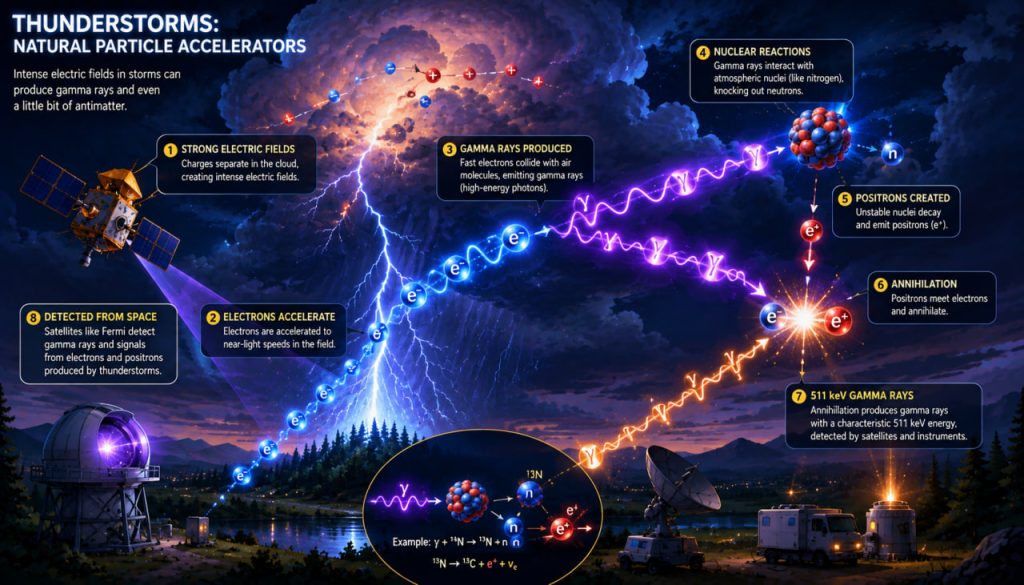
During a storm, charges separate inside the cloud. Some regions become positively charged, while others become negatively charged. This creates intense electric fields.
Under the right conditions, energetic electrons can be accelerated by these fields. As they move through air, they collide with molecules and release high-energy radiation through a process called bremsstrahlung, or braking radiation.
If the electric field is strong enough, the electrons can trigger a chain reaction called a relativistic runaway electron avalanche.
In this avalanche, fast electrons create more fast electrons, which produce more gamma rays.
The storm becomes a natural accelerator, using electric fields instead of laboratory magnets and metal tunnels.
Where Does the Antimatter Come From?
The antimatter produced by thunderstorms is mainly in the form of positrons.
A positron is like an electron with the same mass but opposite electric charge. The electron is negative. The positron is positive.
There are two important ways positrons can appear in thunderstorm-related high-energy events.
First, extremely energetic gamma rays can produce electron-positron pairs when they interact with matter. This process is called pair production.
Second, gamma rays can trigger nuclear reactions in atmospheric nitrogen and oxygen. In 2017, researchers reported ground-based observations from a thunderstorm in Japan showing neutron and positron signals after lightning. The study described photonuclear reactions in which gamma rays can knock neutrons from nitrogen nuclei, eventually producing unstable isotopes that decay and release positrons.
When positrons meet electrons, they annihilate. This produces gamma rays with a characteristic energy of 511 keV, a signature scientists can detect.
The antimatter does not survive for long. It quickly meets ordinary matter and turns into radiation.
Does Ball Lightning Produce Gamma Rays?
Ball lightning is one of the strangest reported atmospheric phenomena: glowing spheres that allegedly appear during thunderstorms and last longer than ordinary lightning flashes.
However, ball lightning is still poorly understood. Reports exist, and there have been some scientific observations, but its nature remains uncertain.
The strongest evidence for gamma rays and antimatter does not come specifically from ball lightning. It comes from ordinary thunderstorms, lightning discharges, thundercloud gamma-ray glows, and terrestrial gamma-ray flashes detected by satellites, aircraft, and ground-based instruments.
So the more accurate statement is:
Thunderstorms can produce gamma rays and positrons. Ball lightning may be related to unusual electrical storm physics, but it is not currently the main confirmed source of thunderstorm antimatter.
This distinction matters because “ball lightning creates antimatter” sounds dramatic, but the scientific evidence is much stronger for TGFs and lightning-associated photonuclear reactions.
What Did NASA’s Fermi Telescope Discover?
NASA’s Fermi Gamma-ray Space Telescope was designed to study high-energy events in the universe. But it also found something remarkable closer to home.
Fermi detected gamma-ray signals linked to antimatter produced by thunderstorms. According to NASA, thunderstorms can emit TGFs along with high-energy electrons and positrons, and scientists now think most TGFs produce particle beams and antimatter.
In some events, the particle beams appear to travel along Earth’s magnetic field lines. That means the spacecraft may detect particles or annihilation gamma rays even when it is not directly above the storm.
This is one reason the discovery felt so extraordinary.
A storm on Earth can launch high-energy particles upward into near-space, where a satellite can detect their antimatter signature.
Lightning Can Trigger Nuclear Reactions in Air
In 2017, a major Nature study reported evidence that lightning can trigger photonuclear reactions in the atmosphere.
During a winter thunderstorm in Japan, detectors observed an intense gamma-ray flash associated with lightning. This was followed by signals interpreted as neutron-related emission and then a prolonged 511 keV line from electron-positron annihilation.
The mechanism involved nitrogen in the air.
A gamma ray can strike a nitrogen-14 nucleus and knock out a neutron, producing nitrogen-13. Nitrogen-13 is unstable and decays by emitting a positron. That positron then annihilates with an electron.
This creates a fascinating chain:
- Lightning accelerates electrons.
- Fast electrons produce gamma rays.
- Gamma rays trigger nuclear reactions.
- Nuclear reactions create unstable isotopes.
- Isotopes release positrons.
- Positrons annihilate with electrons.
- Annihilation produces gamma rays.
A lightning flash can briefly connect weather, particle physics, nuclear physics, and antimatter in one natural process.
Gamma-Ray Glows: The Longer Cousins of TGFs
Not all thunderstorm gamma radiation arrives as a tiny flash.
Scientists also observe gamma-ray glows, longer-lasting increases in gamma radiation near thunderclouds. These can last seconds to minutes and may be detected by ground instruments or aircraft.
A 2019 Nature Communications study reported a gamma-ray glow during a winter thunderstorm in Japan that lasted about 100 seconds and then abruptly ended with a lightning discharge. The same event was associated with a downward terrestrial gamma-ray flash and photonuclear reactions.
Gamma-ray glows suggest that high-energy processes can build inside thunderclouds before lightning occurs.
TGFs are like sudden sparks. Gamma-ray glows are more like a charged, glowing warning that the storm’s electric field is becoming extreme.
Are These Storms Dangerous to People?
Thunderstorms are dangerous because of lightning, wind, flooding, hail, and aviation hazards.
But the antimatter produced by thunderstorms is not a practical danger in the science-fiction sense.
The amounts are tiny. The positrons vanish almost immediately when they encounter electrons. The gamma radiation is real, but TGFs are brief and usually occur high in or above storms.
For aircraft, high-energy thunderstorm radiation is scientifically important and worth studying, especially because planes can fly near storm tops. However, pilots already avoid thunderstorms primarily because of severe turbulence, lightning, hail, and wind shear.
The antimatter is fascinating, not apocalyptic.
It shows how extreme Earth’s atmosphere can become, but it does not mean every thunderstorm is a nuclear disaster.
Expert Perspective
Joseph Dwyer, a physicist known for studying lightning and high-energy atmospheric physics, has emphasized that understanding gamma-ray flashes may help reveal what happens when lightning begins and propagates. Reports on lightning-triggered nuclear reactions highlight his view that lightning initiation remains a deep scientific mystery.
That expert perspective is important because TGFs are not just a strange side effect. They may be clues to one of the biggest unsolved problems in atmospheric electricity: how lightning actually starts inside thunderclouds.
Even though lightning is common, its initiation is still surprisingly difficult to explain in full detail.
Why This Discovery Matters
The idea that thunderstorms produce antimatter changes how we think about Earth.
High-energy particle physics is not limited to distant galaxies or underground accelerators. Under the right conditions, Earth’s own atmosphere can accelerate particles, emit gamma rays, trigger nuclear reactions, and produce positrons.
This discovery connects many fields:
- Meteorology
- Space physics
- Nuclear physics
- Atmospheric electricity
- Radiation science
- Satellite astronomy
- Aviation safety research
Thunderstorms are not simple weather machines. They are complex electrical systems capable of producing some of the most energetic natural radiation on Earth.
Interesting Facts
- Terrestrial gamma-ray flashes can last less than a millisecond.
- NASA’s Fermi telescope has detected antimatter signatures from thunderstorms.
- The antimatter produced in storms is mainly positrons.
- Positrons are the antimatter counterparts of electrons.
- When a positron meets an electron, they annihilate and produce gamma rays.
- Lightning can trigger photonuclear reactions in atmospheric nitrogen.
- Gamma-ray glows can last much longer than TGFs, sometimes for many seconds.
- Some thunderstorm particle beams can travel along Earth’s magnetic field lines.
- The confirmed evidence is strongest for thunderstorms and lightning, not specifically for ball lightning.
- Thunderstorms are natural particle accelerators.
Glossary
- Gamma Ray — The highest-energy form of electromagnetic radiation.
- Terrestrial Gamma-Ray Flash (TGF) — A very brief burst of gamma rays produced in Earth’s atmosphere during thunderstorms.
- Antimatter — Matter made of antiparticles, such as positrons.
- Positron — The antimatter counterpart of the electron, with positive electric charge.
- Electron — A negatively charged elementary particle found in atoms and electric currents.
- Annihilation — A process in which a particle and its antiparticle convert into energy, often gamma rays.
- Bremsstrahlung — Radiation emitted when a charged particle slows down or changes direction.
- Relativistic Runaway Electron Avalanche — A chain reaction in which fast electrons accelerate through a strong electric field and multiply.
- Photonuclear Reaction — A nuclear reaction triggered by a high-energy photon, such as a gamma ray.
- Gamma-Ray Glow — A longer-lasting increase in gamma radiation associated with thunderclouds.
- 511 keV Line — A gamma-ray signature produced when an electron and positron annihilate.
- Ball Lightning — A rare and poorly understood reported phenomenon involving glowing spherical lights during storms.