When people imagine planetary rings, Saturn usually steals the spotlight. Its bright, wide rings are one of the most recognizable sights in astronomy. But Saturn is not alone.
All four giant planets in the Solar System have rings: Jupiter, Saturn, Uranus, and Neptune. NASA’s planet comparison data lists rings for Jupiter, Saturn, Uranus, and Neptune, while Mercury, Venus, Earth, and Mars have none.
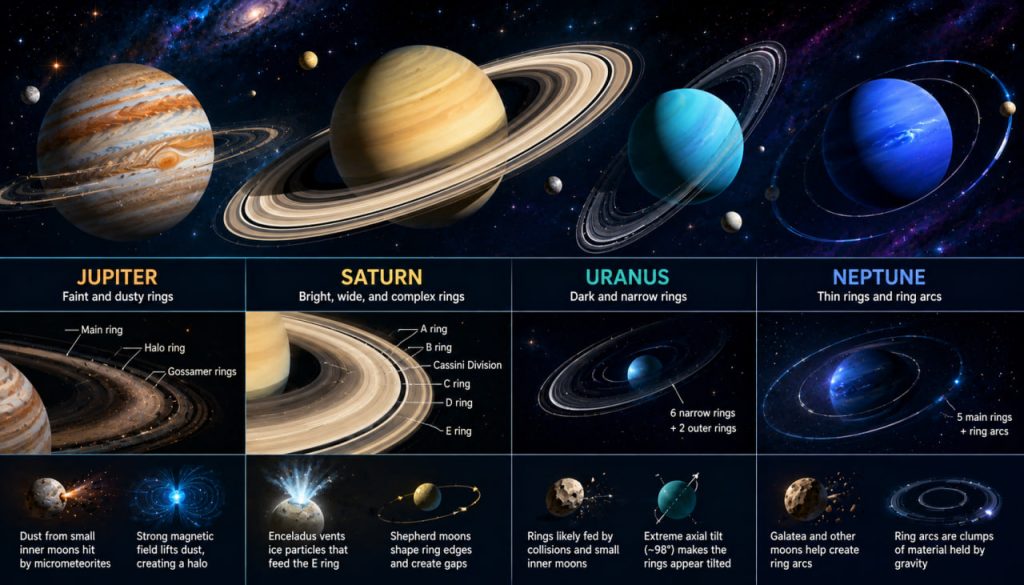
These ring systems are not all alike. Saturn’s rings are icy, wide, and brilliant. Jupiter’s rings are faint and dusty. Uranus has dark, narrow rings. Neptune has thin rings and unusual ring arcs.
Planetary rings are more than beautiful decoration. They are dynamic systems of dust, ice, rock, gravity, collisions, and tiny moons. They help scientists understand how planets, moons, and even young solar systems behave.
What Are Planetary Rings Made Of?
Planetary rings are made of countless small particles orbiting a planet.
These particles can range from microscopic dust grains to chunks the size of boulders. NASA’s basics of space flight material describes the rings of Saturn, Uranus, and Neptune as being made of many particles of ice, ranging from dust and sand to boulders.
The exact composition depends on the planet.
Saturn’s rings are mostly water ice, which makes them bright and reflective. Jupiter’s rings are much darker and dustier. Uranus and Neptune also have dark, faint rings, likely mixed with dust and radiation-darkened material.
A ring is not a solid disk. It is a vast swarm of separate orbiting particles.
Each particle follows its own path around the planet, shaped by gravity, collisions, sunlight, magnetic fields, and nearby moons.
Why Do Planets Have Rings?
Planetary rings can form in several ways.
One possibility is that a moon, comet, or asteroid moved too close to a planet and was torn apart by tidal forces. Another possibility is that collisions between small moons produced debris. Rings can also be supplied by material blasted off moons by micrometeorite impacts or by active moons ejecting particles into space.
Saturn’s E ring is a clear example of moon-fed ring material. NASA’s Cassini mission found that much of the material in Saturn’s diffuse E ring comes from Enceladus, a moon that vents icy particles and gas into space.
Rings are often connected to moons. Some moons create debris, some sculpt ring edges, and some maintain gaps or narrow ring structures through gravity.
Saturn: The King of Planetary Rings
Saturn has the most spectacular ring system in the Solar System.
Its rings are so large and bright that Galileo noticed them in 1610, although his telescope was not powerful enough to reveal their true nature. Today, spacecraft and telescopes show that Saturn’s ring system is made of many rings, gaps, waves, ringlets, and structures.
NASA reports that Saturn’s rings extend up to about 175,000 miles, or 282,000 kilometers, from the planet, while the main rings are typically only about 30 feet, or 10 meters, thick.
That is astonishing.
Saturn’s rings are extremely wide but incredibly thin, like a cosmic sheet of glittering ice.
They are bright because water ice reflects sunlight well. But they are not permanent in the deepest sense. Many scientists think Saturn’s rings may be relatively young compared with the 4.5-billion-year age of the Solar System, though their exact age and origin remain debated.
Jupiter: The Giant with Ghostly Rings
Jupiter also has rings, but they are nothing like Saturn’s.
Jupiter’s rings are faint, dark, and dusty. They were discovered by NASA’s Voyager 1 spacecraft in 1979. From Earth, they are difficult to see because they reflect very little sunlight.
Jupiter’s ring system includes a main ring, a halo ring, and faint outer gossamer rings. NASA’s Jet Propulsion Laboratory explains that Jupiter’s main ring is a thin sheet of material around the planet, while the vertically extended halo is influenced by electromagnetic forces acting on tiny charged dust grains.
The dust in Jupiter’s rings is likely connected to small inner moons. Micrometeorites strike these moons, knock dust into space, and Jupiter’s gravity gathers some of that material into rings.
Jupiter’s rings are a reminder that rings do not need to be bright to be scientifically important.
They reveal how dust behaves near a giant planet with a powerful magnetic field.
Uranus: Dark Rings Around a Tilted Planet
Uranus has a strange ring system around an even stranger planet.
Unlike most planets, Uranus rotates on its side. Its axis is tilted by about 98 degrees, giving it extreme seasons. Its rings follow the planet’s equatorial plane, so they also appear dramatically tilted from our perspective.
Uranus’s rings were discovered in 1977 when the planet passed in front of a distant star. Instead of simply dimming once, the star flickered several times before and after Uranus blocked it. Those flickers revealed narrow rings.
Today, telescopes such as the James Webb Space Telescope have given astronomers sharper views. NASA reported that Webb captured Uranus’s dim inner and outer rings, including the extremely faint Zeta ring closest to the planet.
NASA also notes that Uranus has two outer rings: an inner reddish one like dusty rings elsewhere in the Solar System and an outer blue ring similar in color to Saturn’s E ring.
Uranus’s rings are dark, narrow, and mysterious, shaped by gravity and possibly by small hidden moons.
Neptune: Thin Rings and Strange Arcs
Neptune, the farthest known major planet from the Sun, also has rings.
Its ring system is faint, dusty, and difficult to observe. NASA states that Neptune has at least five main rings and four prominent ring arcs known so far.
The arcs are especially interesting. Instead of forming a perfectly even ring, some material appears concentrated in clumps or segments. Scientists think gravitational interactions with small moons help keep these arcs from spreading out.
Voyager 2 first gave scientists a close view of Neptune’s rings during its 1989 flyby. Decades later, the James Webb Space Telescope captured Neptune’s rings with the clearest view in more than 30 years.
Neptune’s rings show that even at the cold, dark edge of the planetary Solar System, gravity is still sculpting delicate structures.
Why Don’t Earth and Mars Have Rings?
The inner planets — Mercury, Venus, Earth, and Mars — do not have ring systems today.
This does not mean they could never have had rings. A temporary ring could form if a moon, asteroid, or debris cloud were broken apart and captured into orbit. But long-lasting rings are easier to maintain around giant planets because they have strong gravity, many moons, and large regions where ring particles can orbit.
Earth has one large Moon rather than a swarm of small inner moons. Mars has two tiny moons, Phobos and Deimos, but no current rings. Some scientists have proposed that Mars may develop a ring in the future if Phobos continues spiraling inward and eventually breaks apart.
Rings are not impossible around rocky planets, but in today’s Solar System they belong to the giant planets.
The Role of Shepherd Moons
Some rings are shaped by small moons called shepherd moons.
These moons orbit near rings and use gravity to confine particles, sharpen ring edges, maintain gaps, or create waves. Without shepherd moons, some narrow rings might spread out over time.
Saturn provides famous examples of moon-ring interaction. The Cassini mission showed that Saturn’s rings are full of waves, gaps, braids, and structures caused by moons and gravitational resonances.
Jupiter, Uranus, and Neptune also show ring systems influenced by moons, though their rings are fainter and harder to study.
Planetary rings are not passive objects. They are constantly being stirred, sculpted, and refreshed.
Are Planetary Rings Permanent?
Planetary rings may look timeless, but many are temporary on astronomical timescales.
Ring particles collide, spread, darken, fall into the planet, or get pushed around by radiation and magnetic forces. At the same time, new material may be supplied by moons, collisions, or geologic activity.
This creates a balance between loss and renewal.
Saturn’s bright rings may not last forever. Jupiter’s dusty rings may need steady replenishment from small moons. Neptune’s arcs may require gravitational confinement to remain clumped.
Rings are snapshots of ongoing planetary evolution, not frozen decorations.
Expert Perspective
NASA’s Cassini mission transformed modern ring science by spending years orbiting Saturn and studying its rings in extraordinary detail. Cassini’s observations revealed that ring systems are active laboratories for orbital dynamics, particle collisions, moon interactions, and icy debris behavior. NASA notes that continued study of Saturn’s rings can improve understanding of orbital dynamics in systems ranging from forming solar systems to galaxies.
This perspective matters because planetary rings are not only visually impressive. They are natural experiments in gravity.
By studying them, scientists can observe processes similar to those that shape moon systems, asteroid belts, and disks around young stars.
Why Planetary Rings Matter
Rings help astronomers answer big questions.
They reveal how material behaves around massive planets. They show how moons interact with dust and ice. They preserve clues about collisions, tidal forces, and the history of planetary systems.
They also help scientists understand disks elsewhere in the universe.
The disk of gas and dust that formed the Solar System, the rings around young stars, and the disks around compact objects all involve orbiting material shaped by gravity and collisions.
Planetary rings are small-scale cosmic laboratories.
They are beautiful, but they are also useful.
Interesting Facts
- Saturn is not the only ringed planet.
- Jupiter, Saturn, Uranus, and Neptune all have ring systems.
- Saturn’s rings are mostly made of water ice.
- Jupiter’s rings are faint and dusty.
- Uranus’s rings are dark and narrow.
- Neptune has ring arcs where material is concentrated in partial ring segments.
- Saturn’s main rings are extremely thin compared with their width.
- Enceladus helps supply material to Saturn’s E ring.
- The James Webb Space Telescope has captured impressive modern views of Uranus and Neptune’s rings.
- Planetary rings can be shaped by small moons, collisions, magnetic fields, and gravity.
Glossary
- Planetary Ring — A disk or band of particles orbiting a planet.
- Ring Particle — A piece of dust, ice, rock, or debris moving independently within a ring.
- Gas Giant — A large planet made mostly of hydrogen and helium, such as Jupiter and Saturn.
- Ice Giant — A giant planet rich in water, ammonia, methane, and other heavier compounds, such as Uranus and Neptune.
- Accretion — The growth of an object or disk by collecting surrounding material.
- Shepherd Moon — A small moon whose gravity helps shape or confine a planetary ring.
- Ring Arc — A partial ring segment where particles are concentrated instead of evenly spread around the planet.
- Tidal Force — A stretching force caused by differences in gravity across an object.
- Roche Limit — The distance inside which a moon or object may be torn apart by a planet’s tidal forces.
- Micrometeorite — A tiny space rock or dust grain that can strike moons and release debris.
- Resonance — A repeated gravitational interaction that can shape or disturb orbits.
- E Ring — A large, faint ring around Saturn supplied mainly by icy particles from Enceladus.