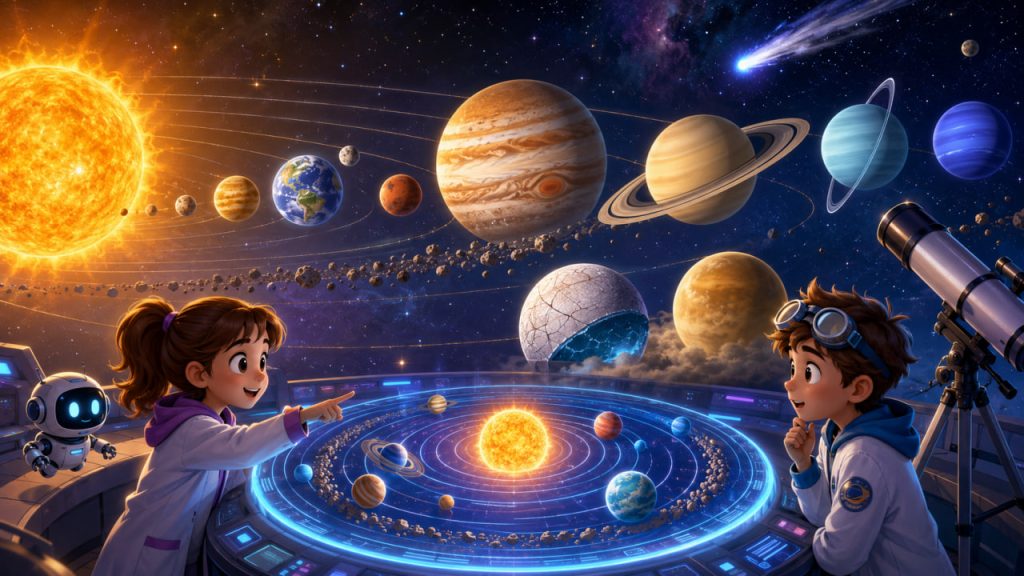
The Solar System is much more than the Sun and eight planets. It is a vast, dynamic neighborhood filled with moons, dwarf planets, asteroids, comets, icy worlds, violent storms, magnetic fields, rings, oceans, volcanoes, and ancient debris from the birth of the planets.
At first glance, it may seem familiar. Mercury is hot, Jupiter is huge, Saturn has rings, and Earth is our home. But the deeper we look, the stranger everything becomes.
Our Solar System is not a quiet collection of planets. It is an active cosmic laboratory where geology, chemistry, gravity, and sunlight create astonishing worlds.
The Sun Contains Almost Everything
The Sun is the center of the Solar System in every possible sense.
It contains more than 99% of the total mass of the Solar System. The planets, moons, asteroids, comets, and dust are only a tiny leftover fraction compared with the Sun itself.
This is why the Sun’s gravity controls the motion of everything around it.
The Sun is also the source of nearly all energy that reaches Earth’s surface. Its light drives climate, weather, photosynthesis, ocean circulation, and the food chains that support life.
Without the Sun, the Solar System would not simply be dark. It would be unrecognizable.
Mercury Is Not the Hottest Planet
Mercury is the closest planet to the Sun, but it is not the hottest.
That title belongs to Venus.
Venus has an extremely dense atmosphere rich in carbon dioxide. This atmosphere traps heat through a runaway greenhouse effect, making the surface hot enough to melt lead.
Mercury, by contrast, has almost no atmosphere to hold heat. Its dayside can become extremely hot, but its nightside can become brutally cold.
Distance from the Sun matters, but atmosphere can matter even more.
Venus is a powerful reminder that a planet’s climate depends not only on location, but also on atmospheric chemistry and pressure.
Venus Spins Backward
Most planets in the Solar System rotate in the same general direction as they orbit the Sun. Venus is different.
Venus rotates in the opposite direction, a motion called retrograde rotation.
This means that if you could stand on Venus and survive its crushing heat and pressure, the Sun would appear to rise in the west and set in the east.
Even stranger, Venus rotates very slowly. One Venus day is longer than one Venus year.
On Venus, the calendar is shorter than the day.
Scientists still study how Venus ended up with such unusual rotation. Possible explanations include ancient impacts, tidal effects, and atmospheric interactions.
Earth Is the Only Known World with Surface Life
Earth is not the largest planet, the hottest planet, or the most visually dramatic planet. But it is unique in the most important way we know.
It is the only confirmed world with life.
Earth has liquid water on its surface, an oxygen-rich atmosphere, active plate tectonics, a protective magnetic field, and a biosphere that has reshaped the planet for billions of years.
Life has changed Earth’s air, rocks, oceans, and climate.
Earth is not just a planet that contains life. It is a planet transformed by life.
This is why scientists compare other worlds to Earth when searching for habitability.
Mars May Once Have Had Rivers and Lakes
Today, Mars is cold, dry, and dusty. But its surface tells a more complicated story.
Ancient valleys, river channels, lakebeds, minerals, and sedimentary rocks suggest that liquid water once flowed on Mars. Some regions may have held lakes for long periods.
This does not prove Mars had life. But it shows that early Mars may have been more Earth-like than it is today.
Mars is a frozen archive of planetary climate change.
Studying Mars helps scientists understand how a world can shift from wetter conditions to a dry, thin-atmosphere desert.
Jupiter Is a Planetary Giant
Jupiter is the largest planet in the Solar System.
It is so massive that it strongly influences asteroids, comets, and the orbits of other bodies. Its gravity helps shape the asteroid belt and can redirect small objects through the Solar System.
Jupiter’s atmosphere is also enormous and turbulent. Its famous Great Red Spot is a gigantic storm that has lasted for centuries.
Jupiter also has a powerful magnetic field and dozens of moons.
Jupiter is almost like a miniature solar system, with its own complex family of orbiting worlds.
Europa May Hide a Global Ocean
One of Jupiter’s most fascinating moons is Europa.
Europa has a bright, cracked icy surface. Beneath that ice, scientists strongly suspect there is a global ocean of salty liquid water.
This makes Europa one of the most important places in the search for possible life beyond Earth.
If Europa has water, chemical energy, and the right ingredients, it could have environments that are potentially habitable.
Some of the most promising places for life may not be warm planets, but icy moons with hidden oceans.
Saturn’s Rings Are Beautiful but Thin
Saturn’s rings look massive from a distance, but they are surprisingly thin.
They are made mostly of countless icy particles, ranging from tiny grains to large chunks. The ring system is extremely wide, but many main ring regions are only tens of meters thick.
That makes Saturn’s rings one of the most elegant structures in the Solar System: vast, bright, complex, and delicate.
The rings are shaped by gravity, collisions, waves, and small moons called shepherd moons.
Saturn’s rings are not solid. They are a swarm of icy particles dancing around the planet.
Titan Has Lakes and Rivers of Methane
Saturn’s moon Titan is one of the strangest worlds ever studied.
It has a thick atmosphere, weather patterns, clouds, dunes, lakes, rivers, and seas. But its surface liquid is not water. It is mainly methane and ethane, substances that exist as gases on Earth under normal conditions.
Titan is so cold that methane can behave there somewhat like water behaves on Earth.
It can evaporate, form clouds, rain, flow across the surface, and collect in lakes.
Titan is like a frozen chemical mirror of Earth, with methane playing the role of water.
Uranus Rolls Around the Sun on Its Side
Uranus has one of the most unusual rotations in the Solar System.
Its axis is tilted by about 98 degrees, which means it essentially rolls around the Sun on its side. This gives Uranus extreme seasons, with each pole receiving decades of sunlight followed by decades of darkness.
This strange tilt may have been caused by a massive ancient impact or a series of gravitational interactions.
Uranus also has faint rings and many moons.
Uranus proves that planets can have surprisingly chaotic histories hidden behind calm appearances.
Neptune Has the Fastest Winds
Neptune is far from the Sun, receiving much less sunlight than Earth. Yet it has some of the fastest winds in the Solar System.
Its atmosphere contains powerful storms, dark spots, bright clouds, and intense weather patterns.
This is surprising because Neptune receives so little solar energy. Scientists think internal heat may help drive its atmospheric activity.
Even at the cold edge of the planetary Solar System, weather can be violent.
Neptune shows that planetary atmospheres can be energized from within, not only from sunlight.
Pluto Is Not a Planet, but It Is Still Fascinating
Pluto was reclassified as a dwarf planet, but that did not make it boring.
When the New Horizons spacecraft flew past Pluto in 2015, it revealed mountains of ice, smooth plains, hazy atmosphere, glaciers made of nitrogen ice, and a surprisingly active surface.
Pluto also has a large moon, Charon, along with smaller moons.
The Pluto-Charon system is especially interesting because Charon is so large compared with Pluto that the two bodies orbit a point outside Pluto itself.
Pluto lost its planet title, but gained a new identity as one of the most fascinating icy worlds ever explored.
The Solar System Has Millions of Small Bodies
Planets get most of the attention, but small bodies are essential to understanding Solar System history.
Asteroids are rocky leftovers, mostly found between Mars and Jupiter. Comets are icy bodies that can develop glowing tails when they approach the Sun. Kuiper Belt objects are icy worlds beyond Neptune.
These objects preserve ancient material from the early Solar System.
Small bodies are time capsules from planetary formation.
They help scientists study what the Solar System was made of before planets fully formed.
Expert Perspective
Planetary scientist Carl Sagan famously helped popularize the idea that worlds are connected by shared cosmic history. His work emphasized that planets are not isolated curiosities, but part of a larger story of matter, chemistry, sunlight, and time.
That perspective remains important today.
Modern planetary science studies the Solar System as an interconnected system: the Sun shapes planetary environments, gravity sculpts orbits, moons affect rings, impacts change surfaces, and small bodies preserve the earliest chapters of planetary history.
The Solar System is not a list of objects. It is a story of formation, evolution, and constant change.
Interesting Facts
- The Sun contains more than 99% of the Solar System’s mass.
- Venus is hotter than Mercury, even though Mercury is closer to the Sun.
- A day on Venus is longer than a year on Venus.
- Mars has evidence of ancient rivers, lakes, and water-shaped landscapes.
- Jupiter’s Great Red Spot is a storm larger than Earth.
- Europa may contain a global ocean beneath its icy crust.
- Saturn’s rings are made of countless separate particles, not solid material.
- Titan has lakes, rivers, and seas of methane and ethane.
- Uranus rotates almost sideways.
- Neptune has some of the fastest winds in the Solar System.
- Pluto has mountains, glaciers, haze, and a complex icy surface.
- Comets and asteroids preserve ancient material from the Solar System’s formation.
Glossary
- Solar System — The Sun and all objects gravitationally bound to it, including planets, moons, asteroids, comets, and dwarf planets.
- Planet — A large body orbiting the Sun that is massive enough to be round and has cleared its orbital neighborhood.
- Dwarf Planet — A round object orbiting the Sun that has not cleared its orbital neighborhood.
- Moon — A natural satellite orbiting a planet or dwarf planet.
- Asteroid — A rocky small body, often found in the asteroid belt between Mars and Jupiter.
- Comet — An icy body that can release gas and dust when heated by the Sun.
- Kuiper Belt — A region beyond Neptune containing icy bodies and dwarf planets.
- Greenhouse Effect — The trapping of heat by gases in an atmosphere.
- Retrograde Rotation — Rotation in the opposite direction from the usual orbital motion.
- Magnetic Field — A region of magnetic influence around a planet or star.
- Gas Giant — A large planet made mostly of hydrogen and helium, such as Jupiter or Saturn.
- Ice Giant — A giant planet rich in heavier compounds such as water, ammonia, and methane, such as Uranus or Neptune.