When people imagine the universe, they usually picture galaxies: glowing spirals, giant elliptical clouds of stars, nebulae, black holes, and clusters of light scattered across darkness.
But galaxies are not packed tightly together. Between them lie enormous regions called intergalactic space.
At first, intergalactic space may sound like pure emptiness. In reality, it is one of the most important environments in the cosmos. It contains thin gas, dark matter, magnetic fields, cosmic rays, radiation, wandering stars, and the faint structure of the cosmic web.
Intergalactic space is not empty. It is the vast, invisible framework that connects galaxies across the universe.
What Is Intergalactic Space?
Intergalactic space is the region between galaxies.
It begins outside the main visible boundaries of a galaxy and extends across the immense gaps that separate one galaxy from another. These distances are difficult to imagine.
The Milky Way and the Andromeda Galaxy, our large neighboring spiral galaxy, are separated by about 2.5 million light-years. That means light itself takes millions of years to travel between them.
Between galaxies, the density of matter is extremely low. A cubic meter of intergalactic space may contain far fewer particles than the best vacuum chambers created on Earth.
But “low density” does not mean “nothing.”
Across huge distances, even very thin gas can add up to enormous amounts of matter.
The Intergalactic Medium
The material between galaxies is called the intergalactic medium, or IGM.
It is mostly made of extremely diffuse gas. Much of this gas is hydrogen and helium, the two lightest and most common elements in the universe.
This gas can be very hot, especially in galaxy clusters where gravity pulls matter together and heats it to millions of degrees. In other regions, it may be cooler and harder to detect.
The intergalactic medium is like a faint cosmic atmosphere spread between galaxies.
It is not breathable, visible, or dense like air on Earth. But it plays a major role in galaxy formation, star formation, and the movement of matter through the universe.
Galaxies do not evolve in isolation. They exchange material with the space around them. Gas can flow into galaxies and help form new stars. Supernova explosions and black hole activity can push gas back out into intergalactic space.
The Cosmic Web
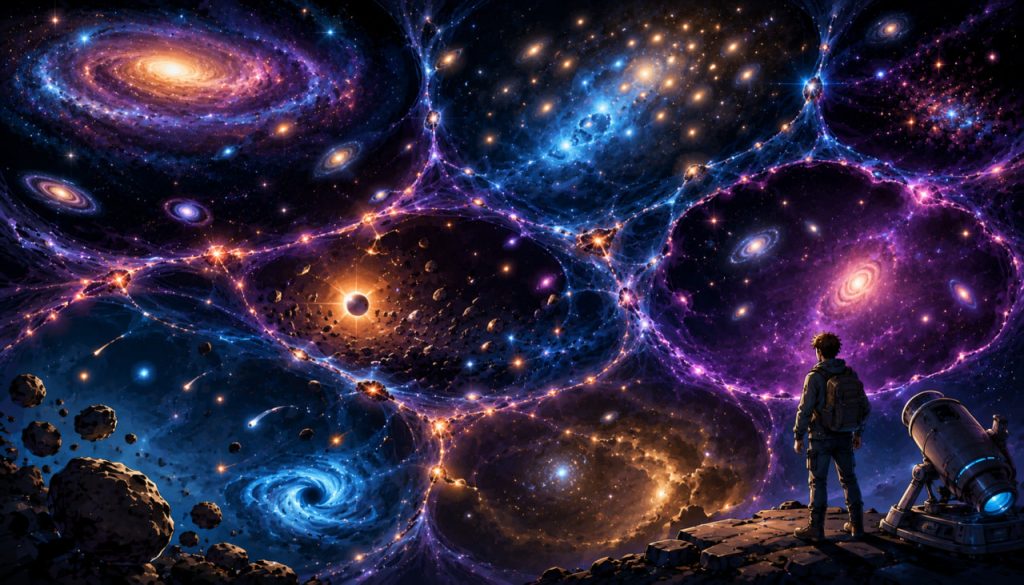
On the largest scales, the universe has a structure known as the cosmic web.
Galaxies are not evenly scattered like grains of sand. They gather along long filaments, sheets, and clusters. Between these structures are enormous low-density regions called voids.
The cosmic web is shaped mainly by gravity and dark matter.
Dark matter does not emit light, but its gravity influences normal matter. Over billions of years, dark matter formed a hidden scaffolding. Gas and galaxies followed that gravitational structure, creating the web-like pattern astronomers observe today.
Intergalactic space is not randomly empty. It is organized into filaments, clusters, and voids.
This structure is one of the strongest pieces of evidence that the universe evolved from tiny early density differences into the complex cosmic architecture we see today.
Galaxy Clusters and Hot Intergalactic Gas
Some of the densest regions of intergalactic space are found inside galaxy clusters.
A galaxy cluster can contain hundreds or thousands of galaxies bound together by gravity. But galaxies are not the only material in a cluster. In fact, much of the ordinary matter in galaxy clusters exists as hot gas between the galaxies.
This gas is called the intracluster medium.
It can reach temperatures of tens of millions of degrees. At those temperatures, it emits X-rays, allowing astronomers to map it with space telescopes.
In galaxy clusters, the space between galaxies can contain more ordinary matter than the galaxies themselves.
This hot gas tells scientists about gravity, dark matter, galaxy collisions, and the history of cluster formation.
Cosmic Voids: The Emptiest Regions
Between filaments of the cosmic web are vast regions called cosmic voids.
Voids can span tens or even hundreds of millions of light-years. They contain far fewer galaxies than average regions of the universe.
But even cosmic voids are not completely empty.
They may contain thin gas, dark matter, faint dwarf galaxies, radiation, and occasional isolated objects. Their emptiness is relative: compared with galaxy clusters, they are incredibly sparse, but they are still part of the cosmic structure.
Cosmic voids are the quiet valleys of the universe, while galaxy clusters are its crowded cities.
Studying voids helps scientists understand how gravity shaped the universe and how matter moved from underdense regions into denser filaments and clusters.
Are There Stars Between Galaxies?
Yes, some stars exist outside galaxies.
These are called intergalactic stars or intracluster stars, depending on their environment. They may have been thrown out of galaxies during gravitational interactions, galaxy mergers, or close encounters with massive black holes.
A star can be ejected from its home galaxy and travel through intergalactic space for millions or billions of years.
These stars are difficult to detect because they are faint and isolated. But in galaxy clusters, their combined light can create a faint glow called intracluster light.
Some stars are cosmic wanderers, drifting through the darkness between galaxies.
Their existence shows that galaxies are not sealed islands. Gravity can strip, scatter, and redistribute stars across enormous distances.
What About Planets in Intergalactic Space?
Planets may also exist between galaxies, though they would be extremely difficult to detect.
Some planets could be ejected from their original star systems and become rogue planets. Others might remain bound to stars that have been thrown into intergalactic space.
A rogue planet drifting between galaxies would receive almost no sunlight. Its surface would likely be extremely cold unless internal heat, tidal energy, or a thick atmosphere kept it warmer.
Such worlds would be lonely and dark, but not impossible.
Intergalactic space may contain hidden objects that produce little or no light.
This is one reason astronomy relies not only on visible light, but also on infrared radiation, X-rays, radio waves, gravitational effects, and statistical modeling.
Radiation in Intergalactic Space
Intergalactic space is filled with radiation.
The most important background radiation is the cosmic microwave background, the ancient afterglow of the early universe. It comes from a time about 380,000 years after the Big Bang, when the universe became transparent to light.
There is also ultraviolet radiation from young stars, X-rays from hot gas and black hole activity, and cosmic rays traveling through space.
Light from galaxies and quasars can ionize gas in intergalactic space, changing its physical state.
Intergalactic space preserves traces of the universe’s history in radiation and gas.
By studying how distant light passes through intergalactic material, astronomers can learn what the universe was like billions of years ago.
How Astronomers Study Invisible Space
Intergalactic gas is often too faint to see directly. So astronomers study it indirectly.
One powerful method is using light from distant quasars.
A quasar is an extremely bright active galactic nucleus powered by a supermassive black hole. As quasar light travels toward Earth, it passes through clouds of gas in intergalactic space. Those gas clouds absorb specific wavelengths of light.
When astronomers split quasar light into a spectrum, they can see absorption lines that reveal the presence of hydrogen and other elements.
Intergalactic space leaves fingerprints in the light of distant objects.
This technique allows scientists to map gas across cosmic time, even when the gas itself is nearly invisible.
Expert Perspective
Modern cosmology treats intergalactic space as an active part of cosmic evolution, not as a blank background. Astronomers studying the intergalactic medium often describe galaxies and their surroundings as connected systems, where gas flows inward to feed star formation and outward through winds, supernovae, and black hole feedback.
This expert view is essential because it changes the way we understand galaxies.
A galaxy is not only its stars. It is part of a larger ecosystem of gas, gravity, radiation, and dark matter.
Intergalactic space is the environment in which galaxies grow, interact, and transform.
Why Intergalactic Space Matters
Intergalactic space helps answer some of the biggest questions in astronomy.
Where is the universe’s missing ordinary matter? How do galaxies get fresh gas for new stars? How do black holes influence their surroundings? How did the cosmic web form? Why are some regions full of galaxies while others are nearly empty?
The answers are not found only inside galaxies. Many are hidden in the spaces between them.
The universe is shaped as much by what lies between galaxies as by the galaxies themselves.
Intergalactic space may look dark, but it contains the memory of cosmic evolution.
Interesting Facts
- Intergalactic space is the region between galaxies.
- It contains extremely thin gas called the intergalactic medium.
- The cosmic web connects galaxies through filaments of matter and dark matter.
- Galaxy clusters contain hot gas between galaxies that can emit X-rays.
- Cosmic voids are huge low-density regions with relatively few galaxies.
- Some stars can be thrown out of galaxies and drift through intergalactic space.
- Rogue planets may exist between galaxies, though they are extremely hard to detect.
- Quasar light helps astronomers study invisible gas between galaxies.
- Intergalactic space contains radiation from stars, black holes, hot gas, and the early universe.
- The space between galaxies plays a major role in galaxy evolution.
Glossary
- Intergalactic Space — The region of space between galaxies.
- Intergalactic Medium (IGM) — Extremely thin gas spread between galaxies.
- Cosmic Web — The large-scale structure of the universe, made of filaments, clusters, sheets, and voids.
- Galaxy Cluster — A large group of galaxies bound together by gravity.
- Intracluster Medium — Hot gas found between galaxies inside galaxy clusters.
- Cosmic Void — A vast region of the universe with far fewer galaxies than average.
- Dark Matter — Invisible matter that does not emit light but affects the universe through gravity.
- Quasar — A very bright active galactic nucleus powered by a supermassive black hole.
- Absorption Line — A dark line in a spectrum caused when gas absorbs specific wavelengths of light.
- Cosmic Microwave Background — Ancient radiation left over from the early universe.
- Rogue Planet — A planet not orbiting a star.
- Intracluster Light — Faint light from stars drifting between galaxies in a cluster.