Some of the most beautiful images in astronomy look almost impossible: glowing arcs wrapped around galaxies, distorted smears of ancient light, and near-perfect circles shining in deep space. These are not optical illusions created by a telescope. They are real cosmic effects predicted by Einstein’s theory of general relativity.
They are called gravitational lenses.
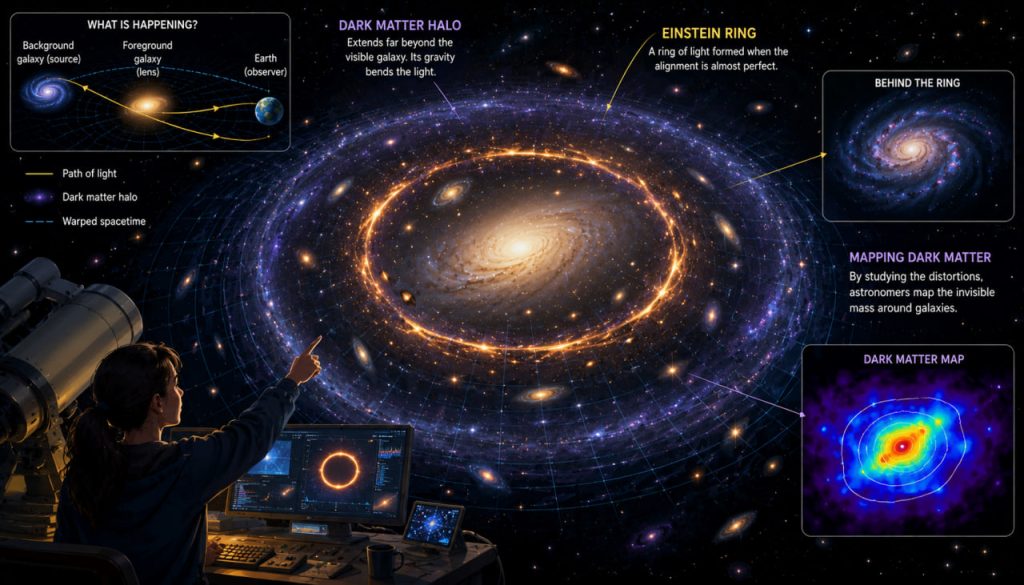
When a massive galaxy or galaxy cluster sits between Earth and a more distant object, its gravity bends the path of light. If the alignment is especially precise, the background light can stretch into a luminous ring known as an Einstein ring.
But here is the deeper mystery: the visible stars in a galaxy are not massive enough to explain the full strength of many gravitational lenses. Something else must be adding extra gravity.
That something is dark matter.
What Is a Gravitational Lens?
A gravitational lens forms when mass bends light.
In everyday life, lenses are made of glass. They bend light because light changes direction as it moves through the material. A gravitational lens is different. It does not use glass. It uses gravity.
According to general relativity, gravity is not simply a force pulling objects together. Massive objects curve spacetime, and light follows that curved geometry.
A galaxy can act like a natural telescope because its gravity bends and magnifies light from objects behind it.
This effect can make distant galaxies appear brighter, larger, stretched, duplicated, or curved into arcs.
What Is an Einstein Ring?
An Einstein ring appears when a distant light source, a massive foreground object, and Earth are aligned almost perfectly.
The foreground galaxy or cluster bends the background light around itself. Instead of seeing the background galaxy as a normal shape, we see its light wrapped into a ring or partial ring.
The ring is named after Albert Einstein because his theory predicted that gravity could bend light.
Einstein did not expect the effect to be easy to observe. The alignment has to be extremely precise, and early telescopes were not powerful enough to reveal many examples. Modern space telescopes changed that.
An Einstein ring is not a physical ring around a galaxy. It is distorted light from a farther object.
The foreground galaxy is the lens. The background galaxy is the source. The ring is the image created by curved spacetime.
Why Dark Matter Matters in Cosmic Lensing
If astronomers calculate lensing using only visible matter — stars, gas, dust, and glowing plasma — the math often does not work.
The bending is too strong.
This means the lensing galaxy or cluster must contain much more mass than we can see. That hidden mass is one of the strongest clues for dark matter.
Dark matter does not emit light, absorb light, or reflect light in an ordinary way. But it has gravity, and gravity bends light.
This makes gravitational lensing one of the best tools for mapping dark matter.
Instead of trying to see dark matter directly, astronomers watch how it distorts the light of objects behind it.
What Is a Dark Matter Halo?
A dark matter halo is a vast, invisible cloud of dark matter surrounding a galaxy.
The visible galaxy — its stars, gas, dust, and central black hole — is only the bright inner part of a much larger gravitational structure. The dark matter halo can extend far beyond the visible edge of the galaxy.
In a spiral galaxy like the Milky Way, stars orbit much faster than expected if only visible matter existed. A massive dark halo helps explain why outer stars do not simply drift away.
A galaxy is not just a glowing disk or ball of stars. It is embedded inside a much larger dark matter structure.
This halo helps shape the galaxy’s rotation, growth, satellite galaxies, and gravitational lensing behavior.
How Lensing Maps Invisible Matter
Gravitational lensing works like a cosmic mass detector.
When light from a distant galaxy passes near a foreground galaxy cluster, it bends. The amount of bending depends on how much mass lies along the light’s path.
By measuring distorted arcs and rings, astronomers can reconstruct where the mass is located.
This is powerful because the method does not care whether the mass shines.
Stars, gas, black holes, and dark matter all bend light through gravity. If most of the bending comes from regions where little visible matter exists, dark matter becomes the natural explanation.
Lensing lets astronomers draw maps of invisible gravity.
These maps often show that dark matter extends beyond visible galaxies and surrounds galaxy clusters in enormous halos.
Strong and Weak Gravitational Lensing
There are two major types of gravitational lensing: strong lensing and weak lensing.
Strong lensing creates dramatic visible effects. These include Einstein rings, giant arcs, and multiple images of the same background galaxy or quasar.
Weak lensing is subtler. It slightly distorts the shapes of many background galaxies. One galaxy may not show much obvious distortion, but when astronomers analyze thousands or millions of galaxies statistically, a pattern appears.
Strong lensing is visually spectacular. Weak lensing is scientifically powerful on huge scales.
Strong lensing gives us cosmic artwork. Weak lensing gives us cosmic cartography.
Together, they help reveal the distribution of dark matter around galaxies and across the cosmic web.
Galaxy Clusters: The Universe’s Biggest Lenses
Galaxy clusters are among the most powerful gravitational lenses in the universe.
A cluster can contain hundreds or thousands of galaxies, hot gas, dark matter, and enormous gravity. When a massive cluster lies in front of distant galaxies, it can stretch their light into long arcs.
Some clusters act like natural telescopes, magnifying galaxies so distant that they would otherwise be too faint to study.
The most famous lensing images often show bright cluster galaxies surrounded by curved streaks of background light.
But the visible cluster galaxies are only part of the story.
In many clusters, most of the mass is dark matter, not stars.
This is why galaxy clusters are essential laboratories for studying the invisible side of the universe.
The Bullet Cluster and Dark Matter Evidence
One of the most famous examples connected with dark matter is the Bullet Cluster.
It is a collision between galaxy clusters. During the collision, hot gas slowed down and interacted, while galaxies and dark matter moved through more freely.
Gravitational lensing showed that much of the mass was separated from the hot visible gas.
This observation became important because it suggested that dark matter behaves differently from ordinary matter. It does not collide and slow down in the same way that hot gas does.
The Bullet Cluster is often described as one of the clearest visual arguments for dark matter.
It shows that mass, light, and ordinary gas do not always occupy the same place.
Why Einstein Rings Are Scientifically Valuable
Einstein rings are beautiful, but they are not just pretty pictures.
They help astronomers measure:
- The mass of foreground galaxies
- The distribution of dark matter halos
- The expansion of the universe
- The structure of distant galaxies
- The geometry of spacetime
- The properties of galaxy clusters
A ring’s size and shape contain information. If the ring is smooth, the lens mass may be distributed smoothly. If the ring is warped or broken, there may be clumps of matter, satellite galaxies, or smaller dark matter structures affecting the light.
Every Einstein ring is a cosmic equation written in light.
By decoding that equation, scientists learn about both the foreground lens and the distant background source.
Dark Matter Substructure
Dark matter halos may not be perfectly smooth.
Theories of cosmic structure suggest that large halos contain many smaller clumps, sometimes called subhalos. Some may host dwarf galaxies. Others may be mostly dark, with few or no stars.
Gravitational lensing can help search for these dark clumps.
If a small dark matter concentration passes near a lensed image, it can slightly change the brightness, position, or shape of the image. This gives astronomers a way to detect dark structures that would otherwise remain hidden.
Dark matter may leave fingerprints in tiny distortions of already distorted light.
This makes lensing one of the most important methods for testing dark matter models.
Expert Perspective
Astrophysicist Vera Rubin’s work on galaxy rotation was one of the major turning points in dark matter research. She showed that stars in spiral galaxies move in a way that cannot be explained by visible matter alone.
Her observations helped strengthen the idea that galaxies are surrounded by large halos of unseen mass.
Modern gravitational lensing builds on the same basic mystery from another direction. Instead of tracking how stars move, it tracks how light bends.
Rubin’s rotation curves and Einstein’s gravitational lenses point toward the same conclusion: galaxies contain far more mass than their visible stars reveal.
This is why dark matter remains one of the central ideas in modern astrophysics.
Could Dark Matter Be Something Else?
Scientists are still investigating what dark matter actually is.
It might be made of unknown particles beyond the Standard Model of particle physics. It might involve new physics that we have not yet detected in laboratories. Some alternative theories try to modify gravity instead of adding invisible matter.
However, gravitational lensing remains a major challenge for many alternatives because it directly maps mass through light bending.
Whatever dark matter is, it behaves like an invisible gravitational framework around galaxies and clusters.
Astronomers can measure its effects even before they know its particle identity.
Why Cosmic Lenses Matter
Cosmic lenses connect two of the biggest ideas in science: Einstein’s theory of gravity and the mystery of dark matter.
They show that space itself can bend light. They reveal that galaxies sit inside enormous invisible halos. They allow astronomers to study distant objects that would otherwise be too faint. They map the hidden structure of the universe.
Most importantly, they remind us that the universe is not limited to what glows.
The brightest objects in space may be stars and galaxies, but the largest structures are often shaped by what we cannot see.
Interesting Facts
- An Einstein ring is distorted light from a background object, not a physical ring.
- Gravitational lenses are created by mass bending spacetime.
- Dark matter halos can extend far beyond the visible edges of galaxies.
- Galaxy clusters are among the most powerful natural lenses in the universe.
- Strong lensing can create arcs, rings, and multiple images.
- Weak lensing can map dark matter statistically across huge regions of space.
- The Bullet Cluster is a famous example where lensing helped reveal dark matter distribution.
- Dark matter does not shine, but its gravity bends light.
- Einstein rings can help measure the mass of galaxies.
- Tiny distortions in lensed images may reveal dark matter substructure.
Glossary
- Gravitational Lens — A massive object whose gravity bends and magnifies light from objects behind it.
- Einstein Ring — A ring-like image formed when a foreground lens, background source, and observer are nearly perfectly aligned.
- Dark Matter — Invisible matter that does not emit light but affects galaxies and light through gravity.
- Dark Matter Halo — A large invisible region of dark matter surrounding a galaxy or galaxy cluster.
- General Relativity — Einstein’s theory describing gravity as the curvature of spacetime.
- Spacetime — The combined fabric of space and time affected by mass and energy.
- Strong Lensing — Gravitational lensing that creates dramatic arcs, rings, or multiple images.
- Weak Lensing — Subtle gravitational distortion of many background galaxies, used statistically to map mass.
- Galaxy Cluster — A large group of galaxies held together by gravity.
- Cosmic Web — The large-scale network of galaxies, gas, and dark matter across the universe.
- Subhalo — A smaller dark matter clump inside a larger dark matter halo.
- Bullet Cluster — A famous colliding galaxy cluster system used as strong evidence for dark matter.