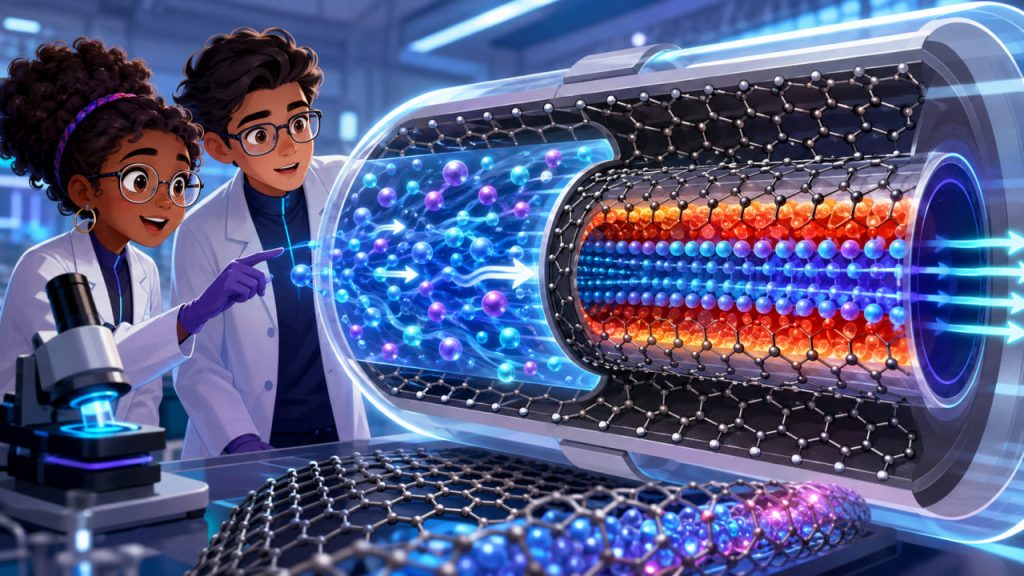
Water in a glass seems simple. Oil sliding across a pan seems familiar. Blood flowing through vessels, ink moving through a printer, and fuel passing through an engine all follow rules that engineers can measure and predict.
But shrink the channel down to the scale of atoms, and liquids start behaving in surprising ways.
In nanofluidics, liquids move through spaces only a few nanometers wide. At that scale, the walls are no longer distant boundaries. They dominate the behavior of every molecule inside the tube.
A liquid inside an atomic-sized channel is not just a smaller version of ordinary liquid flow. It can become layered, sticky, slippery, electrically sensitive, and highly dependent on surface chemistry.
This is why nanofluid viscosity matters for medicine, desalination, batteries, lab-on-a-chip devices, energy storage, and future molecular technologies.
What Is Viscosity?
Viscosity is a liquid’s resistance to flow.
Water has low viscosity, so it flows easily. Honey has high viscosity, so it moves slowly. Motor oil is designed with controlled viscosity so it can protect engine parts under heat and pressure.
In everyday life, viscosity depends mainly on temperature, pressure, and molecular structure.
At the nanoscale, another factor becomes extremely important: the wall.
When a tube is only a few molecules wide, most of the liquid is close to the surface. This means the liquid does not behave as though it is freely flowing in open space.
In nanofluidic channels, viscosity is shaped by both the liquid and the material surrounding it.
What Is a Nanofluid?
The word “nanofluid” can mean two related things.
In engineering, a nanofluid often refers to a liquid containing nanoparticles, such as tiny metal, oxide, carbon, or ceramic particles. These fluids are studied for improved heat transfer, lubrication, and energy systems.
In nanofluidics, the focus is slightly different. It often means a liquid confined inside nanoscale channels, pores, membranes, or tubes.
This article focuses mainly on the second meaning: how ordinary liquids behave when forced through channels close to atomic size.
Examples include:
- Water inside carbon nanotubes
- Electrolytes inside nanopores
- Ions moving through biological channels
- Liquids passing through graphene membranes
- Fluids in battery electrodes
- Water inside clay, minerals, or porous rocks
At this scale, molecules do not always flow smoothly like a continuous stream.
Why Atomic-Sized Tubes Change Everything
Classical fluid mechanics treats liquids as continuous materials. This works beautifully for rivers, pipes, blood vessels, and airplane fuel lines.
But a nanometer is roughly the size range of molecules. In a tube only a few nanometers wide, the assumption of a smooth continuous liquid begins to break down.
Instead, individual molecular interactions become visible in the behavior of the whole fluid.
The wall can:
- Attract or repel molecules
- Slow down or speed up flow
- Organize molecules into layers
- Affect ion movement
- Change local density
- Modify apparent viscosity
- Create slip at the boundary
The smaller the channel, the more the surface becomes part of the liquid’s behavior.
In a large pipe, the wall affects only a thin boundary layer. In a nanochannel, the entire liquid may feel the wall.
Molecular Layering: When Liquids Become Structured
In ordinary pipes, water molecules move in a disordered, fluid way.
Inside extremely narrow channels, molecules may form layers near the walls. This happens because molecules interact with the surface and with each other in organized patterns.
For water, hydrogen bonding can become especially important. Water molecules may orient themselves differently depending on whether the tube wall is hydrophilic or hydrophobic.
A hydrophilic surface attracts water. A hydrophobic surface repels water.
In nanoconfinement, liquid can become partially ordered without becoming fully solid.
This ordering can make the liquid appear more viscous in some cases, because molecular motion becomes restricted. In other cases, especially with very smooth hydrophobic surfaces, the liquid may flow faster than expected.
Slip Flow: When Liquids Stop Sticking to the Wall
In classical pipe flow, scientists often use the no-slip boundary condition. This means the layer of liquid touching the wall is assumed to have zero velocity relative to the wall.
In everyday pipes, this approximation works well.
At the nanoscale, it can fail.
Some surfaces allow slip flow, where liquid molecules slide along the wall instead of sticking tightly to it. Carbon nanotubes are famous for this possibility. Water can sometimes move through them much faster than classical theory predicts.
This does not mean viscosity disappears. It means the relationship between wall, liquid, and flow changes.
Nanotube flow can be fast not because the liquid has no resistance, but because the wall may create unusually low friction.
This is one reason carbon nanotubes and graphene-based membranes are studied for water filtration and desalination.
Apparent Viscosity vs. True Viscosity
One challenge in nanofluidics is that measured viscosity can depend on how it is defined.
In bulk liquid, viscosity is a material property. Under stable conditions, water has a well-known viscosity.
In a nanochannel, researchers may measure an apparent viscosity. This is the viscosity that the fluid seems to have based on flow resistance through the channel.
But apparent viscosity includes many effects:
- Wall friction
- Molecular layering
- Surface charge
- Ion concentration
- Channel roughness
- Slip length
- Pressure
- Temperature
- Confinement geometry
At the nanoscale, viscosity is not always a simple number. It can become a system-level behavior.
The same liquid may behave differently in glass nanopores, carbon nanotubes, biological channels, and mineral pores.
Surface Charge and Electric Effects
Many nanochannels carry electric charge on their surfaces.
This is especially important when the liquid contains ions, such as saltwater, biological fluids, or battery electrolytes.
Charged walls attract ions of the opposite charge and repel ions of the same charge. This creates an electric double layer near the surface.
In a large channel, this charged layer may be small compared with the total fluid volume. In an atomic-sized channel, it can occupy most of the available space.
That changes flow dramatically.
In nanochannels, electricity and viscosity are often linked.
An electric field can move ions, drag water molecules, create electroosmotic flow, and change the effective resistance of the liquid. This is crucial for nanopore sensors, DNA sequencing, filtration membranes, and microfluidic medical devices.
Water in Carbon Nanotubes
Carbon nanotubes are tiny cylindrical structures made from carbon atoms. Their inner walls can be extremely smooth, and their diameters can approach the scale of water molecules.
Water inside carbon nanotubes behaves in remarkable ways.
Depending on the tube size, water molecules may form single-file chains, layered structures, or unusual hydrogen-bond networks. In very narrow tubes, water cannot pass around itself freely. Molecules may move almost like beads on a string.
In some cases, water transport through carbon nanotubes is much faster than expected from ordinary fluid mechanics.
Carbon nanotubes show how atomic smoothness and molecular confinement can rewrite the rules of flow.
This has inspired research into ultra-efficient membranes for water purification and selective ion transport.
Nanofluid Viscosity in Biology
Nature has used nanoscale fluid channels for billions of years.
Cell membranes contain protein channels that allow water, ions, and molecules to pass in controlled ways. Aquaporins, for example, are biological water channels that move water rapidly while blocking many ions.
In the human body, nanoscale transport matters for:
- Nerve signaling
- Kidney filtration
- Cell hydration
- Ion balance
- Drug delivery
- Protein function
- DNA and RNA behavior
Life depends on nanoscale fluid control.
Biological channels are not just tiny pipes. They are molecular machines with specific shapes, charges, and flexible structures that regulate what can pass through.
Studying them helps scientists design artificial membranes, biosensors, and medical nanodevices.
Why Nanofluidics Matters for Technology
Nanofluid viscosity is important because many future technologies need precise control of liquids at tiny scales.
Potential applications include:
- DNA sequencing through nanopores
- High-efficiency desalination membranes
- Better batteries and supercapacitors
- Lab-on-a-chip diagnostics
- Targeted drug delivery
- Artificial kidneys
- Nanoreactors for chemistry
- Cooling systems for microelectronics
- Sensors for viruses, proteins, and pollutants
When devices become smaller, fluid behavior becomes harder to predict using classical formulas alone.
To build reliable nanotechnology, engineers must understand how liquids behave when every molecule matters.
This is why nanofluidics sits at the intersection of physics, chemistry, biology, materials science, and engineering.
Expert Perspective
Researchers in nanofluidics often emphasize that the main challenge is not simply making smaller channels. The challenge is understanding how confinement, surface forces, molecular structure, and electrostatics work together.
A common expert view in the field is that nanofluidic flow cannot be fully understood by scaling down ordinary pipe flow. At atomic dimensions, the liquid, the wall, and the ions form a coupled system.
This perspective is important because it prevents oversimplification. Nanoscale liquids are not magical, but they are governed by details that are invisible in everyday fluid mechanics.
The Big Challenges Ahead
Nanofluidics is promising, but difficult.
Measuring flow in atomic-sized channels is technically challenging. A tiny impurity, surface defect, or change in charge can alter results. Manufacturing billions of identical nanopores is also hard.
Scientists must solve problems such as:
- Controlling channel size precisely
- Measuring viscosity at molecular scales
- Preventing clogging
- Understanding surface chemistry
- Scaling up membranes for industry
- Keeping materials durable
- Predicting ion selectivity
- Managing energy efficiency
The future of nanofluidics depends on precision: precise materials, precise measurements, and precise models.
Why Liquids in Atomic-Sized Tubes Are So Fascinating
Nanofluid viscosity shows that familiar substances can become strange in unfamiliar environments.
Water is still water. Saltwater is still saltwater. But when these liquids are confined in spaces comparable to molecular size, their behavior changes.
They may flow faster than expected, slower than expected, form layers, respond strongly to electric fields, or move one molecule at a time.
At the nanoscale, fluid flow becomes molecular choreography.
Understanding that choreography could help humanity build cleaner water systems, smarter medical tools, better energy storage, and technologies that operate at the scale of life itself.
Interesting Facts
- A nanometer is one billionth of a meter.
- In atomic-sized tubes, most liquid molecules are close to the wall.
- Water can sometimes flow unusually fast through carbon nanotubes.
- Liquids in nanochannels may form molecular layers.
- Surface charge can strongly influence nanofluid flow.
- Biological cells already use nanoscale channels to move water and ions.
- Nanopores can detect single molecules such as DNA strands.
- Apparent viscosity in nanochannels can differ from bulk viscosity.
- Hydrophobic surfaces may allow more slip than hydrophilic surfaces.
- Nanofluidics may improve desalination, medicine, sensors, and energy devices.
Glossary
- Nanofluidics — The study and control of fluid behavior in nanoscale channels or structures.
- Viscosity — A measure of a fluid’s resistance to flow.
- Nanometer — One billionth of a meter.
- Nanochannel — A channel with dimensions measured in nanometers.
- Nanopore — A tiny hole or pore at the nanoscale.
- Hydrophilic — Water-attracting.
- Hydrophobic — Water-repelling.
- Slip Flow — Fluid movement where molecules slide along a wall instead of sticking to it.
- No-Slip Boundary Condition — The classical assumption that liquid touching a wall has no relative motion.
- Apparent Viscosity — The effective viscosity inferred from flow behavior in a specific system.
- Electric Double Layer — A charged layer of ions near a charged surface in a liquid.
- Carbon Nanotube — A tiny cylindrical structure made of carbon atoms.
- Aquaporin — A biological protein channel that allows water to pass through cell membranes.