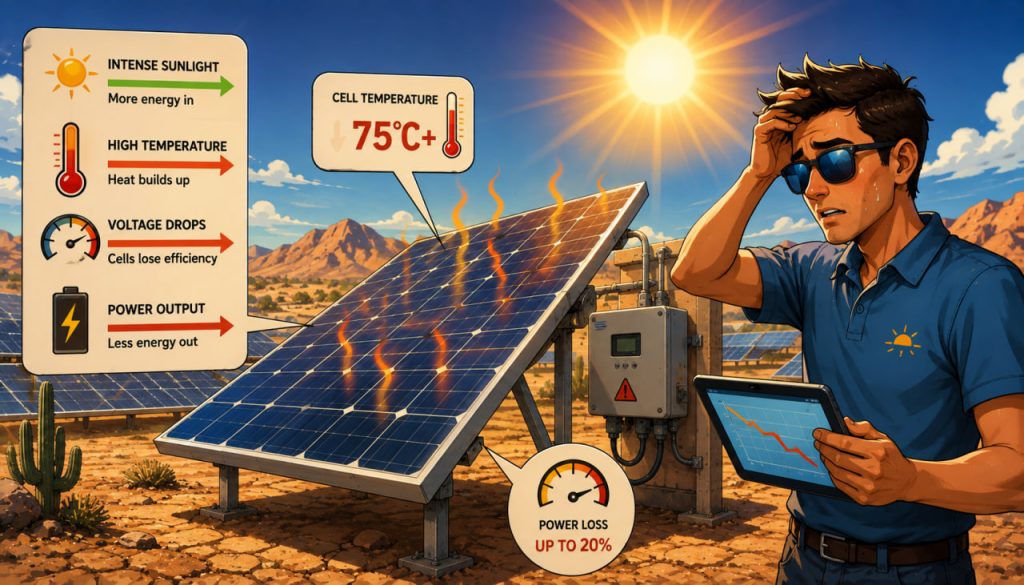
Solar panels seem like they should perform best in extreme heat. After all, they are designed to capture sunlight, and the hottest days are often the sunniest.
But this is one of the most common misunderstandings about solar energy.
Solar panels need light, not heat. In fact, when temperatures climb to +50°C and above, solar panels usually become less efficient, produce less voltage, and may face higher stress on their materials and electronics.
They do not usually “stop working” completely at +50°C. But they can lose a noticeable share of their output, especially when panel surface temperature rises far above air temperature.
A hot desert afternoon can deliver intense sunlight, but it can also push solar equipment into conditions where performance drops and long-term wear accelerates.
Solar Panels Convert Light, Not Heat
Photovoltaic solar panels work by converting sunlight into electricity.
Inside the panel, solar cells absorb photons from sunlight. These photons excite electrons in semiconductor material, usually silicon. The movement of these electrons creates electric current.
This process depends on light energy.
Heat is different. Heat is random molecular motion. It does not help the solar cell produce more electricity in the same way sunlight does.
That is why a bright cold day can be excellent for solar power. A sunny winter mountain location can sometimes produce very strong output because the panels receive intense light while staying cool.
The ideal condition for a solar panel is strong sunlight with moderate or cool temperatures.
Why High Temperature Reduces Solar Panel Efficiency
The main reason solar panels lose power in heat is that high temperature reduces voltage.
As silicon solar cells get hotter, electrons become more active. This makes it easier for them to move, but it also reduces the electrical potential difference the cell can create.
In simple terms, the panel still generates current from sunlight, but each unit of current carries less voltage.
Power is calculated as voltage multiplied by current.
So if voltage drops, total power drops too.
This effect is predictable and is described by the panel’s temperature coefficient. Most standard silicon solar panels lose a fraction of their rated power for every degree Celsius above 25°C cell temperature.
The hotter the solar cell becomes, the lower its power output becomes.
The Difference Between Air Temperature and Panel Temperature
When the weather forecast says +50°C, that means air temperature measured in the shade under standard conditions.
Solar panels are different.
They sit directly under the sun. Their dark surfaces absorb radiation. They may be mounted on hot roofs, desert ground, metal frames, or poorly ventilated structures.
As a result, the actual solar cell temperature can be much higher than the air temperature.
On a +50°C day, a panel may reach +70°C, +80°C, or even higher depending on sunlight intensity, wind, mounting design, and surface conditions.
This is why solar panels can lose significant output during extreme heat events.
A +50°C day can create a much hotter solar module. The cell temperature is what matters most for performance.
What Happens at +50°C and Above?
At +50°C air temperature, several things happen at once.
The solar cells lose efficiency because of heat. The inverter may also become stressed, especially if it is installed in direct sun or inside a poorly ventilated enclosure. Wiring, connectors, mounting structures, and protective materials expand with heat.
If the system is well designed, it continues operating. But output may be lower than expected.
Possible effects include:
- Reduced voltage
- Lower power output
- Inverter derating
- Faster material aging
- Higher electrical resistance
- Thermal expansion stress
- Greater risk of hot spots
- Reduced battery performance in hybrid systems
The system is not failing simply because output drops. It is responding to physics.
Extreme heat creates a performance penalty across the whole solar power system.
Why Solar Panels Are Rated at 25°C
Solar panel ratings are usually measured under Standard Test Conditions.
These conditions include a cell temperature of 25°C, strong sunlight of 1,000 watts per square meter, and a defined solar spectrum.
This makes it possible to compare panels fairly in a laboratory.
But real-world conditions are rarely identical to laboratory conditions.
In hot climates, solar cells often operate well above 25°C. That means actual output may be lower than the nameplate rating during hot periods, even if sunlight is strong.
For example, a panel rated at 400 watts under test conditions may produce less during extreme heat because the cell temperature is far above the rating temperature.
The number printed on a solar panel is not a promise for every weather condition. It is a standardized benchmark.
Temperature Coefficient: The Hidden Number That Matters
The temperature coefficient tells you how much power a solar panel loses as temperature rises above 25°C.
A typical silicon panel may have a power temperature coefficient around -0.3% to -0.5% per degree Celsius.
That may sound small, but it adds up.
If a panel’s cell temperature reaches 75°C, that is 50°C above the standard 25°C rating. With a -0.4% coefficient, the panel could lose around 20% of its rated power because of heat.
This is why temperature coefficient matters when choosing solar panels for hot climates.
Panels with a lower temperature penalty perform better in extreme heat.
In desert and tropical regions, the best panel is not always the one with the highest laboratory wattage. It may be the one that loses less power when hot.
Do Solar Panels Stop Working at +50°C?
Most modern solar panels do not stop working just because the air reaches +50°C.
They are usually built to tolerate high operating temperatures. Many modules are tested for harsh outdoor conditions, including heat, humidity, wind, snow load, and ultraviolet exposure.
However, performance can fall.
The bigger risk is not instant shutdown of the panel itself. The bigger risk is reduced efficiency, inverter derating, accelerated aging, and system stress.
Inverters are especially important. The inverter converts the panel’s direct current into alternating current for home or grid use. If it overheats, it may reduce output to protect itself or temporarily shut down.
At extreme temperatures, the weakest part of the system may not be the panel. It may be the inverter, battery, wiring, or installation design.
Hot Spots and Uneven Heating
A hot spot is an area of a solar panel that becomes much hotter than the surrounding cells.
Hot spots can happen when part of a panel is shaded, dirty, damaged, cracked, or electrically mismatched. Instead of producing power, the affected cell may consume energy and heat up.
Extreme weather can make this worse.
High background temperature means the panel already starts hot. If a damaged or shaded cell heats further, it may create local stress, reduce output, and potentially damage the module over time.
This is why regular inspection matters.
Dust, bird droppings, leaves, broken glass, and poor wiring can all increase the risk of performance problems.
Heat alone reduces efficiency. Heat plus defects can shorten system life.
Why Desert Solar Farms Still Work
If heat reduces solar performance, why are huge solar farms built in deserts?
Because deserts have another major advantage: intense sunlight.
Even if panels lose efficiency in heat, the large amount of solar radiation can still make desert solar extremely productive. Dry climates often have fewer cloudy days, more direct sunlight, and large open areas.
The goal is not to avoid heat completely. That is impossible in many high-sun regions.
The goal is to design systems that manage heat well.
Desert solar projects can use elevated mounting, airflow gaps, heat-tolerant equipment, careful inverter placement, robotic cleaning, optimized tilt angles, and panel technologies with better temperature coefficients.
Hot places can still be excellent for solar power, but they require smarter engineering.
How Installation Design Affects Heat
The same solar panel can perform differently depending on how it is installed.
A panel mounted tightly against a roof may run hotter because air cannot circulate behind it. A panel mounted with a good gap underneath can cool more effectively.
Ground-mounted systems often allow better airflow than roof-mounted systems, though local conditions matter.
Color and material also matter. A dark roof can radiate heat upward into the panels. Dust accumulation can reduce sunlight absorption and increase surface heating.
Good installation practices include:
- Leaving airflow space behind panels
- Avoiding direct inverter exposure to sun
- Using heat-rated cables and connectors
- Choosing panels with better temperature coefficients
- Keeping panels clean
- Avoiding partial shading
- Designing for local wind and dust conditions
Cooling does not always require active technology. Sometimes good airflow is the most important design feature.
Expert Perspective
Solar engineers often emphasize that photovoltaic performance is a balance between irradiance and temperature.
High irradiance increases output because more photons reach the solar cells. High temperature reduces output because voltage falls. The final performance depends on which effect dominates.
This is why professional solar design uses local climate data, expected module temperature, panel temperature coefficients, inverter limits, roof conditions, and seasonal demand patterns.
The expert lesson is simple: solar systems should be designed for real operating temperatures, not only for ideal laboratory ratings.
In very hot climates, this can mean choosing different panels, improving ventilation, oversizing parts of the system carefully, placing inverters in shaded areas, and planning for lower midday efficiency during heat waves.
Can Solar Panels Be Cooled?
Yes, solar panels can be cooled, but not every cooling method is practical.
Passive cooling is the simplest. It uses airflow, spacing, reflective surfaces, and better mounting design to reduce temperature.
Active cooling uses water, fans, or heat-transfer systems. These methods can improve performance, but they also add cost, maintenance, complexity, and sometimes water use.
For most residential and commercial systems, passive cooling and good installation design are more practical than active cooling.
Some advanced systems explore hybrid photovoltaic-thermal technology, where heat is captured for useful purposes while electricity is generated.
But for ordinary solar installations, the best strategy is usually simple: good panels, proper spacing, clean surfaces, shaded electronics, and climate-aware design.
Batteries Also Struggle in Extreme Heat
Many solar systems now include batteries.
Batteries are sensitive to temperature. High heat can reduce battery efficiency, shorten lifespan, and increase safety management demands.
Lithium-ion batteries usually need thermal management to operate safely and reliably. If installed in a very hot location, the system may reduce charging or discharging rates to protect the battery.
This matters because solar plus storage is often used during hot evenings, when air-conditioning demand remains high after sunset.
A solar system in extreme heat must protect not only energy production, but also energy storage.
Battery location, ventilation, insulation, and manufacturer temperature limits are critical.
What Homeowners Should Know
For homeowners, the key message is practical.
Do not assume solar panels are useless in hot weather. They are not. But do not assume heat improves performance either.
A properly installed solar system can work well in hot climates, but output will vary with temperature, sunlight, shading, dust, and equipment quality.
Before installing solar in a very hot region, ask about:
- Panel temperature coefficient
- Expected summer output
- Roof ventilation
- Inverter placement
- Battery temperature limits
- Dust and cleaning needs
- Warranty conditions
- Local heat-wave performance
The best solar system is not the one that only looks good on paper. It is the one designed for the climate where it will actually operate.
Interesting Facts
- Solar panels usually perform better in cool sunny weather than in extremely hot sunny weather.
- A panel’s surface temperature can be much higher than the surrounding air temperature.
- Most panel ratings are based on 25°C cell temperature, not desert heat.
- Voltage drops as solar cells get hotter.
- Dust can reduce solar output and may worsen heating.
- Inverters can reduce output or shut down temporarily if they overheat.
- Panels with better temperature coefficients are more useful in hot climates.
- Desert solar farms can still produce huge amounts of power because sunlight is so intense.
- Airflow behind panels can improve performance.
- Batteries in solar systems also need protection from extreme heat.
Glossary
- Photovoltaic Panel — A solar panel that converts sunlight directly into electricity.
- Solar Cell — The semiconductor component inside a panel that produces electricity from light.
- Voltage — Electrical pressure that helps push current through a circuit.
- Current — The flow of electric charge.
- Power Output — The amount of electricity produced at a given moment.
- Temperature Coefficient — A number showing how much panel output changes as temperature rises or falls.
- Standard Test Conditions — Laboratory conditions used to rate and compare solar panels.
- Cell Temperature — The actual temperature of the solar cells inside a panel.
- Inverter — A device that converts direct current from solar panels into alternating current used by homes and grids.
- Derating — Automatic reduction of output to protect equipment from overheating or stress.
- Hot Spot — A small overheated area on a solar panel, often caused by shading, dirt, or damage.