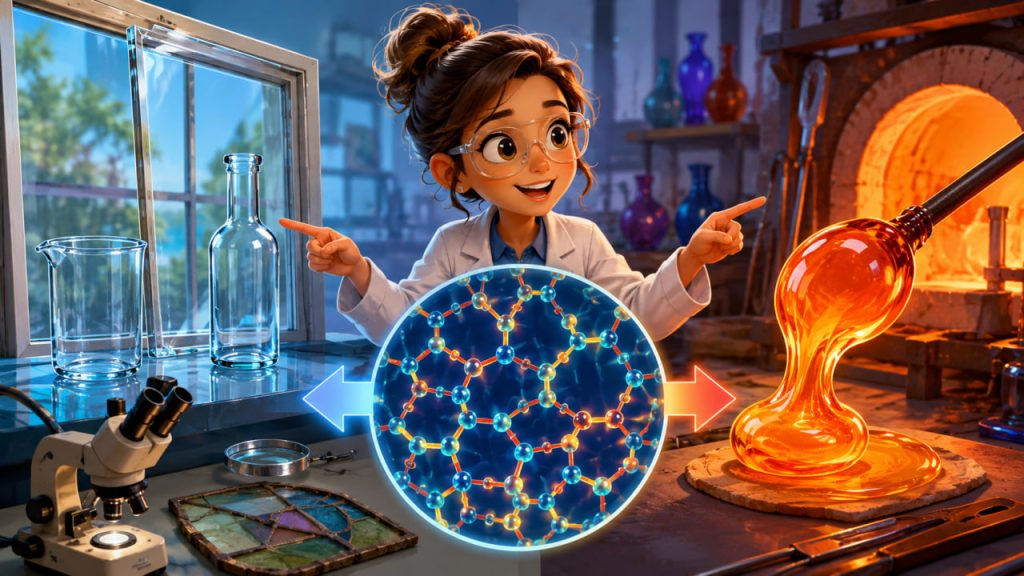
Glass is one of the most familiar materials in human life. It surrounds us in windows, screens, bottles, lenses, laboratory tools, fiber optics, solar panels, and architecture. Yet one popular idea continues to create confusion: is glass really a liquid that flows extremely slowly over centuries?
The short answer is clear: glass is a solid, not a slow-moving liquid at room temperature.
More precisely, glass is an amorphous solid. That means it has the mechanical properties of a solid, but its atoms are arranged without the regular repeating pattern found in crystals.
This makes glass scientifically fascinating. It is solid enough to hold its shape for thousands of years, but structurally unusual enough to behave differently from metals, ice, salt, or quartz.
Why People Think Glass Is a Liquid
The myth comes mostly from old windows.
In some historic buildings, old glass panes appear thicker at the bottom than at the top. This has often been explained by saying that glass slowly flowed downward over centuries.
It sounds convincing, but it is not the correct explanation.
Old window glass was often made using imperfect handcrafting methods. Techniques such as crown glass and cylinder glass produced sheets with uneven thickness. When these panes were installed, builders sometimes placed the thicker edge at the bottom for stability.
The uneven thickness of old windows is mainly a manufacturing artifact, not proof that glass flows like syrup.
If ordinary glass flowed noticeably over centuries, ancient glass objects, telescope lenses, mirrors, and museum pieces would show clear deformation. They generally do not.
What Makes Glass Different from a Crystal?
To understand glass, we need to compare it with a crystal.
In a crystal, atoms are arranged in a repeating pattern. Salt, diamond, ice, and quartz are examples of crystalline solids. Their atoms follow an organized structure over long distances.
Glass is different.
In common window glass, silicon and oxygen atoms form a connected network, but that network lacks long-range order. The atoms are not randomly scattered, but they do not repeat in a neat crystal pattern.
Glass is structurally disordered but mechanically solid.
This is why it can look transparent, break sharply, and hold its shape, while still being scientifically classified as amorphous rather than crystalline.
What Is an Amorphous Solid?
An amorphous solid is a solid material without a regular crystalline structure.
The word “amorphous” means “without definite form” in the structural sense. It does not mean the object cannot keep a shape. A glass cup, window, or phone screen clearly has a stable shape.
Other amorphous solids include some plastics, gels, and certain metallic glasses.
The key point is that amorphous refers to atomic arrangement, not everyday physical firmness.
Glass is rigid. It resists flow. It can support weight. It cracks rather than pours. These are solid-like behaviors.
How Glass Forms
Most familiar glass begins as a hot liquid melt.
For example, common soda-lime glass is made from ingredients such as silica sand, soda ash, and limestone. These materials are heated until they melt into a liquid. Then the melt is cooled.
If cooling happens in a way that prevents atoms from arranging into a crystal, the material becomes glass.
Instead of freezing into a neat atomic pattern, the structure becomes locked into a disordered arrangement.
This process is called vitrification.
Glass is born from a liquid, but it does not remain a liquid once cooled below its glass transition range.
That distinction is essential.
The Glass Transition
Glass does not have a sharp melting point like many crystals.
Ice, for example, melts at a clear temperature under normal pressure. Glass softens gradually over a range of temperatures.
This range is called the glass transition.
Above the glass transition temperature, glass becomes softer and more rubbery or liquid-like. Below it, glass is rigid and solid-like.
At room temperature, ordinary window glass is far below its glass transition temperature. Its atoms are moving only extremely slightly, locked in place on human timescales.
Glass can flow when it is hot enough, but room-temperature glass is effectively solid.
This is why glassblowers heat glass until it softens before shaping it.
Does Glass Flow at All?
Technically, nearly all solids can deform under enough stress, heat, or time. Even metals can slowly change shape under certain conditions, a process called creep.
But this does not make them liquids.
At room temperature, the viscosity of ordinary glass is so high that any flow is unimaginably slow. It would take far longer than the age of human civilization to produce noticeable window-like sagging under normal conditions.
Calling glass a liquid because it has theoretical molecular motion is misleading.
By that logic, many solids would have to be called liquids, which would make the word “solid” useless.
In practical, engineering, and scientific terms, glass at room temperature is a solid.
Why Glass Breaks Like a Solid
Glass does not bend or flow easily at room temperature. Instead, it fractures.
When enough force is applied, tiny cracks spread rapidly through the material. Because glass lacks the crystal structures that help some materials deform plastically, cracks can move quickly and sharply.
This is why ordinary glass can shatter.
Tempered glass is treated to improve safety. It is made by heating and rapidly cooling glass so that internal stresses form. When it breaks, it tends to crumble into small pieces instead of large sharp shards.
Laminated glass uses layers, often with plastic between them, to hold fragments together.
The way glass breaks is another sign of its solid behavior.
A slow-flowing liquid does not shatter into fragments.
Why Glass Is Transparent
Glass is transparent because visible light can pass through it without being strongly absorbed or scattered.
In common glass, the electronic structure of the material does not absorb most visible wavelengths. Also, because the glass is uniform on the scale of visible light, it does not scatter light strongly.
This is why glass is useful for windows, lenses, microscopes, telescopes, and optical fibers.
Transparency is not unique to liquids. Many solids are transparent, including diamond, quartz, sapphire, and some plastics.
Glass is transparent not because it is liquid, but because of how its atoms and electrons interact with light.
Expert Perspective
Materials scientists generally define glass as a non-crystalline solid formed by cooling a liquid without crystallization. Glass researcher John C. Mauro and other experts in glass science have emphasized that the “glass is a liquid” idea is a persistent misconception.
The expert view is straightforward: glass has a disordered atomic structure like a frozen liquid, but its physical behavior at room temperature is that of a solid.
This is the best way to understand the topic without confusion. Glass is not a crystal, but it is also not a practical liquid.
Why This Question Matters
The glass question is more than a fun myth. It helps explain how scientists classify matter.
In school, we often learn only three states: solid, liquid, and gas. But real materials can be more subtle. Plasma, gels, liquid crystals, supercritical fluids, and amorphous solids show that matter can behave in complex ways.
Glass is important because it sits between simple categories.
It begins as a liquid melt. It avoids crystallization. It becomes rigid. It keeps a disordered internal structure. It softens gradually when heated.
Glass teaches us that “solid” does not always mean “crystalline.”
That idea matters in chemistry, physics, geology, engineering, electronics, and materials science.
Modern Uses of Glass
Glass is not only for windows.
Modern civilization depends on advanced glass technologies:
- Fiber-optic cables for internet communication
- Smartphone screens and touch displays
- Solar panel covers
- Laboratory glassware
- Medical containers
- Camera lenses
- Telescope mirrors
- Architectural glass
- Protective glass ceramics
- Laser and optical systems
Special glasses can resist heat, block radiation, bend light precisely, or strengthen electronic devices.
Glass is one of humanity’s oldest materials, but also one of its most advanced technologies.
Its unique combination of transparency, hardness, chemical stability, and moldability keeps it essential.
Interesting Facts
- Glass is an amorphous solid, not a slow-flowing liquid at room temperature.
- Old windows are often thicker at the bottom because of historic manufacturing methods.
- Glass has no regular crystal lattice.
- Ordinary glass softens gradually instead of melting sharply like ice.
- Glassblowers shape glass by heating it above its softening range.
- Volcanic glass, called obsidian, forms when lava cools quickly.
- Fiber-optic glass can carry information across continents using light.
- Tempered glass is stronger than ordinary glass and breaks into smaller pieces.
- Some metallic alloys can form metallic glass.
- Glass can preserve ancient objects and chemical samples for thousands of years.
Glossary
- Glass — A hard, brittle, usually transparent amorphous solid made by cooling a melt without crystallization.
- Amorphous Solid — A solid without a regular repeating atomic structure.
- Crystal — A solid with atoms arranged in a repeating pattern.
- Glass Transition — The temperature range where glass changes from rigid and solid-like to softer and more flexible.
- Viscosity — A measure of resistance to flow.
- Vitrification — The process of forming glass by cooling a liquid into an amorphous solid.
- Soda-Lime Glass — The most common type of glass, used in windows and bottles.
- Silica — Silicon dioxide, a major ingredient in many types of glass.
- Creep — Slow deformation of a solid under stress.
- Tempered Glass — Strengthened glass made by controlled heating and cooling.
- Laminated Glass — Glass made with layers that help hold broken pieces together.
- Obsidian — Natural volcanic glass formed from rapidly cooled lava.