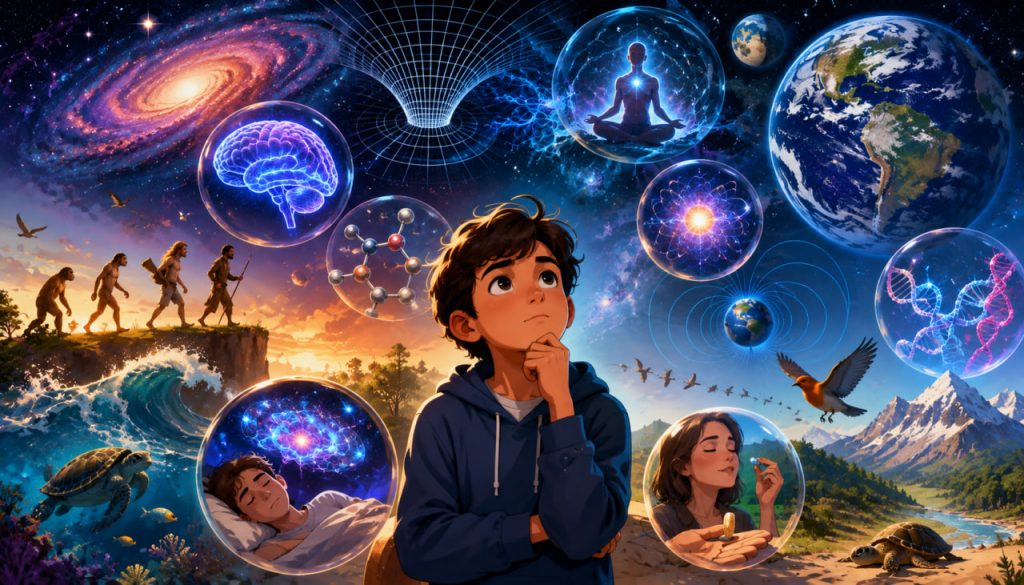
Science has explained an astonishing amount about the universe: how stars form, how DNA works, why diseases spread, how electricity moves, and how life evolved over billions of years.
Yet the more humanity discovers, the more mysterious reality becomes.
Some questions are not “unscientific.” They are simply not solved yet. They sit at the edge of physics, biology, consciousness studies, cosmology, and medicine.
The greatest scientific mysteries are not failures of science. They are open doors to the next level of discovery.
1. What Is Consciousness?
Consciousness is one of the deepest mysteries in science.
We know the brain processes signals, stores memories, controls movement, and responds to the world. But science still does not fully explain why these physical processes create inner experience.
Why does the brain produce the feeling of being “you”? Why does pain feel painful, color feel colorful, and memory feel personal?
Neuroscience can map brain activity, but the subjective experience of awareness remains one of the hardest problems in modern science.
This mystery touches psychology, philosophy, artificial intelligence, medicine, and even the future of human-machine interaction.
2. Why Does the Universe Exist?
Science can describe many stages of cosmic history, including the expansion of the universe and the formation of stars and galaxies.
But the deeper question remains: why is there something rather than nothing?
The Big Bang model explains the early hot, dense state of the universe, but it does not fully answer what caused existence itself or why the laws of physics are the way they are.
The existence of the universe is not just a scientific puzzle. It is one of the most profound questions humans can ask.
Cosmologists study inflation, quantum fields, multiverse models, and fundamental constants, but a complete answer remains beyond reach.
3. What Is Dark Matter?
Visible matter makes up only a small part of the universe.
Galaxies rotate in ways that suggest there is much more mass than we can see. Large-scale cosmic structures also behave as if invisible matter is shaping them gravitationally.
Scientists call this unseen substance dark matter.
It does not emit light, reflect light, or absorb light in a normal way. Yet its gravitational effects appear to be everywhere.
Dark matter may be one of the most important ingredients of the cosmos, but nobody has directly identified what it is.
It could be made of unknown particles, or it may point toward a deeper modification of our understanding of gravity.
4. What Is Dark Energy?
Dark matter is mysterious, but dark energy may be even stranger.
The universe is not only expanding. Its expansion appears to be accelerating.
To explain this, scientists use the term dark energy. It may be a property of space itself, a field, or something more fundamental that current physics does not yet understand.
Dark energy is thought to dominate the total energy budget of the universe.
The largest component of reality may be something science can describe mathematically but still cannot truly explain.
Understanding dark energy could transform cosmology and reveal the future fate of the universe.
5. How Did Life Begin?
Evolution explains how life changes and diversifies once it already exists.
But the origin of life itself remains unsolved.
How did nonliving chemistry become self-replicating biological systems? How did simple molecules become the first cells? What conditions allowed metabolism, genetic information, and membranes to come together?
Scientists study early Earth chemistry, hydrothermal vents, RNA molecules, mineral surfaces, meteorite chemistry, and laboratory simulations.
The transition from chemistry to biology is one of the greatest unanswered questions in science.
Solving it could also help us understand whether life may exist elsewhere in the universe.
6. Are We Alone in the Universe?
The universe contains billions of galaxies, each with billions of stars. Many stars have planets. Some planets may have water, atmospheres, and stable climates.
This makes one question unavoidable: is life common, or is Earth extraordinarily rare?
So far, science has not confirmed life beyond our planet.
Microbial life may exist on Mars, icy moons, or distant exoplanets. Intelligent civilizations may exist somewhere in the galaxy, but no confirmed signal has been found.
The silence of the cosmos is one of the most haunting scientific mysteries.
This is often connected to the Fermi paradox: if the universe is so large, why have we not clearly detected anyone else?
7. Why Do We Sleep and Dream?
Science knows sleep is essential. It supports memory, brain repair, immune function, emotional balance, metabolism, and overall health.
But the full purpose of sleep is still not completely understood.
Dreaming is even more mysterious. Dreams may help process emotion, organize memory, simulate threats, or reflect random brain activity during sleep cycles.
Yet no single explanation fully accounts for why dreams feel so vivid, symbolic, emotional, and sometimes deeply meaningful.
Every person enters an altered state of consciousness each night, and science still does not fully understand it.
Sleep remains one of the most familiar and mysterious parts of human life.
8. Why Does Time Move Forward?
Physics equations often work in both directions of time. Yet everyday life does not.
Ice melts, but melted water does not spontaneously become a perfect ice cube. People age forward, not backward. Memories point to the past, not the future.
This one-way direction is called the arrow of time.
It is strongly connected to entropy, the tendency of systems to move toward disorder. But why the universe began in such a low-entropy state is still a major mystery.
Time is something everyone experiences, but its deepest nature remains unresolved.
Understanding time may require new insights into quantum mechanics, gravity, and cosmology.
9. How Does the Placebo Effect Work So Powerfully?
The placebo effect shows that belief, expectation, and context can influence real physical symptoms.
People can experience pain relief, changes in stress response, improved mood, and measurable biological effects after receiving treatments with no active drug ingredient.
This does not mean illness is imaginary. It means the brain and body are connected in powerful ways science is still mapping.
The placebo effect reveals that expectation can become biology.
Researchers study brain chemistry, endorphins, dopamine, immune signaling, and doctor-patient communication to understand how this happens.
10. Why Do Some Animals Navigate So Accurately?
Many animals perform astonishing navigation feats.
Birds migrate across continents. Sea turtles return to beaches where they were born. Salmon find their original rivers. Bees communicate food locations. Some animals appear to sense Earth’s magnetic field.
Science has identified several mechanisms, including smell, stars, sunlight, landmarks, magnetic sensing, and inherited instincts.
But the full picture is still incomplete.
Animal navigation suggests that living organisms can read the planet in ways humans barely understand.
This mystery connects biology, neuroscience, evolution, and Earth’s magnetic environment.
Expert Perspective
Many scientists describe unsolved mysteries as the engine of discovery. Theoretical physicists, neuroscientists, and biologists often emphasize that science advances by finding gaps between what we can measure and what we can explain.
A practical expert view is this: an unanswered question is not an empty space. It is a research frontier.
The mysteries of consciousness, dark matter, the origin of life, and time are difficult because they challenge the foundations of current knowledge. They require better instruments, sharper theories, and sometimes entirely new ways of thinking.
Why These Mysteries Matter
These questions are not just abstract puzzles.
Understanding consciousness could change medicine and artificial intelligence. Explaining dark matter and dark energy could rewrite cosmology. Solving the origin of life could transform biology and the search for extraterrestrial life. Understanding sleep, placebo effects, and animal navigation could improve health, neuroscience, and technology.
The unknown is not useless. It is where future breakthroughs begin.
P.S. Unfortunately, many scientists spend their entire lives developing dead-end theories, often guided by the opinions of scientific authorities, forgetting that these authorities, too, can be mistaken. Since time immemorial, true scientists have sought answers within themselves, living with dignity and striving to learn or invent, not to satisfy their delusions of grandeur, but to help others. And when a person combines a sincere desire to help others with real actions and self-improvement, the fruits of their labors become truly valuable, and there are many examples of such scientists even in modern times. If you’re interested in examples and looking for answers, please write in the comments!
Interesting Facts
- Most of the universe appears to be made of dark matter and dark energy, not ordinary atoms.
- Scientists still do not know exactly how life first emerged from nonliving chemistry.
- Dreams can feel emotionally real even when their events are impossible.
- Some animals can navigate across thousands of kilometers with remarkable accuracy.
- The placebo effect can produce measurable changes in the brain and body.
- The arrow of time is connected to entropy, but its cosmic origin remains mysterious.
- Consciousness is studied by neuroscientists, philosophers, computer scientists, and doctors.
- The search for extraterrestrial life is one of the most active scientific quests of the modern era.
Glossary
- Consciousness — The state of awareness and subjective experience.
- Dark Matter — Invisible matter inferred from its gravitational effects.
- Dark Energy — A mysterious form of energy associated with the accelerating expansion of the universe.
- Big Bang — The early hot, dense state from which the universe expanded.
- Origin of Life — The scientific question of how living systems emerged from nonliving chemistry.
- Fermi Paradox — The puzzle of why we have not detected alien civilizations if the universe is so vast.
- Arrow of Time — The one-way direction in which time appears to move.
- Entropy — A measure of disorder or the number of possible arrangements in a system.
- Placebo Effect — A real biological or psychological response caused by expectation rather than an active treatment.
- Magnetoreception — The ability of some organisms to sense Earth’s magnetic field.
- Cosmology — The study of the origin, structure, and evolution of the universe.
- Neuroscience — The scientific study of the brain and nervous system.