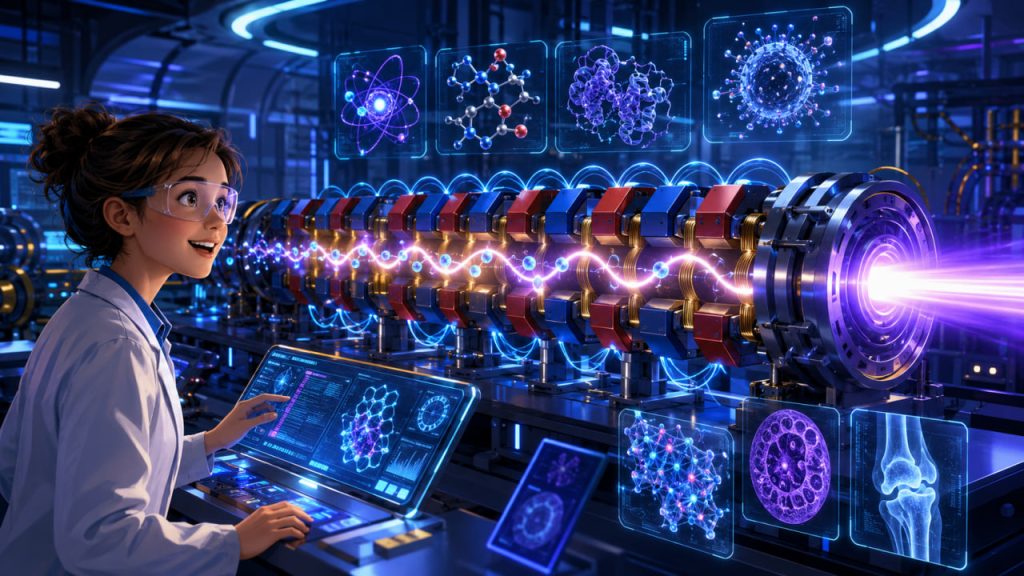
Free-electron lasers are among the most powerful and flexible light sources ever built. They can produce intense beams of radiation ranging from microwaves to X-rays, allowing scientists to observe atoms, molecules, proteins, materials, chemical reactions, and ultrafast physical processes with extraordinary precision.
Unlike ordinary lasers, free-electron lasers do not rely on atoms or molecules inside a fixed laser medium. Instead, they use high-speed electrons moving through a magnetic structure.
A free-electron laser turns the motion of accelerated electrons into extremely bright, tunable, coherent light.
This makes it one of the most important tools in modern experimental physics, chemistry, biology, materials science, and nanotechnology.
What Is a Free-Electron Laser?
A free-electron laser, often called an FEL, is a laser-like device that generates radiation using a beam of fast-moving electrons.
The term “free-electron” means that the electrons are not bound to atoms inside a crystal, gas, or chemical medium. They move freely through a vacuum beamline.
A traditional laser uses a gain medium such as a gas, crystal, semiconductor, or dye. The atoms or molecules in that medium emit light when they are excited.
A free-electron laser works differently.
It sends a high-energy electron beam through a special magnetic structure called an undulator or wiggler. As electrons pass through this alternating magnetic field, they wiggle from side to side and emit radiation.
The light comes from moving electrons, not from electronic transitions inside atoms.
How Free-Electron Lasers Work
The basic process begins with an electron accelerator.
Electrons are produced, accelerated to very high energies, and formed into a narrow beam. This beam travels through a long vacuum system.
Next, the electrons enter the undulator.
Inside the undulator, magnets are arranged with alternating polarity. These magnets force the electrons to follow a wavelike path instead of a straight line.
When charged particles accelerate or change direction, they emit electromagnetic radiation. In an FEL, the carefully controlled electron motion produces light with specific properties.
At first, the emitted radiation may be weak. But under the right conditions, the radiation interacts with the electron beam and causes electrons to bunch together at microscopic intervals.
This process is called microbunching.
Once microbunching begins, electrons emit light in a synchronized way. The radiation becomes much stronger, brighter, and more laser-like.
Why FEL Light Is So Special
Free-electron lasers are valuable because their light can be extremely bright, coherent, and tunable.
Brightness matters because scientists often study tiny samples or ultrafast events. A brighter beam can reveal details that ordinary light sources cannot.
Coherence means the light waves are highly organized. This allows advanced imaging and scattering experiments.
Tunable means researchers can adjust the wavelength of the radiation. By changing the electron energy or undulator settings, an FEL can generate different colors or wavelengths.
A free-electron laser is not locked to one fixed laser color. It can be tuned across wide spectral ranges.
This flexibility is one of its greatest advantages.
From Microwaves to X-Rays
Free-electron lasers can be designed for many different parts of the electromagnetic spectrum.
Some operate in the infrared region. Others produce ultraviolet light. The most famous modern machines generate intense X-ray pulses.
X-ray free-electron lasers are especially important because X-rays can probe matter at atomic scales.
They can help reveal:
- Crystal structures
- Protein shapes
- Chemical reaction pathways
- Magnetic materials
- Plasma behavior
- Nanostructures
- Atomic motion
- Phase transitions
X-ray FELs allow scientists to investigate matter with both spatial and time resolution that older tools could not easily achieve.
Seeing Atoms in Motion
One of the most exciting uses of free-electron lasers is observing ultrafast processes.
Atoms and molecules move incredibly quickly. Chemical bonds can stretch, break, and form in femtoseconds. A femtosecond is one quadrillionth of a second.
Ordinary cameras cannot capture such events.
FELs can produce ultrashort pulses of light, acting like high-speed flashes. These pulses allow scientists to take snapshots of molecular motion.
By collecting many snapshots, researchers can reconstruct how a reaction unfolds.
Free-electron lasers help scientists watch matter change instead of only studying before-and-after states.
This is essential for understanding photosynthesis, catalysis, combustion, drug binding, and radiation damage.
X-Ray Crystallography and Biology
Biology has benefited greatly from X-ray light sources.
Proteins, viruses, enzymes, and molecular machines often have complex structures. Knowing their shapes helps scientists understand how life works at the molecular level.
Traditional X-ray crystallography requires crystals that can survive exposure to radiation. But intense X-ray beams can damage biological samples.
Free-electron lasers solve part of this problem by using extremely short pulses.
A pulse can capture structural information before the sample is destroyed. This approach is sometimes described as “diffraction before destruction.”
It allows researchers to study tiny crystals and delicate biological structures that are difficult to examine with conventional methods.
Materials Science and Extreme Conditions
Free-electron lasers are also powerful tools for materials science.
Scientists use FELs to study superconductors, magnets, semiconductors, nanomaterials, batteries, catalysts, and high-pressure phases of matter.
Because FEL pulses are so intense and short, they can reveal how materials respond to heat, pressure, electric fields, magnetic fields, and shock waves.
This helps researchers design better materials for electronics, energy storage, solar cells, medicine, and advanced manufacturing.
FELs can also create and examine extreme states of matter, such as warm dense matter and plasma-like conditions.
These states are important for astrophysics, fusion research, and planetary science.
The Role of Accelerators
A free-electron laser depends on an advanced particle accelerator.
The accelerator must create an electron beam with high energy, low spread, and precise timing. Even small imperfections can reduce the quality of the emitted light.
This is why FEL facilities are large and technically complex. They require accelerators, undulators, beam diagnostics, vacuum systems, magnets, radio-frequency technology, precision timing, control software, and radiation shielding.
An FEL is not just a laser. It is a complete accelerator-based research facility.
Some machines are hundreds of meters or even kilometers long.
Expert Perspective
Physicist John Madey is widely credited with developing the first operational free-electron laser in the 1970s. His work showed that a beam of relativistic electrons moving through a magnetic structure could produce tunable coherent radiation.
That idea changed light-source science.
Instead of being limited by the natural energy levels of atoms or molecules, researchers could use accelerator physics to create powerful radiation with adjustable wavelength.
The free-electron laser proved that controlled electron motion could become a new kind of light engine.
Why Free-Electron Lasers Are Expensive
Free-electron lasers are not small desktop devices.
They require large buildings, expert teams, stable power systems, cryogenic equipment in some designs, advanced detectors, and extreme mechanical precision.
The cost is high because every part of the system must work together.
The electron beam must arrive at the right place, at the right time, with the right energy. The undulator magnets must be aligned with exceptional accuracy. The experimental stations must handle intense radiation and delicate samples.
This complexity is the price of producing some of the most advanced scientific light available.
The Future of Free-Electron Lasers
The future of free-electron lasers is focused on making them brighter, faster, more stable, and more accessible.
Scientists are developing better accelerator technologies, improved electron sources, compact FEL concepts, higher repetition rates, and more precise control of X-ray pulses.
Future FELs may help answer major scientific questions:
How do molecules transform during chemical reactions?
How can proteins be imaged more clearly?
How do quantum materials change under ultrafast excitation?
How can matter behave under the extreme conditions found inside planets or stars?
Free-electron lasers are giving science something rare: the ability to see tiny structures and ultrafast events at the same time.
Interesting Facts
- Free-electron lasers use electrons moving through magnetic fields to generate light.
- Unlike ordinary lasers, FELs do not require a fixed atomic or molecular gain medium.
- The wavelength of an FEL can often be tuned by changing electron energy or magnet settings.
- X-ray free-electron lasers can produce pulses short enough to study femtosecond processes.
- FELs can help image delicate biological molecules before radiation destroys the sample.
- Some FEL facilities are hundreds of meters long.
- Microbunching allows electrons to radiate together in a synchronized way.
- Free-electron lasers are used in physics, chemistry, biology, materials science, and nanotechnology.
- FEL light can be billions of times brighter than many conventional laboratory X-ray sources.
- The technology combines accelerator physics, optics, magnet design, and ultrafast science.
Glossary
- Free-Electron Laser — A laser-like light source that uses free electrons moving through magnetic fields to generate radiation.
- Electron Beam — A stream of electrons traveling together through a vacuum system.
- Accelerator — A machine that increases the energy and speed of charged particles.
- Undulator — A magnetic structure that forces electrons to wiggle and emit radiation.
- Wiggler — A magnetic device similar to an undulator, often producing broader radiation.
- Coherent Light — Light waves that are organized in phase and direction.
- Tunable Radiation — Radiation whose wavelength can be adjusted.
- Microbunching — The grouping of electrons into tiny clusters that emit synchronized radiation.
- X-Ray Free-Electron Laser — An FEL designed to produce extremely bright X-ray pulses.
- Femtosecond — One quadrillionth of a second.
- Diffraction — The spreading and interference of waves, used to study structures.
- X-Ray Crystallography — A method for determining atomic structures by analyzing X-ray diffraction from crystals.
- Relativistic Electron — An electron moving at a speed close to the speed of light.
- Beamline — The path and equipment through which a particle or light beam travels.