Tooth enamel looks ordinary because we see it every day. It is the smooth, pale outer layer of the teeth, designed to bite, grind, and protect. But under a microscope, enamel becomes something extraordinary.
It is not just “hard tissue.” It is a highly organized biological ceramic built from ionic crystals, proteins, minerals, and nanoscale architecture.
Tooth enamel is the hardest tissue in the human body because biology has learned how to build a mineral material with remarkable strength, precision, and durability.
Understanding enamel helps explain why teeth can survive years of chewing pressure, temperature changes, acids, bacteria, and mechanical wear. It also shows why enamel is difficult to repair once damaged.
What Are Ionic Crystals?
Ionic crystals are solid materials made from positively and negatively charged ions arranged in a repeating pattern.
A classic example is table salt. Sodium ions and chloride ions attract each other and form a crystal lattice.
In biology, ionic crystals are often based on calcium, phosphate, carbonate, sodium, magnesium, and other ions. These charged particles can organize into strong mineral structures.
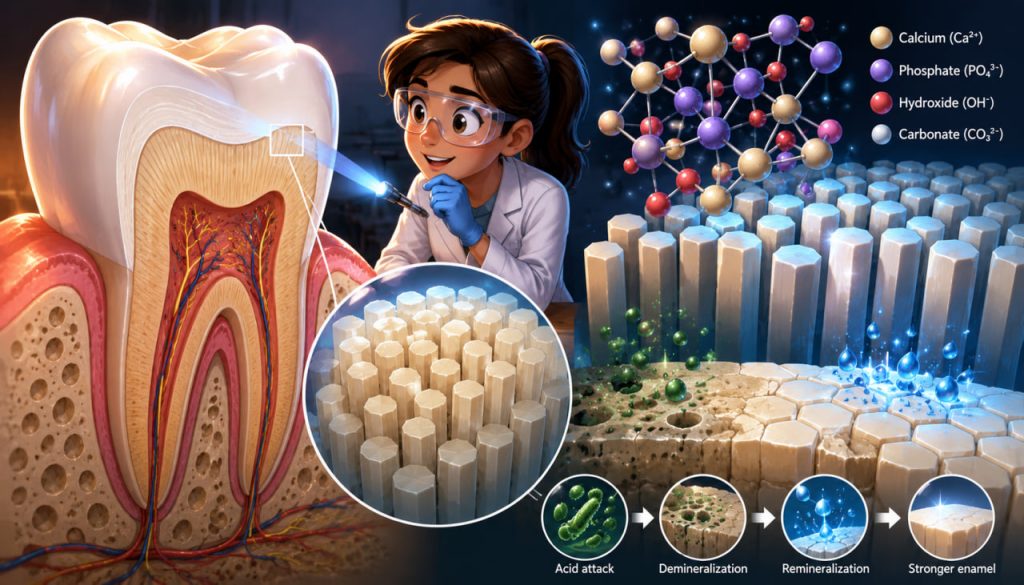
Tooth enamel is mainly made from a calcium phosphate mineral called hydroxyapatite.
Hydroxyapatite crystals contain calcium ions, phosphate groups, and hydroxide ions. Together, they form a rigid crystal structure that gives enamel its incredible hardness.
Enamel is biological, but its strength comes largely from mineral chemistry.
Why Tooth Enamel Is Like a Ceramic
Ceramics are usually hard, heat-resistant, and wear-resistant materials made from inorganic compounds.
Porcelain, alumina, zirconia, and glass ceramics are familiar examples. They are strong under compression but can be brittle when cracked.
Tooth enamel shares many ceramic-like qualities. It is extremely hard, highly mineralized, resistant to wear, and built mostly from inorganic crystals.
However, enamel is not the same as industrial ceramic.
It is created by living cells during tooth development. It contains a highly controlled crystal arrangement. It grows in an aqueous biological environment rather than a furnace.
This makes enamel a natural bioceramic.
Enamel is one of the best examples of how living organisms can manufacture advanced materials at body temperature.
The Mineral Structure of Enamel
Human enamel is about 96% mineral by weight. The rest is mostly water and a small amount of organic material.
This is one reason enamel is so hard. It contains far less organic material than bone or dentin.
The hydroxyapatite crystals in enamel are long, thin, and tightly packed. They are not scattered randomly. They are grouped into structures called enamel rods or prisms.
Each rod contains bundles of crystals aligned in a specific direction.
Between rods, crystals are arranged slightly differently. This creates a complex pattern that helps enamel resist cracks and distribute mechanical stress.
At the nanoscale, enamel is not a simple block of mineral. It is a hierarchical structure.
Hierarchy: The Secret of Enamel Strength
Enamel strength comes from multiple levels of organization.
At the smallest level, atoms form ions. Ions form hydroxyapatite crystals. Crystals assemble into rods. Rods organize into larger enamel regions. These regions form the full protective crown of the tooth.
This layered organization matters.
A single crystal can break. But a carefully arranged structure can guide, slow, or deflect cracks.
Nature often builds strong materials by combining hard minerals with smart architecture.
This is why enamel can handle chewing forces despite being mineral-rich and relatively brittle compared with softer tissues.
The design is not accidental. During tooth development, specialized cells guide mineral growth with remarkable precision.
How Enamel Forms
Enamel is produced by cells called ameloblasts.
These cells are active during tooth development before the tooth fully erupts into the mouth. Ameloblasts secrete proteins that help control where and how mineral crystals grow.
At first, forming enamel contains more organic material and water. As development continues, most of the protein is removed, and mineral crystals expand dramatically.
The result is mature enamel with very high mineral content.
This process is called amelogenesis.
The problem is that ameloblasts disappear after enamel formation is complete. Mature enamel has no living cells inside it.
That means enamel cannot regenerate the way bone can.
Once enamel is lost, the body cannot naturally grow it back in the same complete biological way.
Why Enamel Is Harder Than Bone
Bone is strong, but it is also alive, vascular, and constantly remodeled.
Bone contains collagen, cells, blood supply, mineral crystals, and organic matrix. This makes it tough and repairable.
Enamel is different. It contains no blood vessels, no nerves, and no living cells in its mature form. It is much more mineralized than bone.
That high mineral content makes enamel harder, but it also makes it less able to repair itself.
Bone can heal after a fracture. Enamel cannot rebuild a lost section on its own.
This is why cavities, erosion, cracks, and enamel wear require prevention or dental treatment.
Acid: The Enemy of Enamel Crystals
Enamel is strong, but it has a weakness: acid.
Acids can dissolve hydroxyapatite crystals by pulling mineral ions out of the enamel structure. This process is called demineralization.
Acid can come from bacteria that feed on sugars and produce acids. It can also come from acidic drinks, citrus foods, reflux, or frequent snacking.
When the mouth becomes too acidic, calcium and phosphate can leave enamel.
If the damage remains early and microscopic, minerals from saliva and fluoride can help restore some strength through remineralization.
But if mineral loss progresses too far, a cavity forms.
Enamel damage often begins invisibly at the crystal level before a hole appears.
Fluoride and Stronger Enamel
Fluoride is important because it can help enamel resist acid.
When fluoride is present, it can promote the formation of fluorapatite-like mineral at the enamel surface. This mineral is more resistant to acid than ordinary hydroxyapatite.
Fluoride also supports remineralization by helping calcium and phosphate return to weakened enamel areas.
This is why fluoride toothpaste is widely used for cavity prevention.
Fluoride does not make enamel indestructible. But it improves the chemical resistance of the surface and helps slow the cycle of mineral loss.
Enamel as a Smart Biological Material
Enamel is impressive because it solves a difficult engineering problem.
It must be hard enough to crush food, smooth enough to reduce friction, stable enough to last decades, and organized enough to resist cracking.
At the same time, it must be formed by cells in a living organism under mild conditions.
Industrial ceramics often require extreme heat. Enamel is built in the body using proteins, ions, water, and biological control.
This makes enamel a powerful model for materials science.
Researchers study enamel to design better dental restorations, synthetic enamel-like coatings, biomimetic ceramics, and self-healing mineral materials.
Expert Perspective
Materials scientists often describe enamel as a hierarchical bioceramic because its properties depend not only on chemical composition, but also on structure across many scales.
This perspective is important. Hydroxyapatite alone does not fully explain enamel’s performance. The arrangement of crystals, rods, interfaces, and mineral gradients is what makes enamel so effective.
Enamel teaches scientists that material strength is not only about what something is made of, but how it is organized.
This idea has influenced biomimetic materials research, where engineers try to copy strategies found in natural structures.
Why Enamel Still Challenges Science
Despite decades of research, enamel is difficult to imitate.
A synthetic material may be hard, but not arranged like enamel. A dental filling may restore function, but it is not living enamel. A coating may contain hydroxyapatite, but not the same full architecture formed by ameloblasts.
The challenge is structure.
To recreate enamel, scientists must control crystal growth from the atomic scale to the visible scale. That means understanding chemistry, biology, mechanics, and nanoscale self-assembly.
Future dentistry may include better enamel regeneration strategies, mineralizing gels, peptide-guided crystal growth, and advanced ceramic restorations that behave more like natural enamel.
Why Tooth Enamel Matters
Tooth enamel is easy to underestimate because it is familiar.
But it is one of the most advanced materials made by the human body.
It is an ionic crystal-based bioceramic, a protective armor, a chemical barrier, and a mechanical surface all at once.
It shows how biology can use simple ions to build a material stronger than many human-made structures of similar size.
Every tooth is a small masterpiece of mineral engineering.
Interesting Facts
- Tooth enamel is the hardest tissue in the human body.
- Mature enamel contains no living cells, nerves, or blood vessels.
- Enamel is made mostly from hydroxyapatite crystals.
- The enamel surface can lose minerals during acid attacks and regain some minerals through remineralization.
- Fluoride helps enamel resist acid damage.
- Enamel rods are microscopic structural units that help organize mineral crystals.
- Bone can remodel itself, but enamel cannot fully regenerate naturally after it is lost.
- Enamel forms under biological conditions, not high-temperature industrial processing.
- The structure of enamel inspires research into biomimetic ceramics.
- Cavities begin when acids dissolve minerals from enamel faster than they can be replaced.
Glossary
- Ionic Crystal — A solid structure made from positively and negatively charged ions arranged in a repeating pattern.
- Ion — An atom or molecule with an electric charge.
- Tooth Enamel — The hard outer layer of the tooth that protects it from wear and chemical damage.
- Hydroxyapatite — A calcium phosphate mineral that forms most of tooth enamel and much of bone mineral.
- Bioceramic — A ceramic-like material produced by or used in biological systems.
- Enamel Rod — A microscopic structural unit of enamel made from organized mineral crystals.
- Ameloblast — A specialized cell that forms enamel during tooth development.
- Amelogenesis — The biological process of enamel formation.
- Demineralization — Loss of minerals from enamel, often caused by acid.
- Remineralization — Return of minerals to weakened enamel.
- Fluoride — A mineral ion that helps strengthen enamel and reduce acid damage.
- Dentin — The softer tooth tissue beneath enamel.
- Hierarchical Structure — Organization across multiple size levels, from atoms to larger visible structures.
- Biomimetic Material — A material designed to imitate structures or strategies found in nature.