Most people learn that matter has clear states: solid, liquid, and gas. Water freezes into ice, melts into liquid, and boils into vapor. This simple picture works well in everyday life.
But fluids have a strange and fascinating secret.
Under certain conditions, the difference between liquid and vapor disappears completely. There is no sharp surface, no boiling boundary, and no clear separation between dense liquid and thin gas. This happens at the critical point.
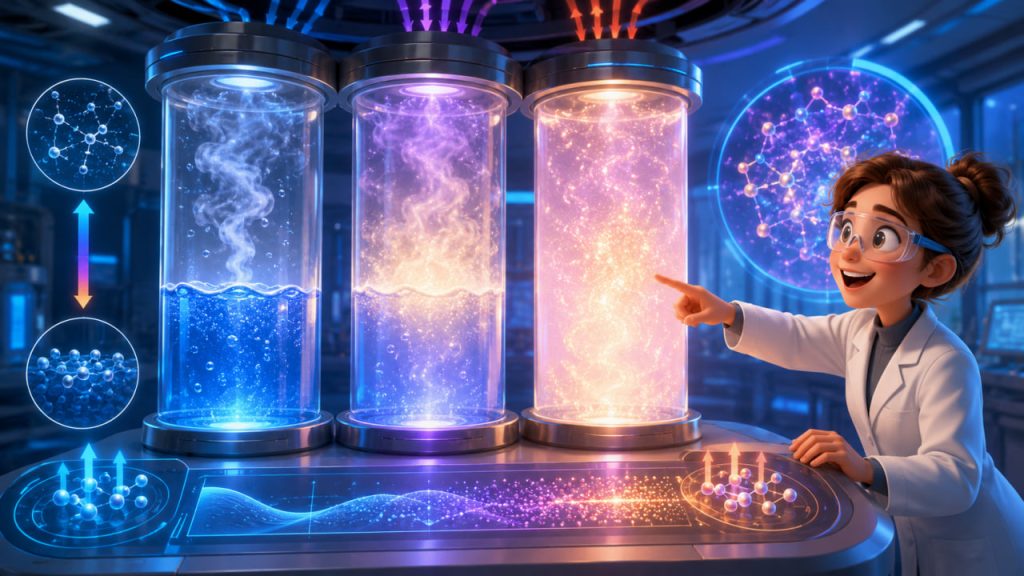
The critical point is the temperature and pressure where a liquid and its vapor become one continuous phase called a supercritical fluid.
This idea is central to physical chemistry, thermodynamics, geology, engineering, food processing, energy technology, and materials science.
What Is the Critical Point?
The critical point is a special condition where a substance reaches its critical temperature and critical pressure.
Below the critical temperature, a gas can be compressed into a liquid. This is why steam can condense into water if cooled or compressed properly.
Above the critical temperature, no amount of pressure can turn the gas into an ordinary liquid. Instead, the substance becomes a supercritical fluid.
At the critical point, liquid and vapor stop being separate phases.
There is no visible boundary between them. The density of the liquid decreases, the density of the vapor increases, and the two become indistinguishable.
In simple terms, the critical point is where the “liquid version” and “gas version” of a substance merge.
Liquid, Vapor, and Phase Boundaries
To understand the critical point, it helps to understand phase boundaries.
A phase boundary is a line of conditions where two states of matter coexist. For example, liquid water and water vapor can coexist at the boiling point.
At normal atmospheric pressure, water boils at 100°C. At that temperature, liquid water and steam can exist together. Add heat, and more liquid becomes vapor.
But boiling temperature changes with pressure.
At high pressure, water must reach a higher temperature before it boils. This is why pressure cookers can cook food faster: water inside them can become hotter than 100°C before boiling strongly.
If pressure and temperature keep rising together, the liquid-vapor boundary eventually ends.
That endpoint is the critical point.
The Critical Point of Water
Water’s critical point occurs at about 374°C and 22.1 megapascals of pressure.
That pressure is more than 200 times normal atmospheric pressure.
At this point, water is no longer clearly liquid or gas. It becomes supercritical water.
Supercritical water behaves in unusual ways. It can spread like a gas, dissolve some substances like a liquid, and participate in chemical reactions very differently from ordinary water.
This makes it useful in specialized technologies, including waste treatment, high-temperature chemistry, and studies of deep Earth conditions.
Water near its critical point is not the gentle liquid we drink. It is an extreme fluid with powerful chemical behavior.
What Is a Supercritical Fluid?
A supercritical fluid is a state of matter that exists beyond the critical temperature and critical pressure.
It is not a normal liquid and not a normal gas.
It can have gas-like and liquid-like properties at the same time.
A supercritical fluid can:
- Flow through small spaces like a gas
- Dissolve materials like a liquid
- Change density with pressure
- Diffuse faster than ordinary liquids
- Penetrate porous materials efficiently
This combination makes supercritical fluids extremely useful.
One of the most famous examples is supercritical carbon dioxide. It is used to decaffeinate coffee, extract flavors, clean materials, and perform greener chemical processes.
Why the Critical Point Looks Strange
At ordinary boiling, liquid and vapor are easy to distinguish.
Liquid is dense. Vapor is much less dense. A surface separates them.
Near the critical point, that difference fades.
The liquid becomes less dense because heat gives molecules more energy. The vapor becomes denser because high pressure forces molecules closer together.
Eventually, the two densities become equal.
At that moment, surface tension disappears. Without surface tension, there is no meaningful liquid surface. The substance becomes one uniform fluid phase.
The critical point is not a violent explosion or a magical transformation. It is the disappearance of difference between two phases.
Critical Opalescence
One of the most beautiful phenomena near the critical point is critical opalescence.
As a fluid approaches the critical point, tiny density fluctuations become very large. Small regions of the fluid briefly become denser or less dense than nearby regions.
These fluctuations scatter light strongly.
As a result, the fluid can appear cloudy, milky, or glowing with a bluish-white haze.
Critical opalescence is important because it reveals that the fluid is becoming unstable at many scales. Molecules are no longer behaving in a neatly uniform way.
This effect helped scientists understand the deep connection between thermodynamics, molecular motion, and phase transitions.
The Role of Pressure
Pressure is essential to the critical point.
If you heat an open pot of water, it simply boils away into steam. It will not become supercritical because pressure is not high enough.
To reach the critical point, the fluid must be held under high pressure.
This usually requires a sealed vessel or specialized industrial equipment.
That is why supercritical fluids are not everyday household states of matter, even though the science behind them applies to familiar substances like water and carbon dioxide.
Temperature alone is not enough. The critical point requires the right combination of temperature and pressure.
Expert Perspective
The study of critical points became a major part of thermodynamics in the 19th century. The physicist Thomas Andrews is especially associated with classic experiments on carbon dioxide that showed how liquid and gas could become indistinguishable above a critical temperature.
His work helped scientists understand that boiling and condensation are not always sharp transitions. Under the right conditions, a substance can move smoothly from gas-like to liquid-like behavior without crossing a visible phase boundary.
This insight changed how scientists viewed matter.
The critical point proved that the states of matter are not always separated by simple borders. Sometimes, the border itself disappears.
Why Critical Points Matter in Science
Critical points are important because they reveal how matter behaves under extreme conditions.
They help scientists understand molecular interactions, phase transitions, density fluctuations, and material properties.
Critical point research is useful in:
- Physical chemistry
- Chemical engineering
- Climate science
- Petroleum extraction
- Planetary science
- Materials processing
- Food and flavor extraction
- Environmental technology
In geology, fluids under high temperature and pressure move through rocks deep underground. These fluids can dissolve minerals, transport metals, and influence volcanic and hydrothermal systems.
In engineering, supercritical fluids can act as efficient solvents, coolants, or working fluids.
Supercritical Carbon Dioxide
Carbon dioxide has a much more accessible critical point than water: about 31°C and 7.38 megapascals.
Because this temperature is close to room temperature, supercritical CO₂ is widely used in industry.
It is popular because it is nonflammable, relatively inexpensive, and can be removed easily by reducing pressure.
Supercritical CO₂ is used for:
- Decaffeinating coffee
- Extracting essential oils
- Cleaning delicate materials
- Producing fine particles
- Supporting some green chemistry processes
- Advanced power-cycle research
Supercritical carbon dioxide is one of the most practical examples of critical-point science in daily life.
Critical Points Beyond Fluids
The idea of a critical point is not limited to liquid and vapor.
Similar concepts appear in magnetism, superconductivity, liquid mixtures, polymers, and even models of complex systems.
In many cases, a critical point marks a condition where a system changes behavior and large-scale fluctuations appear.
This is why critical phenomena are important across physics.
A fluid near its critical point can teach scientists about patterns that also appear in very different systems.
Why the Critical Point Is So Fascinating
The critical point is fascinating because it challenges the simple categories we use to understand matter.
A liquid seems obvious. A gas seems obvious. But under extreme conditions, nature refuses to keep them separate.
The critical point shows that matter is continuous, flexible, and deeply dependent on conditions.
It also shows why scientific definitions matter. A substance is not “just water” or “just carbon dioxide.” Its behavior depends on temperature, pressure, molecular motion, and the environment around it.
At the critical point, matter reveals that boundaries can vanish when conditions change.
Interesting Facts
- At the critical point, liquid and vapor have the same density.
- Surface tension disappears at the critical point.
- Supercritical carbon dioxide is used to remove caffeine from coffee.
- Water’s critical point occurs at much higher temperature and pressure than carbon dioxide’s.
- Near the critical point, fluids can become cloudy because of critical opalescence.
- Above the critical temperature, a gas cannot be liquefied by pressure alone.
- Supercritical fluids can behave partly like gases and partly like liquids.
- Critical-point science is important in chemistry, geology, engineering, and materials research.
- Deep underground fluids can reach high-temperature and high-pressure states similar to supercritical conditions.
- The critical point helped scientists understand that phase changes are more complex than simple boiling and condensation.
Glossary
- Critical Point — The temperature and pressure where liquid and vapor become indistinguishable.
- Critical Temperature — The highest temperature at which a substance can exist as a normal liquid.
- Critical Pressure — The pressure required to reach the critical point at the critical temperature.
- Supercritical Fluid — A fluid above its critical temperature and pressure, with both gas-like and liquid-like properties.
- Phase — A distinct form of matter, such as solid, liquid, gas, or supercritical fluid.
- Vapor — The gas-like form of a substance that can usually condense into liquid under suitable conditions.
- Phase Boundary — The line or condition where two phases coexist.
- Surface Tension — The tendency of a liquid surface to resist being stretched or broken.
- Density — Mass per unit volume.
- Critical Opalescence — Cloudiness near the critical point caused by strong density fluctuations.
- Thermodynamics — The science of heat, energy, temperature, pressure, and matter.
- Condensation — The process in which vapor becomes liquid.
- Boiling Point — The temperature at which a liquid turns into vapor at a given pressure.
- Supercritical Carbon Dioxide — Carbon dioxide above its critical temperature and pressure, often used as an industrial solvent.