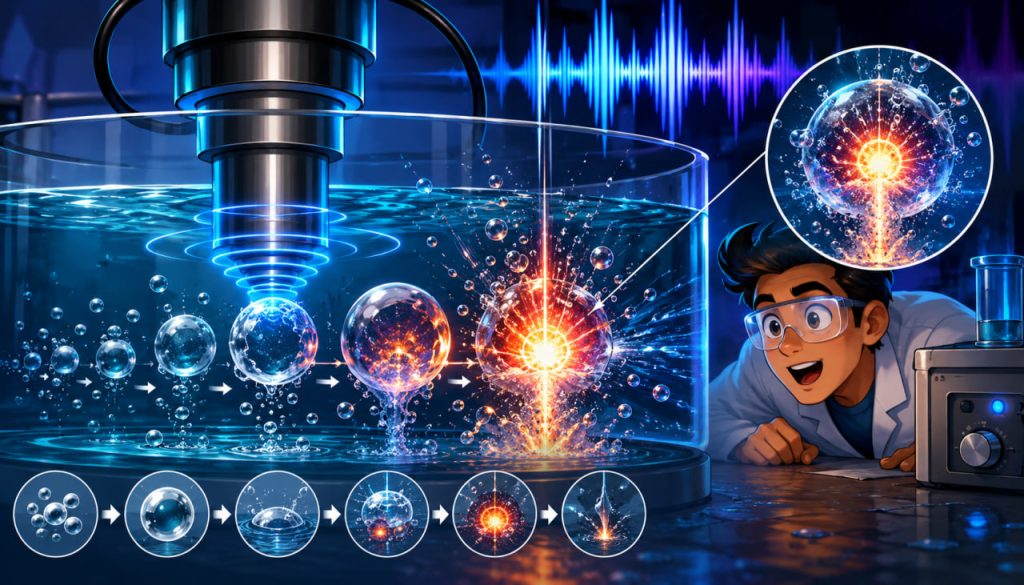
Ultrasonic cavitation sounds like science fiction: invisible sound waves move through a liquid, tiny bubbles appear, grow, and suddenly collapse so violently that they create extreme local conditions.
For a fraction of a second, inside a microscopic collapsing bubble, temperatures can reach thousands of degrees. In some experiments, estimates approach temperatures comparable to the surface of the Sun.
This does not mean the whole liquid becomes solar-hot. The extreme heat exists only in tiny, short-lived zones during bubble collapse.
Ultrasonic cavitation is powerful because it concentrates ordinary sound energy into microscopic bursts of heat, pressure, shock waves, and chemical activity.
What Is Ultrasonic Cavitation?
Ultrasonic cavitation is the formation, growth, and collapse of tiny bubbles in a liquid caused by ultrasonic sound waves.
Ultrasound means sound with a frequency higher than humans can normally hear. Human hearing usually reaches about 20 kilohertz. Ultrasonic devices often work above that range.
When ultrasound travels through a liquid, it creates alternating pressure cycles.
During high-pressure cycles, the liquid is compressed.
During low-pressure cycles, the liquid is stretched apart.
If the negative pressure becomes strong enough, small cavities or vapor bubbles can form in the liquid. These are cavitation bubbles.
The bubbles may oscillate, grow, split, merge, or collapse depending on the sound intensity, frequency, liquid properties, dissolved gases, and temperature.
Why Sound Can Create Bubbles
Liquids may look continuous, but at the microscopic level they contain tiny imperfections, dissolved gases, suspended particles, and weak spots.
When an intense sound wave passes through the liquid, the pressure does not stay constant. It rises and falls rapidly.
During the low-pressure part of the wave, the liquid can be pulled apart enough for a bubble to form or expand.
This does not happen easily in perfectly pure liquid, but real liquids usually contain nucleation sites where bubbles can begin.
Cavitation begins when sound creates pressure swings strong enough to overcome the liquid’s resistance to being pulled apart.
The bubble is not just empty space. It may contain vapor from the liquid, dissolved gas, or a mixture of both.
Stable Cavitation vs. Inertial Cavitation
There are two important types of cavitation.
Stable cavitation happens when bubbles oscillate repeatedly without collapsing violently. They expand and contract with the sound wave. This can create microstreaming, which means tiny fluid currents around the bubble.
Stable cavitation is useful in cleaning, mixing, and some biomedical applications.
Inertial cavitation, also called transient cavitation, is more dramatic. A bubble grows during low-pressure phases and then collapses suddenly during high-pressure compression.
This collapse can be extremely violent.
It can create shock waves, high-speed liquid jets, intense local pressure, and very high temperature inside the bubble.
The most famous “sun-like” conditions are associated with inertial cavitation.
What Happens During Bubble Collapse?
A cavitation bubble can grow to many times its original size. Then the surrounding liquid pressure forces it inward.
As the bubble collapses, its contents are compressed rapidly.
Compression raises temperature. This is similar to how air heats up when compressed, but the cavitation bubble collapse is far faster and more concentrated.
At the final stage, the bubble may shrink to a tiny fraction of its maximum size. The gas and vapor inside can reach extreme temperatures and pressures for an incredibly short time.
A cavitation bubble acts like a microscopic energy concentrator. It takes sound energy spread through liquid and focuses it into a tiny collapsing volume.
This is why cavitation can produce chemical reactions, surface erosion, and even flashes of light.
Sonoluminescence: Light From Collapsing Bubbles
One of the most fascinating cavitation phenomena is sonoluminescence.
Sonoluminescence occurs when collapsing bubbles emit tiny flashes of light.
This light is extremely brief, often lasting only a fraction of a billionth of a second. Scientists have studied it for decades because it shows how violent bubble collapse can become.
The exact details are complex, but the general idea is that the bubble collapse heats and excites the gas inside. As the energy is released, light appears.
This is one of the clearest visual signs that cavitation is not a gentle process.
A liquid that appears calm can contain microscopic bubbles producing intense bursts of energy.
Can Cavitation Really Reach the Temperature of the Sun?
This statement needs careful explanation.
The surface of the Sun is about 5,500°C. During violent cavitation collapse, local bubble interiors may reach temperatures of several thousand degrees Celsius, and some estimates in specific conditions approach or exceed solar-surface levels.
However, this does not mean the liquid becomes hot like the Sun.
The hot zone is extremely tiny. The event is extremely brief. The surrounding liquid remains much cooler because the energy is localized and quickly dissipated.
Cavitation can create Sun-like temperatures locally, but only inside microscopic collapsing bubbles for incredibly short moments.
This is why cavitation can drive chemical reactions without boiling the entire liquid.
Cavitation and Sonochemistry
Ultrasonic cavitation is central to sonochemistry, the use of sound to influence chemical reactions.
When bubbles collapse, they can split molecules apart, create reactive radicals, and accelerate reactions that would normally require harsh conditions.
For example, in water, cavitation can generate hydroxyl radicals. These are highly reactive chemical species that can help break down pollutants or support advanced oxidation processes.
Sonochemistry is used or studied for:
- Water treatment
- Nanoparticle synthesis
- Emulsification
- Polymer processing
- Chemical extraction
- Surface modification
- Green chemistry
Ultrasound can act like a chemical tool because collapsing bubbles create tiny hot reactors inside the liquid.
Ultrasonic Cleaning
One of the most familiar uses of cavitation is ultrasonic cleaning.
Jewelry, medical instruments, precision parts, lenses, laboratory glassware, and electronic components can be cleaned using ultrasonic baths.
The device sends ultrasonic waves through a cleaning liquid. Cavitation bubbles form and collapse near surfaces.
When bubbles collapse close to a solid surface, they can produce tiny liquid jets and shock waves that remove dirt, oil, dust, and contaminants.
This method is useful because it can reach small cracks, holes, and complex shapes that brushes cannot clean easily.
Cavitation in Medicine
Ultrasonic cavitation also has medical and biomedical applications.
In diagnostic ultrasound, cavitation is usually controlled carefully because unwanted bubble collapse can damage tissue. But in some treatments, cavitation is intentionally used.
Focused ultrasound can target tissue with precision. Microbubbles may be used to improve drug delivery, open biological barriers temporarily, or enhance imaging.
Cavitation is also studied in cancer therapy, kidney stone treatment, and non-invasive medical procedures.
The key is control. Cavitation can be useful or harmful depending on intensity, location, and exposure time.
In medicine, cavitation is powerful because it can concentrate mechanical effects in tiny regions.
Cavitation Can Also Be Destructive
Cavitation is not always helpful.
In pumps, ship propellers, turbines, pipes, and hydraulic systems, cavitation can cause serious damage.
When bubbles collapse near metal surfaces, they can create microjets and shock waves that repeatedly strike the material. Over time, this can pit, erode, and weaken surfaces.
This is why engineers work hard to prevent uncontrolled cavitation in machinery.
The same phenomenon that cleans jewelry can damage propellers.
The difference is whether cavitation is controlled and used for a purpose or uncontrolled and destructive.
Expert Perspective
Physicist Lord Rayleigh made one of the classic early theoretical studies of bubble collapse in liquids after investigating cavitation damage. His work helped establish that collapsing cavities can generate enormous pressures.
Later research in acoustics, fluid dynamics, and sonochemistry expanded this idea, showing that cavitation is not merely a mechanical curiosity but a powerful physical process with chemical and technological consequences.
The expert lesson is clear: a bubble in liquid can become a microscopic laboratory where pressure, heat, chemistry, and fluid motion meet.
Why Ultrasonic Cavitation Matters
Ultrasonic cavitation matters because it transforms sound into action.
Sound waves usually seem harmless. But when they are intense enough and pass through a liquid under the right conditions, they can create bubbles that collapse with remarkable force.
This makes cavitation useful in cleaning, medicine, chemistry, food processing, materials science, environmental technology, and nanotechnology.
It also teaches a deeper scientific lesson.
Energy does not need to be large in total to be powerful. If it is concentrated into a tiny enough space and time, it can produce extreme effects.
Ultrasonic cavitation is the science of small bubbles with enormous consequences.
Interesting Facts
- Ultrasonic cavitation happens at sound frequencies above normal human hearing.
- Cavitation bubbles can grow and collapse in less than a millisecond.
- Bubble collapse can create tiny shock waves and high-speed liquid jets.
- Sonoluminescence is light emitted by collapsing bubbles.
- Local bubble temperatures can reach thousands of degrees.
- Ultrasonic cleaning uses cavitation to remove dirt from tiny surface details.
- Cavitation can damage ship propellers, pumps, and turbines.
- In medicine, controlled cavitation may help with imaging, drug delivery, and focused ultrasound therapies.
- Cavitation can produce reactive chemical species such as hydroxyl radicals.
- A single collapsing bubble can act like a microscopic high-temperature reactor.
Glossary
- Ultrasonic Cavitation — The formation and collapse of tiny bubbles in liquid caused by ultrasonic sound waves.
- Ultrasound — Sound with a frequency above the normal human hearing range.
- Cavitation Bubble — A small vapor or gas-filled cavity formed in a liquid under changing pressure.
- Stable Cavitation — Bubble oscillation without violent collapse.
- Inertial Cavitation — Rapid bubble growth followed by violent collapse.
- Pressure Cycle — Repeating high-pressure and low-pressure phases in a sound wave.
- Nucleation Site — A tiny imperfection, particle, or gas pocket where a bubble can begin forming.
- Sonoluminescence — Light emitted by collapsing cavitation bubbles.
- Sonochemistry — The use of ultrasound and cavitation to influence chemical reactions.
- Microstreaming — Tiny fluid motion created around oscillating bubbles.
- Shock Wave — A sudden pressure wave produced by rapid energy release.
- Microjet — A tiny high-speed stream of liquid created when a bubble collapses near a surface.
- Hydroxyl Radical — A highly reactive chemical species often formed during cavitation in water.
- Focused Ultrasound — Ultrasound directed precisely at a target region, often used in medical research and treatment.