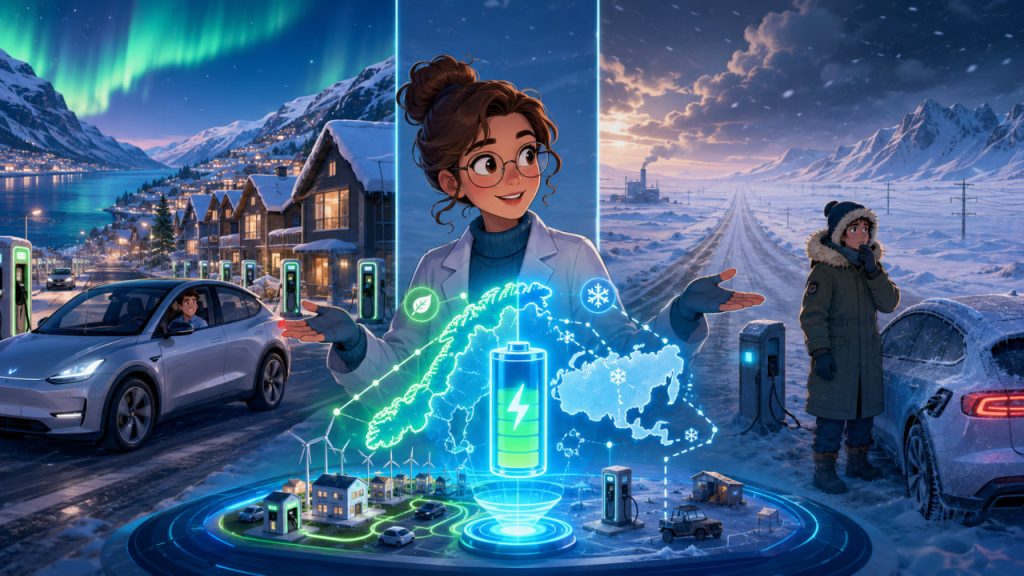
Electric cars are often criticized for winter range loss, slow charging in freezing weather, and battery performance problems. Yet Norway, one of the coldest countries in Europe, has become the world’s leading electric vehicle market.
This creates an obvious question: if electric cars can succeed in Norway, why are they still far less popular in Siberia?
The answer is not simply temperature. Cold matters, but it is only one part of the story. The real difference is a combination of policy, income, charging infrastructure, electricity prices, road networks, vehicle supply, climate severity, and public trust.
Cold Weather Really Does Affect Electric Cars
Electric vehicles lose efficiency in winter because batteries and people both dislike extreme cold.
Lithium-ion batteries work through chemical reactions. When temperatures drop, these reactions slow down. The car also needs energy to heat the cabin, warm the battery, defrost windows, and maintain safe operating conditions.
The U.S. Department of Energy explains that cold temperatures can reduce EV range and increase charging time, especially when the vehicle is not preconditioned before driving. It recommends warming the cabin and battery while the car is still plugged in to preserve driving range.
Winter does not make electric cars useless. It makes planning, charging access, and vehicle quality much more important.
A modern EV with a heat pump, battery preconditioning, good insulation, and reliable charging can handle winter far better than an older imported model with limited range.
Why Norway Became an EV Success Story
Norway did not become electric by accident.
For years, the country used strong financial incentives to make electric cars more attractive than petrol and diesel cars. Norway taxed combustion-engine vehicles heavily while giving electric cars major advantages.
The Norwegian government reports that electric vehicles held an 88% share of Norway’s new passenger car market at the end of 2024, and EVs made up 28% of the total passenger car fleet.
By 2025, Norway’s transition went even further. The International Energy Agency reported that about 97% of new car sales in Norway were electric in 2025, making it the global leader by sales share.
Norway proved that cold weather is not the main barrier to EV adoption. A weak ecosystem is.
Norwegian drivers bought EVs because the entire system pushed them in that direction.
Incentives Changed the Math
Electric cars are usually more expensive upfront than comparable petrol cars, especially in markets without subsidies or tax benefits.
Norway changed the price equation.
EVs received exemptions or reductions from major vehicle taxes, and some user benefits also made them more convenient. According to the Norwegian government, local authorities can charge EVs no more than 70% of the full toll road rate, and many areas have allowed EVs to use bus lanes.
Norway also applies VAT rules that favor electric vehicles. As of recent rules, electric vehicles with a value up to NOK 300,000 are exempt from VAT, while only the amount above that threshold is taxed.
When an EV becomes cheaper to buy, cheaper to drive, and easier to use, cold weather becomes a manageable inconvenience rather than a deal-breaker.
Charging Infrastructure Makes Winter Livable
An electric car is only as practical as the charging network around it.
Norway invested early in public charging and encouraged market-driven charging development. The government has reported more than 20,000 publicly available charging points, including more than 5,000 fast charging points.
This matters greatly in winter. If a driver loses range in cold weather but has reliable chargers nearby, the problem is manageable. If chargers are rare, broken, slow, or far apart, the same range loss becomes stressful.
Norway did not defeat range anxiety with battery technology alone. It defeated it with infrastructure.
Drivers trust EVs when charging is predictable.
Why Siberia Is a Harder Case
Siberia has several challenges that Norway does not face in the same way.
First, Siberia is vast. Distances between cities, towns, villages, and service points can be enormous. Long road trips in very cold weather require reliable fast chargers along highways, not only in big cities.
Second, winter conditions can be more severe. Many Siberian regions experience temperatures far below typical coastal Norwegian winter conditions. At extremely low temperatures, range loss becomes more serious, charging can be slower, and battery preconditioning becomes essential.
Third, incomes, vehicle prices, and financing options matter. If an EV is expensive to buy and repair, people will choose familiar petrol cars that have known maintenance networks.
Fourth, fuel habits are deeply established. In many regions, drivers trust combustion engines because they understand how to repair them, refuel them, and use them in remote areas.
In Siberia, the problem is not only cold. It is cold plus distance plus infrastructure gaps plus economics.
Russia’s EV Market Is Still Small
Russia’s electric vehicle market has grown, but it remains tiny compared with Norway.
AUTOSTAT reported that 17,805 new electric cars were sold in Russia in 2024, while EV share in total new passenger car sales declined from 1.3% in 2023 to 1.1% in 2024.
By mid-2025, AUTOSTAT reported 65,200 registered electric vehicles in the Russian Federation. That is growth, but it remains small for a country with Russia’s population, distances, and total vehicle fleet.
Charging infrastructure is also developing, but it is still uneven. AUTOSTAT reported about 6,500 public EV charging stations in Russia as of October 2025.
For a compact country, that number might sound large. For Russia, it is still limited when spread across huge territory.
Vehicle Choice Matters
Norway’s EV boom happened with a wide selection of new electric cars from major global brands, including models designed for cold climates.
Many Norwegian EVs come with heat pumps, battery thermal management, winter tires, preconditioning systems, and software that helps drivers plan charging.
In Russia and Siberia, the market has often depended more heavily on imported vehicles, Chinese brands, used cars, parallel imports, and uneven service availability. Reuters has described Russia’s EV sector as small but growing, with Chinese automakers becoming dominant after Western carmakers reduced or exited operations.
A driver in Norway may buy an EV with official dealer support, predictable warranty service, and charging integration. A driver in Siberia may worry about parts, diagnostics, battery repair, resale value, and winter reliability.
People do not buy technology only because it exists. They buy it when support systems make it trustworthy.
Electricity Is an Advantage Only When Access Is Easy
Electric cars can be cheaper to run than petrol cars when electricity is affordable and charging is convenient.
Norway benefits from abundant electricity, much of it from hydropower, and a national policy environment that supports electrification.
Siberia also has energy resources, but household charging access, grid connection, public chargers, apartment parking, payment systems, service points, and highway coverage are not equally convenient everywhere.
For an EV owner, the most important question is not theoretical electricity production. It is practical access: can I charge where I live, where I work, and where I travel?
If the answer is uncertain, buyers hesitate.
Expert Perspective
Energy and transport experts often emphasize that EV adoption depends on an ecosystem, not just the car itself.
The International Energy Agency notes that access to public charging is key to supporting mass EV adoption, even though home charging remains the most popular option for many owners.
That view explains the Norway-Siberia contrast clearly. Cold weather can be solved with good cars, home charging, fast chargers, incentives, and driver education. But without those pieces, cold weather becomes a powerful argument against EVs.
What Could Make EVs More Popular in Siberia?
Electric cars could become more practical in Siberia if several conditions improve.
The biggest changes would include:
- More reliable fast chargers between cities
- Better home and workplace charging
- EVs with larger batteries and heat pumps
- Battery preconditioning as a standard feature
- Local service centers and spare parts
- Affordable winter-ready models
- Clear incentives and lower ownership costs
- Better public information about winter EV use
Hybrid vehicles may also play a transitional role because they reduce fuel use while keeping a combustion engine for long, remote winter trips.
Siberia does not need to copy Norway exactly. It needs an EV model designed for its own geography and climate.
Interesting Facts
- Cold weather affects petrol cars too, but EV range loss is more visible because drivers track battery percentage closely.
- Heat pumps can reduce winter energy use compared with simple resistance heating.
- Preheating an EV while plugged in helps save battery energy for driving.
- Norway’s success came from taxes, incentives, infrastructure, and public trust working together.
- Siberia’s main EV challenge is not only low temperature, but also long distances and uneven charging access.
- Used EVs with small batteries are much harder to use in extreme winter than newer long-range models.
- A garage or protected parking space can make EV ownership much easier in cold regions.
Glossary
- Electric Vehicle — A vehicle powered by an electric motor and a rechargeable battery.
- Battery Electric Vehicle — A fully electric vehicle with no petrol or diesel engine.
- Range Loss — The reduction in driving distance caused by cold, speed, heating, terrain, or battery condition.
- Preconditioning — Heating or cooling the battery and cabin before driving or fast charging.
- Heat Pump — An efficient heating system that helps warm an EV cabin while using less battery energy.
- Fast Charger — A high-power charging station that can recharge an EV much faster than a regular outlet.
- Charging Infrastructure — The network of home, workplace, public, and highway chargers.
- Range Anxiety — Fear that an electric vehicle will run out of battery before reaching a charger.
- Thermal Management — Systems that keep the battery at a safe and efficient temperature.
- Total Cost of Ownership — The full cost of owning a vehicle, including purchase price, fuel or electricity, maintenance, taxes, insurance, and resale value.