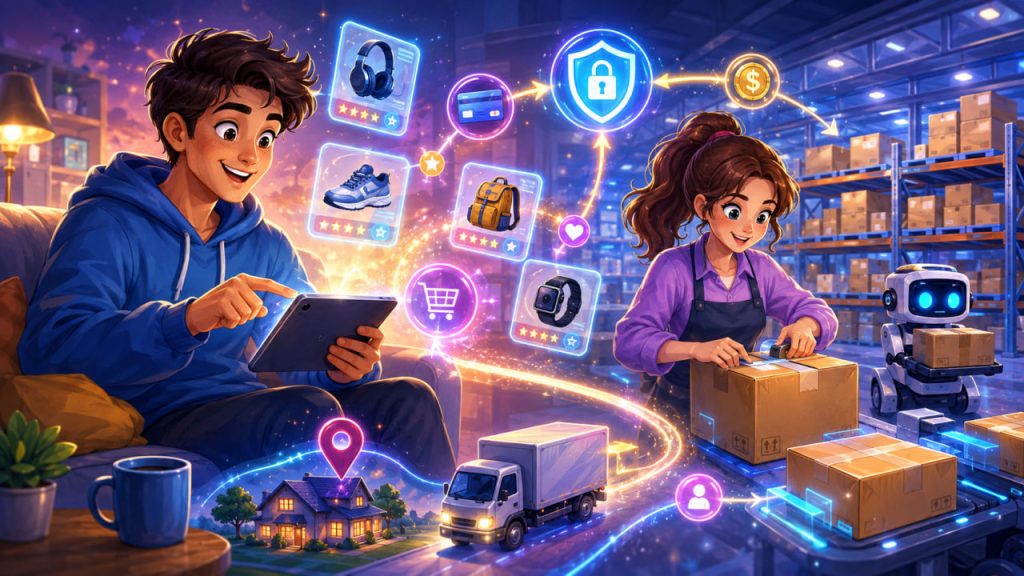
Modern marketplaces are the invisible engines behind much of today’s online shopping. When people buy clothes, electronics, handmade goods, food, books, home items, or digital services online, they are often not buying directly from one single store. They are using a marketplace.
A marketplace is a digital platform that connects buyers and sellers in one place. The platform does not always own the products. Instead, it provides the technology, traffic, payment system, rules, delivery tools, advertising options, and trust mechanisms that make online trade possible at massive scale.
Modern marketplaces are not just websites. They are ecosystems where technology, logistics, data, sellers, buyers, and financial services work together.
What Is a Modern Marketplace?
A modern marketplace is an online platform where many independent sellers can offer products or services to many customers.
Unlike a traditional online store, which usually sells its own inventory, a marketplace allows third-party sellers to list their goods. The platform then helps customers search, compare, pay, receive orders, and sometimes return products.
Examples of marketplace models include:
- Product marketplaces
- Service marketplaces
- Food delivery marketplaces
- Travel marketplaces
- Freelance marketplaces
- Digital product marketplaces
- B2B marketplaces
The basic idea is simple: the platform creates the environment, while sellers provide supply and customers create demand.
This structure allows marketplaces to grow quickly because they do not need to manufacture or own every product listed on the site.
The Three Main Participants
Every marketplace depends on three key groups.
The first group is buyers. They come to the platform looking for convenience, variety, competitive prices, fast delivery, reviews, and secure payments.
The second group is sellers. They join the platform to reach a large audience without building their own e-commerce infrastructure from zero.
The third group is the marketplace operator. This is the company that owns and manages the platform. It controls the rules, ranking algorithms, payment processing, commissions, data systems, customer experience, and dispute procedures.
A successful marketplace must keep all three groups satisfied. If buyers leave, sellers lose revenue. If sellers leave, buyers lose choice. If the platform loses trust, the entire system weakens.
How Sellers List Products
For sellers, the marketplace usually begins with registration.
A seller creates an account, verifies business information, uploads product details, sets prices, adds images, chooses shipping options, and agrees to platform policies.
A strong product listing usually includes:
- Product title
- Description
- Images
- Price
- Category
- Specifications
- Availability
- Delivery options
- Return rules
The marketplace may review listings automatically or manually to prevent prohibited products, misleading claims, unsafe items, or duplicate pages.
Good listings are important because the marketplace search engine depends on structured information. If a seller writes unclear titles or incomplete descriptions, the product may appear lower in search results.
How Search and Ranking Work
Search is one of the most important parts of any marketplace.
When a customer types a query, the platform must decide which products to show first. This decision is rarely random. It is usually based on a ranking algorithm.
The algorithm may consider:
- Keyword relevance
- Product category
- Price
- Customer reviews
- Seller rating
- Delivery speed
- Stock availability
- Return rate
- Conversion rate
- Advertising bids
- Customer behavior
For example, if two sellers offer similar products, the marketplace may rank the one with better reviews, faster delivery, clearer images, and a stronger sales history higher.
The marketplace does not only show what exists. It decides what becomes visible.
This is why sellers often invest heavily in product optimization, reviews, pricing, and advertising.
Payments and Commissions
Modern marketplaces simplify payments for buyers and sellers.
The buyer usually pays the platform, not the seller directly. The marketplace processes the transaction, protects payment data, calculates fees, and then transfers money to the seller after certain conditions are met.
The platform may earn money through:
- Sales commissions
- Listing fees
- Subscription plans
- Advertising
- Payment processing fees
- Fulfillment services
- Premium seller tools
- Data and analytics services
Commissions vary depending on category, product type, seller status, and platform policy.
This model works because the seller receives access to customers, infrastructure, payment tools, and trust. The marketplace receives revenue for enabling the transaction.
Logistics and Fulfillment
Logistics is where modern marketplaces become especially powerful.
Some marketplaces allow sellers to ship products themselves. Others offer fulfillment services, where sellers send inventory to marketplace warehouses. The platform then stores, packs, ships, tracks, and sometimes handles returns.
Fulfillment services can improve delivery speed and customer satisfaction. They also give the marketplace more control over quality.
A typical fulfillment process may include:
- Inventory storage
- Order processing
- Packing
- Shipping label creation
- Delivery tracking
- Returns management
Fast and predictable delivery has become one of the biggest competitive advantages in e-commerce.
For many customers, the delivery experience is part of the product.
A cheap item with slow, unreliable shipping may lose to a slightly more expensive item that arrives quickly and safely.
Reviews, Ratings, and Trust
Trust is the heart of any marketplace.
Customers often buy from sellers they have never met. They need signals that help them decide whether a product is reliable.
Reviews and ratings provide social proof. They show whether previous buyers were satisfied with the item, delivery, packaging, and seller communication.
Marketplaces also use trust systems such as:
- Verified purchases
- Seller ratings
- Refund policies
- Buyer protection
- Dispute resolution
- Product authenticity checks
- Fraud detection
- Identity verification
These systems reduce risk and make customers more willing to buy.
However, reviews can also create challenges. Fake reviews, review manipulation, unfair negative ratings, and paid feedback can damage marketplace credibility. That is why large platforms invest in moderation and fraud detection.
Advertising Inside Marketplaces
Modern marketplaces are also advertising platforms.
Sellers compete not only through price and quality, but also through visibility. Sponsored product placements allow sellers to appear higher in search results or category pages.
Marketplace advertising is attractive because shoppers are already close to buying. Unlike general social media ads, marketplace ads appear in a buying environment.
A customer searching for “wireless headphones” is already showing strong purchase intent. A seller who appears at the right moment has a better chance of making a sale.
This creates a new challenge: organic visibility may become harder when many competitors pay for advertising.
In modern marketplaces, success often depends on both product quality and visibility strategy.
Data and Personalization
Marketplaces collect large amounts of data about browsing, searching, buying, returns, reviews, prices, and seller performance.
This data helps platforms personalize the shopping experience.
A customer may see recommendations based on previous purchases, location, price preferences, search history, and similar users’ behavior.
Sellers may receive analytics about impressions, clicks, conversion rates, inventory levels, and advertising performance.
Data also helps the platform detect fraud, predict demand, optimize logistics, and improve search results.
The challenge is privacy. Modern marketplaces must balance personalization with responsible data handling and transparent user protection.
Why Marketplaces Are So Powerful
Marketplaces benefit from network effects.
The more buyers join, the more attractive the platform becomes for sellers. The more sellers join, the more attractive the platform becomes for buyers.
This creates a growth loop.
A marketplace with many sellers offers more choice. More choice attracts more buyers. More buyers attract more sellers. Over time, the platform becomes harder to compete with.
This is why leading marketplaces can become dominant in their categories.
But scale also creates responsibility. Large marketplaces must manage counterfeit goods, unsafe products, seller disputes, unfair competition, delivery pressure, and customer protection.
Expert Perspective
E-commerce experts often describe marketplaces as trust-based infrastructure rather than simple online catalogs.
Peter Fader, a well-known marketing professor associated with customer analytics, has emphasized the importance of understanding customer behavior and lifetime value in modern commerce. This idea is especially relevant for marketplaces because platforms do not only process one-time purchases. They try to build repeat relationships between customers, sellers, and the marketplace itself.
The strongest marketplaces understand that long-term customer trust is more valuable than short-term transaction volume.
If customers believe the platform is safe, convenient, and fair, they return. If sellers believe the platform offers real opportunity, they invest more effort into product quality and service.
The Future of Marketplaces
The future of marketplaces will likely become more automated, personalized, and service-oriented.
Artificial intelligence will improve search, recommendations, fraud detection, customer support, pricing tools, and seller analytics. Augmented reality may help customers preview furniture, clothing, cosmetics, and home goods before buying.
Logistics will continue to evolve through smart warehouses, robotics, local fulfillment centers, electric delivery vehicles, and faster returns processing.
Marketplaces may also become more specialized. Instead of only giant platforms selling everything, there will be more niche marketplaces for sustainable products, professional services, local goods, luxury resale, digital assets, and B2B trade.
The biggest challenge will be trust. Customers will expect authenticity, fair prices, safe products, transparent delivery, and responsible data use.
The marketplace of the future will not win only by having the most products. It will win by making buying and selling feel simple, safe, fast, and intelligent.
Interesting Facts
- A marketplace can grow faster than a traditional store because it does not need to own every product it sells.
- Reviews are one of the most powerful trust signals in online shopping.
- Marketplace search algorithms can strongly influence which sellers succeed.
- Many large marketplaces earn significant revenue from advertising, not only from sales commissions.
- Fast delivery has become a major part of customer satisfaction.
- Network effects make successful marketplaces increasingly difficult to compete with.
- Some marketplaces now offer sellers warehousing, payment tools, loans, analytics, and advertising in one ecosystem.
- The same marketplace can serve as a store, search engine, payment processor, logistics network, and advertising platform.
Glossary
- Marketplace — An online platform where multiple sellers offer products or services to customers.
- Seller — A person or business that lists and sells goods or services through a marketplace.
- Listing — A product or service page that contains images, description, price, and purchase details.
- Algorithm — A system of rules or calculations used by a platform to rank, recommend, or process information.
- Commission — A fee the marketplace takes from a sale.
- Fulfillment — The process of storing, packing, shipping, and sometimes returning products.
- Conversion Rate — The percentage of visitors who complete a desired action, such as making a purchase.
- Sponsored Product — A paid advertisement that promotes a product inside marketplace search results or category pages.
- Network Effect — A situation where a platform becomes more valuable as more people use it.
- Personalization — The use of data to show users more relevant products, recommendations, or offers.
- Buyer Protection — Policies that help customers receive refunds, replacements, or support when something goes wrong.
- B2B Marketplace — A marketplace where businesses sell products or services to other businesses.