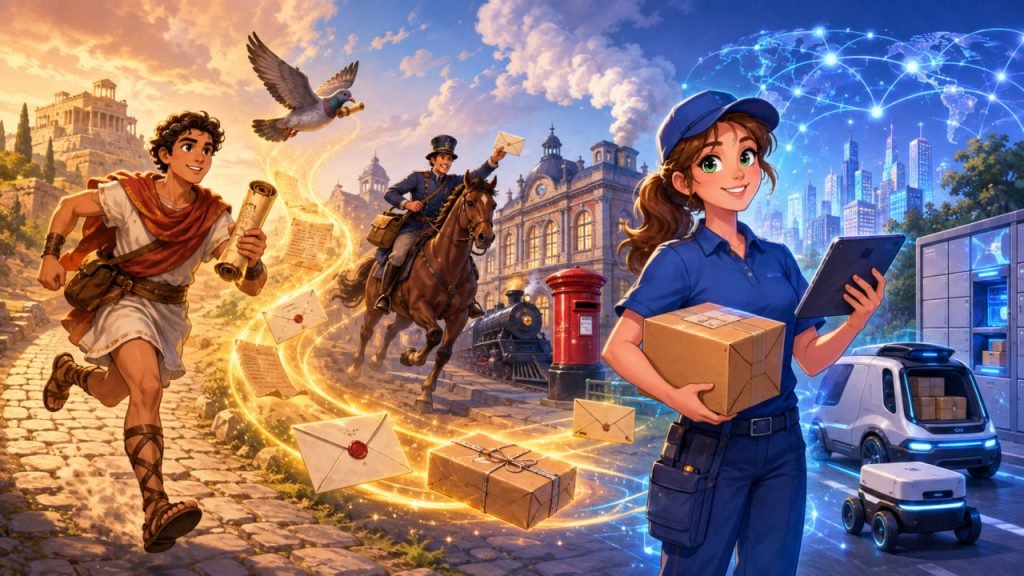
Mail is one of the oldest communication systems in human history. Long before phones, email, and instant messaging, people needed reliable ways to send orders, news, trade information, personal messages, and official documents across distance.
The story of mail is not only about letters. It is about power, trust, trade, technology, and connection.
From royal couriers on horseback to global parcel tracking, the postal system has constantly evolved with civilization. Every major improvement in transportation, government, commerce, and communication has changed how people send and receive information.
The Earliest Forms of Mail
The first mail systems were not created for ordinary people. They were created for rulers.
Ancient kings, emperors, and military leaders needed fast communication across large territories. Orders had to reach governors, armies, tax collectors, and distant cities.
Early messages were often carried by runners, riders, boatmen, or relay messengers. These systems were expensive and usually controlled by the state.
In the ancient world, mail was a tool of government before it became a public service.
Some of the earliest organized courier networks appeared in ancient Egypt, Persia, China, India, Greece, and Rome. These systems allowed large states to function more effectively because decisions could travel faster than before.
The Persian Royal Road
One of the most famous ancient communication networks was the Persian courier system.
The Achaemenid Persian Empire developed a road and relay system that helped connect its enormous territory. The Royal Road allowed official messengers to move across long distances using fresh horses and rest stations.
Instead of one courier traveling the entire route, messages could be passed through a chain of riders. This made delivery much faster and more reliable.
The Greek historian Herodotus admired the speed of Persian messengers and described how they continued their work despite snow, rain, heat, or darkness.
This idea later became strongly associated with postal service dedication, even though the famous phrase was not originally a modern postal motto.
Mail in Ancient Rome
The Roman Empire also built an advanced state communication system.
Its official courier network, known as the cursus publicus, used roads, stations, horses, carriages, and official authorization documents. It helped Roman authorities send administrative orders, military instructions, tax information, and government reports.
Rome’s success depended partly on roads. The empire’s famous road network made it easier to move soldiers, goods, and messages.
However, Roman mail was not a public postal service in the modern sense. It primarily served the state and its officials.
Still, it showed an important principle: a strong postal system requires strong infrastructure.
Medieval Messengers and Trade Routes
After the fall of the Western Roman Empire, communication systems in Europe became more fragmented.
Kings, nobles, monasteries, universities, merchants, and city governments used their own messengers. Letters were carried by riders, travelers, monks, traders, and professional couriers.
In the Islamic world, the barid system helped rulers communicate across vast territories. It supported administration, intelligence gathering, and official transport.
Meanwhile, trade networks also shaped mail history. Merchants needed to send contracts, prices, shipping details, and financial instructions. As commerce expanded, reliable communication became more valuable.
Large trading families and organizations developed courier routes that connected important economic centers.
The Rise of Organized Postal Services
The transition from private messengers to organized postal services happened gradually.
In Europe, the Thurn und Taxis family became famous for operating one of the most important postal networks from the late medieval period into the early modern era. Their routes connected many parts of Europe and served rulers, merchants, and institutions.
As centralized states grew stronger, governments began to see postal systems as strategic assets.
Control over mail meant control over information. It helped states collect taxes, manage armies, regulate trade, and monitor political activity.
Over time, more postal systems became officially managed or licensed by governments.
The Birth of Public Mail
A major turning point came when postal services became more available to ordinary people.
At first, sending letters was expensive. Fees were often based on distance, number of sheets, and delivery complexity. In many places, the recipient paid the postage, which could make letters inconvenient or unwanted.
The introduction of prepaid postage changed everything.
In Britain, the Penny Post reform of 1840 made sending letters cheaper and simpler. The famous Penny Black, one of the world’s first adhesive postage stamps, allowed senders to prepay delivery.
This reform helped transform mail from an elite service into a mass communication system.
Affordable postage made personal letter writing part of everyday life.
Families, friends, businesses, migrants, soldiers, and lovers could communicate across distance more easily than ever before.
Railways, Steamships, and Global Mail
The 19th century brought a transportation revolution.
Railways allowed mail to move faster across countries. Steamships connected continents more reliably than sailing ships. Postal sorting became more organized, and schedules became more predictable.
Mail trains became a symbol of speed and modernity. In some systems, workers sorted letters inside moving railway cars, reducing delivery time.
International mail also became more important as migration, colonial empires, global trade, and diplomacy expanded.
As more letters crossed borders, countries needed common rules. This led to the creation of international postal agreements and eventually the Universal Postal Union in the 19th century.
The goal was simple but powerful: make international mail easier, more standardized, and more dependable.
Mail in the Age of Telegraph and Telephone
The telegraph changed communication dramatically.
For the first time, messages could travel faster than any horse, ship, or train. Later, the telephone made real-time voice communication possible.
Yet mail did not disappear.
Instead, it changed its role. Telegraphs and phones were useful for urgent messages, but letters remained important for personal communication, business records, legal documents, packages, magazines, newspapers, and official notices.
New communication technology rarely destroys older systems completely. It forces them to specialize.
Mail continued to provide physical proof, privacy, portability, and access for people who did not use newer technologies.
Airmail and the Speed of the 20th Century
The 20th century added the airplane to postal history.
Airmail made long-distance communication much faster, especially between countries and continents. What once took weeks by ship could eventually take days by aircraft.
During this period, postal services became large national institutions. They handled letters, parcels, money orders, savings services, government forms, and public information.
The post office was often more than a delivery center. In many communities, it was a trusted public space.
Stamps also became cultural objects. They showed national leaders, scientific achievements, wildlife, historical events, art, and symbols of identity.
The Digital Challenge
Email, mobile phones, and messaging apps created the biggest communication shift since the telegraph.
Personal letters declined sharply in many countries. Bills, bank statements, invitations, and business messages moved online.
For a time, many people assumed postal services would become obsolete.
But the rise of e-commerce changed the story.
As letters declined, parcels grew. Online shopping turned postal and delivery networks into essential parts of modern retail. People may send fewer handwritten letters, but they receive more packages.
The modern postal system now combines physical delivery with digital tools such as tracking numbers, automated sorting, smart lockers, delivery apps, and electronic notifications.
Expert Perspective
Postal historians often emphasize that mail systems succeed when they combine trust, infrastructure, and standardization.
Rowland Hill, the British postal reformer behind the Penny Post, understood that a simple and affordable system could dramatically increase communication. His reforms showed that when sending mail becomes cheap and predictable, society uses it more.
That lesson remains relevant today. Modern postal services must still be affordable, reliable, and easy to use, even when the technology behind them becomes more complex.
Modern Mail and the Future
Today, mail is entering another transformation.
The future postal system will likely include electric delivery vehicles, AI-based route planning, smart parcel lockers, digital identity services, secure electronic mailboxes, drone experiments, and more sustainable logistics.
Traditional letters will probably continue to decline, but physical delivery will remain important because people still need medicines, documents, goods, returns, official notices, and trusted services.
The postal system began as a tool for kings and empires. It became a public service for citizens. Now it is becoming a hybrid network that connects homes, businesses, governments, and digital platforms.
The history of mail proves one thing clearly: communication methods change, but the human need to connect across distance never disappears.
Interesting Facts
- Ancient courier systems were often reserved for rulers, military leaders, and officials.
- The Persian Royal Road helped messages travel quickly across a huge empire.
- Roman postal infrastructure depended heavily on roads and relay stations.
- The Penny Black, introduced in Britain in 1840, became one of the most famous stamps in history.
- Railways made mail faster and allowed letters to be sorted while trains were moving.
- Airmail transformed international communication in the 20th century.
- Email reduced personal letter writing, but online shopping increased parcel delivery.
- Modern postal systems often handle both physical delivery and digital services.
Glossary
- Courier — A person who carries messages, documents, or packages.
- Relay System — A delivery method where messages pass between multiple riders or stations.
- Royal Road — An ancient Persian route used for travel, administration, and official communication.
- Cursus Publicus — The official courier and transport system of the Roman Empire.
- Barid — A postal and intelligence system used in parts of the Islamic world.
- Postage — The fee paid to send mail.
- Postage Stamp — A small adhesive label showing that postage has been paid.
- Penny Post — A British postal reform that made letter delivery cheaper and simpler.
- Airmail — Mail transported by airplane.
- Universal Postal Union — An international organization that helps coordinate mail exchange between countries.
- E-Commerce — Buying and selling goods or services online.
- Smart Locker — An automated secure locker used for receiving or returning parcels.