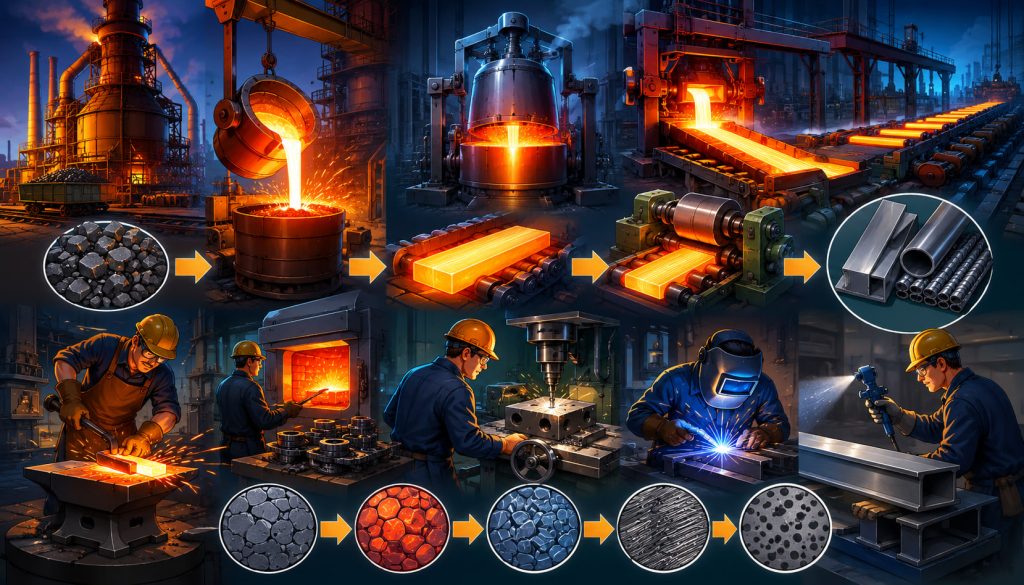
Steel is everywhere.
It forms bridges, skyscrapers, cars, railways, tools, machines, pipelines, ships, household appliances, and countless industrial components. Its success comes from a rare combination of strength, durability, affordability, and adaptability.
But steel is not a single material.
Different grades can behave very differently depending on their carbon content, alloying elements, internal structure, and processing history. Heating, cooling, rolling, forging, welding, machining, and surface treatment can all dramatically change how steel performs.
What Is Steel?
Steel is primarily an alloy of iron and carbon.
Most common steels contain less than about 2% carbon by weight, although the exact composition varies by grade.
Carbon has an enormous effect on mechanical properties.
Low-carbon steels are usually easier to form and weld.
Higher-carbon steels can become much harder and stronger after heat treatment, but they may also become less ductile and more difficult to weld.
Steel may also contain elements such as:
- Chromium
- Nickel
- Manganese
- Molybdenum
- Vanadium
- Silicon
- Tungsten
These elements can improve hardness, corrosion resistance, toughness, heat resistance, or other properties.
How Steel Is Made
Traditional steel production begins with iron ore.
Iron ore contains iron combined with oxygen and other elements.
In integrated steelworks, iron ore is typically processed in a blast furnace with coke and limestone.
The furnace produces molten iron containing relatively high levels of carbon and impurities.
This material is then converted into steel by reducing unwanted elements and adjusting its composition.
One major method is the basic oxygen furnace, where oxygen is blown into molten iron.
The oxygen reacts with excess carbon and other elements, allowing their concentrations to be reduced.
Electric Arc Furnaces
Another important production route uses an electric arc furnace.
Electric arcs generate extremely high temperatures that melt scrap steel and, in some cases, direct-reduced iron.
Electric arc furnaces are especially important for recycling.
Large amounts of old steel from buildings, vehicles, machinery, and other products can be melted and transformed into new material.
Steel is one of the most widely recycled industrial materials in the world.
The exact environmental impact depends heavily on the energy source, raw materials, and production technology.
Casting the Steel
After steel reaches the desired chemical composition, it must be formed into solid shapes.
Most modern steel is produced through continuous casting.
Molten steel is poured into a water-cooled mold and gradually solidifies as it moves through the casting machine.
The process creates semi-finished products such as slabs, billets, and blooms.
These forms then become the starting material for rolling and other shaping methods.
Hot Rolling
Hot rolling is one of the most important steel-processing methods.
Steel is heated to high temperatures and passed between large rotating rolls.
The rolls reduce thickness and change the material into shapes such as:
- Sheets
- Plates
- Rails
- Structural beams
- Bars
Because the steel is hot, it can be deformed relatively easily.
Hot rolling is efficient and suitable for producing large quantities of material.
However, the final surface is generally rougher and dimensions are less precise than with cold-processed steel.
Cold Rolling
Cold rolling usually starts with previously hot-rolled steel.
The material is processed at or near room temperature.
Rolling under these conditions improves dimensional accuracy and surface quality.
Cold rolling can also increase strength through work hardening.
The steel becomes stronger as its internal crystal structure accumulates defects created by deformation.
Cold-rolled steel is widely used for products where appearance, precision, and smooth surfaces matter.
Examples include vehicle panels, appliances, furniture, and precision components.
Forging
Forging shapes steel using compressive forces.
The metal may be hammered, pressed, or squeezed into the required form.
Hot forging is common because heated steel is easier to deform.
Forged components can have excellent mechanical properties because the process can create a favorable internal grain flow.
This makes forging useful for heavily loaded parts such as:
- Crankshafts
- Connecting rods
- Gears
- Axles
- High-strength tools
Forging is especially valuable when reliability under heavy mechanical stress is critical.
Machining
Machining removes steel rather than reshaping the entire piece.
Common machining operations include:
- Turning
- Milling
- Drilling
- Grinding
- Cutting
Computer numerical control machines can produce extremely precise steel components.
Machining is widely used for engine parts, tools, molds, fasteners, and industrial equipment.
The challenge is that hard steels can be difficult to cut.
Tool wear, heat generation, and machining speed therefore depend strongly on the grade and heat treatment of the steel.
Heat Treatment Changes Steel Internally
One of the most powerful ways to modify steel is heat treatment.
Steel contains microscopic crystal structures that change depending on temperature, carbon content, and cooling rate.
By carefully heating and cooling the metal, engineers can create dramatically different properties without changing the overall shape of the part.
Common heat treatments include annealing, normalizing, hardening, and tempering.
Annealing
Annealing usually involves heating steel and then allowing it to cool slowly under controlled conditions.
The process can soften the material, reduce internal stresses, improve ductility, and make machining or forming easier.
Steel may be annealed after heavy deformation or before further manufacturing.
Annealing can also help refine or reorganize the internal microstructure.
Normalizing
Normalizing is similar to annealing but usually involves cooling steel in air rather than cooling it very slowly inside a furnace.
This often produces a finer and more uniform structure.
Normalized steel may have greater strength and hardness than fully annealed steel while still retaining useful toughness.
It is frequently used to prepare steel for later machining or heat treatment.
Quenching
Quenching involves heating suitable steel to a high temperature and then cooling it rapidly.
The cooling medium may include:
- Water
- Oil
- Polymer solutions
- Gas
Rapid cooling can form a very hard microstructure known as martensite.
This can dramatically increase hardness and wear resistance.
However, freshly quenched steel may also become brittle and contain high internal stresses.
That is why quenching is commonly followed by tempering.
Tempering
Tempering reheats hardened steel to a lower temperature and then cools it again.
The purpose is to reduce excessive brittleness while retaining much of the hardness gained during quenching.
By adjusting tempering temperature and time, engineers can create different balances between hardness, strength, toughness, and wear resistance.
Heat treatment is fundamentally a process of balancing properties rather than simply making steel as hard as possible.
Case Hardening
Sometimes a component needs a hard surface but a tough interior.
This is common for gears, shafts, and other parts exposed to wear and impact.
Case-hardening processes modify mainly the outer layer of the steel.
Carburizing increases carbon near the surface.
Nitriding introduces nitrogen.
Other methods combine carbon and nitrogen.
The result can be a very hard wear-resistant surface surrounding a tougher core.
Welding
Welding joins steel components by creating a strong metallurgical bond.
Common methods include arc welding, resistance welding, laser welding, and gas-shielded processes.
Different steels behave differently during welding.
Some low-carbon steels are relatively easy to weld.
High-carbon and alloy steels may require careful control of heating and cooling to prevent cracks or unwanted hard zones.
Welding can also change the microstructure around the joint.
This region is known as the heat-affected zone.
Stainless Steel
Stainless steel is a family of steels containing enough chromium to form a thin protective oxide layer on the surface.
This layer helps resist corrosion.
Many stainless steels also contain nickel, molybdenum, or other alloying elements.
Stainless steel is used in food equipment, medical instruments, chemical plants, architecture, and household products.
It is not completely immune to corrosion, but suitable grades can perform extremely well in demanding environments.
Surface Treatments and Coatings
Steel surfaces can be modified without changing the entire material.
Galvanizing coats steel with zinc.
The zinc protects the underlying steel from corrosion.
Paints, polymer coatings, metallic coatings, and chemical conversion treatments can provide additional protection.
Mechanical methods such as polishing, shot blasting, and grinding can also change surface condition.
Surface engineering is particularly important because corrosion and wear often begin at the surface.
Expert Perspective
Metallurgical engineers generally emphasize that steel performance depends on composition, processing, and microstructure working together.
Two pieces of steel with similar chemical composition can behave very differently if one has been forged and heat-treated while the other has been slowly cooled after casting.
This is why steel selection is not simply about choosing a grade.
Engineers must also specify manufacturing processes, heat treatment, surface condition, and quality requirements.
Interesting Facts
- Steel is primarily an alloy of iron and carbon.
- Small changes in carbon content can significantly change hardness and strength.
- Hot rolling and cold rolling produce different surface quality and mechanical properties.
- Quenching can create extremely hard martensitic steel.
- Tempering reduces the brittleness of quenched steel.
- Forging can improve the internal grain flow of heavily loaded parts.
- Stainless steel resists corrosion mainly because chromium forms a protective surface film.
- Galvanized steel is protected by a coating of zinc.
- Steel can be recycled repeatedly through melting and refining.
- Modern steelmaking often uses continuous casting rather than traditional ingot casting.
- Heat treatment can dramatically change steel properties without altering its basic chemical composition.
Glossary
- Steel — An alloy based primarily on iron and carbon, often containing additional alloying elements.
- Alloy — A material made by combining a metal with one or more additional elements.
- Carbon Steel — Steel in which carbon is one of the main elements controlling mechanical properties.
- Alloy Steel — Steel containing deliberate additions of elements such as chromium, nickel, or molybdenum.
- Hot Rolling — Shaping steel between rolls while it is at high temperature.
- Cold Rolling — Rolling steel near room temperature to improve surface quality, dimensions, and strength.
- Forging — Shaping metal using compressive forces such as hammering or pressing.
- Annealing — Heat treatment used to soften steel, reduce internal stress, and improve ductility.
- Normalizing — Heat treatment involving heating followed by air cooling to create a more uniform microstructure.
- Quenching — Rapid cooling of heated steel to produce increased hardness.
- Tempering — Reheating hardened steel to reduce brittleness and adjust mechanical properties.
- Martensite — A very hard microstructure that can form when suitable steel is rapidly cooled.
- Case Hardening — Treatment that creates a hard outer surface while preserving a tougher interior.
- Heat-Affected Zone — The region beside a weld where heat has altered the steel’s microstructure.
- Galvanizing — Coating steel with zinc to improve corrosion resistance.
- Microstructure — The microscopic arrangement of grains and phases inside a material.