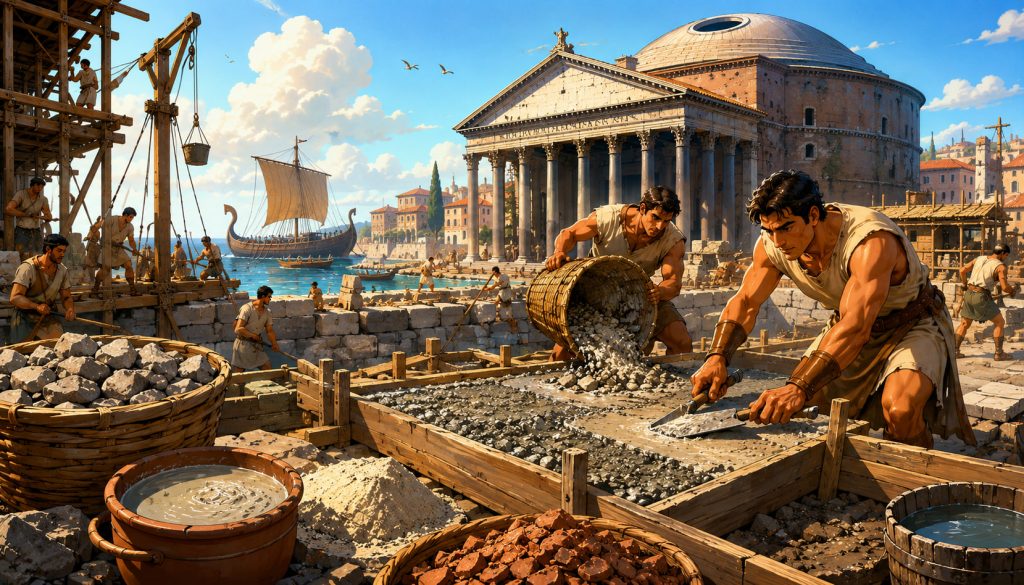
Roman concrete is one of the most fascinating building materials in history.
Ancient Roman engineers used it to construct harbors, temples, baths, aqueducts, vaults, and massive public buildings. Some of those structures are still standing after almost two millennia.
This durability has led to a natural question: why has Roman concrete survived so long, and what made it different from modern concrete?
The answer lies in a combination of volcanic ash, lime, seawater, careful mixing, and chemical reactions that continued long after the concrete hardened.
What Is Roman Concrete?
Roman concrete was a building material made from a mixture of lime, water, aggregate, and volcanic material.
The Romans often called their concrete-like construction opus caementicium.
Unlike modern Portland cement concrete, Roman concrete did not depend on industrially produced clinker.
Instead, Roman builders commonly used volcanic ash called pozzolana.
When mixed with lime and water, this ash could react chemically and create strong cement-like compounds.
This made Roman concrete especially useful in places where ordinary lime mortar would have been too weak or vulnerable to water.
Why Pozzolana Was So Important
Pozzolana is a fine volcanic ash rich in reactive silica and alumina.
When mixed with lime in the presence of water, it participates in what is called a pozzolanic reaction.
This reaction forms cementing compounds that bind the material together.
The Romans discovered that volcanic ash from certain regions, especially around the Bay of Naples, produced exceptionally durable results.
The key advantage was that the material could harden even in wet environments.
That made it extremely valuable for harbors, foundations, baths, and hydraulic structures.
Roman Concrete Could Harden Underwater
One of Roman concrete’s most remarkable properties was its ability to work in marine construction.
Roman engineers built breakwaters, piers, and harbor structures directly in seawater.
Ordinary lime mortar performs poorly when constantly exposed to water.
Pozzolanic concrete was different.
Its chemical reactions could continue underwater, allowing the material to become strong and durable.
This capability helped Roman engineers build some of the most ambitious coastal infrastructure of the ancient world.
Why Some Roman Marine Concrete Became Stronger Over Time
Modern concrete can deteriorate when seawater penetrates it.
Roman marine concrete behaved differently in some structures.
Researchers studying ancient harbor concrete have found that seawater moving through microscopic cracks and pores can interact with volcanic minerals.
Over very long periods, new mineral crystals can form inside the concrete.
These minerals may help reinforce the internal structure.
One important mineral identified in Roman marine concrete is aluminous tobermorite.
Its formation can contribute to long-term strength and stability.
In certain Roman concretes, interaction with seawater did not simply cause damage — it became part of the material’s long-term chemical evolution.
The Role of Lime Clasts
Another interesting feature of many Roman concrete samples is the presence of small white fragments known as lime clasts.
For a long time, researchers sometimes assumed these were simply evidence of poor mixing.
More recent research has suggested a different possibility.
Some lime clasts may have resulted from a process involving very hot lime mixed directly with other ingredients.
This technique is often described as hot mixing.
The resulting lime-rich fragments may have played an important role in the material’s behavior.
Could Roman Concrete Repair Its Own Cracks?
One of the most exciting modern theories is that some Roman concrete had a limited ability to self-heal.
When small cracks formed and water entered them, water could react with lime-rich particles.
The dissolved calcium could move into the crack.
As it reacted with carbon dioxide or other components, new calcium carbonate crystals could form.
These crystals could gradually fill or partially seal the crack.
This would not mean Roman concrete could repair massive structural failures.
But for small cracks, the process could reduce further water penetration and slow deterioration.
Self-healing behavior may be one reason some Roman structures remained durable for centuries.
How Was Roman Concrete Made?
Roman concrete recipes varied depending on location and purpose.
A typical mixture could include:
- Lime
- Volcanic ash
- Water
- Broken stone
- Brick fragments
- Rubble
- Ceramic pieces
Builders often placed the concrete between layers of stone or brick facing.
The mixture filled the interior of walls and vaults.
Different aggregates could be chosen depending on the desired properties.
For example, lighter volcanic materials could be used in upper parts of domes to reduce weight.
Roman construction was therefore not based on one universal recipe.
It was a flexible engineering system.
The Pantheon Shows Roman Concrete at Its Best
The Pantheon in Rome is one of the most impressive surviving examples of Roman concrete construction.
Its enormous unreinforced concrete dome remains the largest of its kind in the world.
The dome was completed in the second century CE.
Roman engineers carefully reduced the weight of the structure toward the top.
Heavier aggregates were used lower down, while lighter volcanic materials were incorporated higher in the dome.
The walls are extremely thick near the base and become thinner toward the top.
At the center is the famous oculus, which reduces weight while also allowing light into the building.
The Pantheon demonstrates how Roman engineers combined materials science with sophisticated structural design.
Roman Concrete Was Not Always Better Than Modern Concrete
It is tempting to say that Roman concrete was simply superior to everything used today.
That is not accurate.
Modern concrete can achieve much higher early strength and can be engineered for skyscrapers, bridges, dams, tunnels, and highly specialized structures.
Modern reinforced concrete also works with steel reinforcement, which allows structures to resist tensile forces that ordinary concrete handles poorly.
Roman concrete often gained strength slowly.
Its properties also depended strongly on local volcanic materials.
Roman concrete and modern concrete were optimized for different technological worlds.
The extraordinary durability of some Roman structures does not mean every Roman concrete structure survived.
Many did not.
Why Modern Concrete Sometimes Deteriorates Faster
Modern reinforced concrete introduces one major vulnerability: steel reinforcement.
Concrete protects steel from corrosion under normal conditions.
But when water, salts, or carbon dioxide penetrate deeply enough, the steel can begin to rust.
Rust expands.
This expansion creates internal pressure that cracks and breaks the surrounding concrete.
Roman concrete usually did not contain steel reinforcement.
That eliminated one major pathway of deterioration.
Modern structures are also often designed for rapid construction and high early strength.
Ancient Roman structures could rely on much thicker walls and slower curing.
Expert Perspective
Materials scientists studying Roman concrete emphasize that its durability came from chemistry, raw materials, and construction methods working together.
There was no single magical ingredient.
Volcanic ash created useful pozzolanic reactions.
Lime provided reactive calcium.
Seawater influenced mineral formation in marine structures.
Hot mixing may have created reactive lime clasts.
And massive structural designs reduced stresses that would challenge thinner modern structures.
The most important lesson is not that modern engineers should copy Roman recipes exactly.
It is that long-term durability can be designed into concrete through carefully controlled chemistry and microstructure.
Could Roman Concrete Inspire Greener Modern Materials?
This is one of the most important modern research questions.
Portland cement production requires high temperatures and releases significant amounts of carbon dioxide.
Researchers are therefore exploring alternative binders that use less cement or incorporate pozzolanic materials.
Some modern concretes already use fly ash, slag, calcined clays, and natural pozzolans.
Roman concrete demonstrates that strong, durable structures do not always require the same chemistry as conventional Portland cement.
If modern materials can combine lower emissions with long service life and self-healing behavior, the environmental benefits could be substantial.
Why Roman Concrete Lasted So Long
Its survival was not the result of one factor.
Several advantages worked together:
- Durable pozzolanic chemistry
- Mineral formation over time
- Thick structural sections
- Limited reliance on steel reinforcement
- Careful aggregate selection
- Slow chemical development
- In some cases, self-healing behavior
Roman engineers also had centuries of practical experience.
They may not have understood chemistry in modern scientific terms, but they clearly knew which materials worked.
Interesting Facts
- Roman concrete was widely used in major buildings, baths, harbors, and infrastructure.
- The Romans often used volcanic ash called pozzolana as a reactive binder ingredient.
- Some Roman marine concrete has survived nearly 2,000 years underwater.
- The Pantheon still contains the world’s largest unreinforced concrete dome.
- Roman builders reduced the weight of the Pantheon dome by using lighter materials near the top.
- Some Roman marine concrete developed new mineral crystals after long exposure to seawater.
- Lime clasts once interpreted as mixing defects may have played a useful role in self-healing.
- Ancient concrete often gained strength more slowly than modern Portland cement concrete.
- Roman concrete usually did not contain steel reinforcement.
- Modern researchers are studying ancient concrete to develop more durable and lower-carbon construction materials.
Glossary
- Roman Concrete — A concrete-like building material used by ancient Roman engineers, commonly made with lime, aggregate, and volcanic materials.
- Opus Caementicium — The Latin term commonly associated with Roman concrete construction.
- Pozzolana — Reactive volcanic ash that can combine with lime and water to form cementing compounds.
- Pozzolanic Reaction — A chemical reaction between reactive silica or alumina, lime, and water that produces cement-like materials.
- Lime — A calcium-based material used historically as a binder in mortars and concrete.
- Lime Clast — A small lime-rich fragment found in some ancient concrete.
- Hot Mixing — A method in which reactive lime is mixed under high-temperature conditions, potentially creating distinctive lime-rich particles.
- Self-Healing Concrete — Concrete capable of partially sealing small cracks through chemical or biological processes.
- Calcium Carbonate — A mineral compound that can form inside cracks and contribute to sealing them.
- Aluminous Tobermorite — A durable calcium-aluminum-silicate mineral identified in some ancient Roman marine concrete.
- Aggregate — Sand, gravel, crushed stone, brick, or other solid material mixed into concrete.
- Portland Cement — The most widely used modern hydraulic cement.
- Reinforced Concrete — Concrete containing steel bars or other reinforcement to improve tensile strength.
- Oculus — A circular opening, such as the large opening at the center of the Pantheon dome.