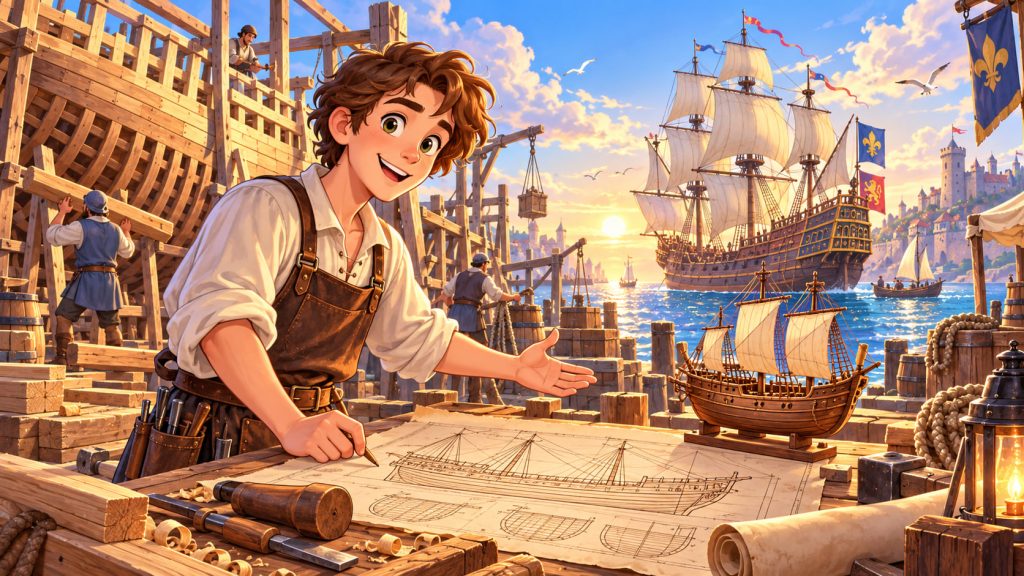
Medieval shipbuilding transformed the way people traded, explored, fought, and connected distant regions. Between the early Middle Ages and the beginning of the Age of Exploration, European, Mediterranean, Nordic, Arab, and Asian shipbuilders developed increasingly capable wooden vessels designed for coastal travel, open-sea voyages, warfare, and commerce.
These ships were built without modern engines, steel hulls, satellite navigation, or industrial machinery. Yet they crossed rough seas, carried heavy cargoes, supported kingdoms, and opened new maritime routes.
The medieval sailing ship was one of the most advanced technologies of its time.
Why Medieval Shipbuilding Mattered
Ships were essential to medieval economies.
Overland transport was slow, expensive, and often dangerous. By contrast, ships could move large quantities of grain, timber, wine, salt, metals, cloth, and luxury goods over long distances.
Ports became centers of wealth and political influence.
Merchant cities such as Venice, Genoa, Lübeck, and Bruges prospered because maritime trade linked them to wider commercial networks.
Navies also became increasingly important.
Kings and city-states depended on ships to defend coastlines, transport soldiers, blockade ports, and control sea routes.
Ships Were Built Almost Entirely by Hand
Medieval shipyards were highly skilled workplaces.
Shipwrights relied on axes, adzes, saws, augers, chisels, hammers, ropes, wooden measuring tools, and generations of practical experience.
There were no computer models or standardized industrial blueprints.
Instead, many ships were built using inherited proportions, geometric rules, full-scale shaping methods, and the judgment of experienced craftsmen.
Timber selection was crucial.
Oak was widely prized in northern Europe because of its strength and durability. Pine, fir, elm, beech, and other woods were also used depending on region and purpose.
The shape of the tree itself often influenced how individual structural pieces were chosen.
Naturally curved branches and trunks could provide strong frames because their grain followed the shape of the timber.
Clinker Construction and the Viking Tradition
One of the most important medieval construction methods was clinker building.
In clinker-built ships, hull planks overlapped one another along their edges.
The planks were fastened together, and the overlapping structure created a strong yet relatively flexible hull.
This technique became strongly associated with Scandinavian shipbuilding.
Viking longships were among the most famous clinker-built vessels.
They were fast, shallow-drafted, and capable of traveling across open seas while also navigating rivers and approaching beaches.
Their combination of sail and oars made them highly versatile.
The same broad northern European shipbuilding tradition later influenced merchant ships as well as warships.
Carvel Construction Changed Large Ship Design
Another major method was carvel construction.
In a carvel-built hull, planks were fitted edge to edge rather than overlapping.
This produced a smoother outer surface.
Carvel techniques were well established in the Mediterranean and became increasingly influential in Atlantic Europe during the later Middle Ages.
The method offered important advantages for larger ships.
A smoother hull could be built around a strong internal framework and allowed shipbuilders to construct increasingly large vessels.
The spread of carvel construction helped prepare the way for the ocean-going ships of the Age of Exploration.
The Cog: The Workhorse of Northern Trade
The cog became one of the most recognizable merchant ships of medieval northern Europe.
Cogs were particularly important in the North Sea and Baltic regions.
They typically had broad hulls, substantial cargo capacity, a single mast with a large square sail, and high sides.
Their design prioritized carrying goods rather than speed.
The rise of the Hanseatic League, a powerful network of trading cities and merchants, increased the importance of ships capable of transporting bulk cargo across northern European waters.
Cogs transported everything from grain and timber to wax, fish, beer, and textiles.
Many also carried defensive structures because piracy and maritime conflict were persistent risks.
Castles at the Bow and Stern
Medieval ships gradually became visually more imposing.
Raised structures appeared at the bow and stern.
These became known as forecastles and sterncastles.
Originally, such structures provided elevated fighting positions during naval combat.
Archers and crossbowmen could fire downward onto enemy decks, while soldiers could defend their own vessel during boarding actions.
Over time, these structures also provided accommodation and working space.
However, excessively tall castles could make ships top-heavy and difficult to handle.
Later ship designers had to balance defensive value against stability and sailing performance.
The Sternpost Rudder Improved Control
Steering technology also advanced.
Earlier European vessels often used large steering oars mounted along the side of the ship.
During the medieval period, the sternpost rudder became increasingly common in northern Europe.
Mounted at the center of the stern, the rudder could be controlled through a tiller.
This arrangement allowed more effective steering, especially as ships became larger.
The stern-mounted rudder was a major step toward the handling systems used by later sailing ships.
It worked particularly well with the evolving hull shapes of medieval merchant vessels.
Sails Became More Sophisticated
Square sails remained important throughout the Middle Ages.
They were excellent for sailing with favorable winds and could generate substantial power.
But Mediterranean sailors also made extensive use of the lateen sail.
The lateen sail was triangular and mounted on a long angled yard.
It allowed ships to sail more effectively at angles to the wind.
This provided greater maneuverability than a simple square-rigged arrangement.
As maritime traditions interacted, shipbuilders increasingly combined different sail types.
By the late medieval period, larger vessels could carry several masts with different sail configurations.
This gave sailors much greater control over their ships.
The Carrack and the Rise of Ocean-Going Ships
By the late Middle Ages, one of the most influential large sailing vessels was emerging: the carrack.
Carracks combined features from Mediterranean and Atlantic shipbuilding traditions.
They were broad, deep-hulled ships capable of carrying substantial cargo while surviving long voyages.
Many had three or four masts.
Square sails supplied power, while a lateen sail on the rear mast improved maneuverability.
Carracks later became important during Portuguese and Spanish oceanic exploration.
Ships of this general type helped connect Europe with Africa, Asia, and the Americas.
The medieval shipbuilding revolution was therefore directly connected to the dramatic expansion of global navigation that followed.
How Shipbuilders Made Wooden Hulls Watertight
Wooden hulls were never simply collections of planks.
The spaces between planks had to be sealed carefully.
Shipbuilders used caulking materials such as animal hair, plant fibers, moss, or other fibrous substances combined with pitch or tar.
These materials helped prevent water from entering through seams.
Maintaining a wooden ship required constant attention.
Salt water, marine organisms, storms, and mechanical stress could damage hulls.
Ships regularly needed inspection, caulking, replacement planks, and repairs.
A medieval sailing ship was not merely built once; it had to be continuously maintained throughout its working life.
Life in a Medieval Shipyard
Large ships required organized teams of specialized workers.
Shipwrights shaped the main structure.
Carpenters prepared planks and frames.
Blacksmiths produced nails, bolts, anchors, tools, and metal fittings.
Ropemakers manufactured enormous lengths of rope.
Sailmakers prepared sails from durable cloth.
Caulkers sealed the hull.
Timber cutters and transport workers supplied raw materials.
The construction of a major vessel therefore depended on an entire economic network.
Shipbuilding stimulated forestry, mining, metalworking, textile production, and port development.
Expert Perspective
Maritime historians generally emphasize that medieval shipbuilding did not progress through one single invention.
Instead, it advanced through the gradual combination of hull design, steering systems, rigging, navigation, craftsmanship, and maritime experience.
Northern clinker traditions, Mediterranean carvel construction, square sails, lateen rigs, improved rudders, and better navigation techniques all contributed.
This combination eventually produced ships capable of crossing entire oceans.
The great exploration vessels of the 15th and 16th centuries were therefore not sudden inventions. They were the product of centuries of medieval experimentation.
Wooden Ships Were Complex Machines
It is easy to imagine a medieval sailing ship as simple because it was made mostly from wood, rope, cloth, and iron.
In reality, it was a highly complex machine.
The hull had to withstand waves while remaining flexible enough not to break.
Masts had to carry enormous wind forces.
Rigging transferred loads throughout the vessel.
Ballast helped maintain stability.
Sails had to be adjusted constantly as wind direction changed.
Crews needed to understand weather, navigation, currents, tides, maintenance, and ship handling.
Successful medieval seafaring depended on engineering knowledge as much as courage.
Interesting Facts
- Some Viking ships were light enough to approach beaches and shallow rivers directly.
- Clinker-built ships use overlapping hull planks, while carvel-built ships use planks fitted edge to edge.
- Oak was one of the most valuable shipbuilding timbers in medieval northern Europe.
- A large medieval ship could require timber from many mature trees.
- Cogs became important merchant vessels in the North Sea and Baltic trade.
- Lateen sails helped ships sail more effectively across the wind.
- Sternpost rudders became increasingly important as ships grew larger.
- Pitch and fibrous materials were used to help seal wooden hulls.
- Medieval ships required frequent repairs because wood constantly reacted to water, stress, and weather.
- Shipbuilding supported many other trades, including blacksmithing, sailmaking, ropemaking, and forestry.
- The carrack became one of the major predecessors of early modern ocean-going ships.
- Many ships used stone, sand, or other heavy materials as ballast to improve stability.
Glossary
- Shipwright — A skilled craftsman who designs and constructs wooden ships.
- Clinker Construction — A shipbuilding method in which hull planks overlap each other.
- Carvel Construction — A method in which hull planks are fitted edge to edge to create a smooth surface.
- Cog — A broad medieval merchant ship widely used in northern European trade.
- Carrack — A large late-medieval sailing ship developed for cargo transport and long-distance voyages.
- Lateen Sail — A triangular sail mounted on an angled yard, especially associated with Mediterranean sailing.
- Square Sail — A roughly rectangular sail mounted across the ship and especially effective with following winds.
- Sternpost Rudder — A steering device mounted vertically at the stern of a vessel.
- Tiller — A lever used to turn a ship’s rudder.
- Rigging — The ropes, lines, cables, and related equipment used to support masts and control sails.
- Caulking — The process of sealing gaps between hull planks to prevent water leakage.
- Pitch — A sticky waterproofing material historically used to protect and seal wooden ships.
- Ballast — Heavy material placed low inside a ship to improve balance and stability.
- Forecastle — A raised structure located toward the bow of a ship.
- Sterncastle — A raised structure located toward the rear of a medieval ship.