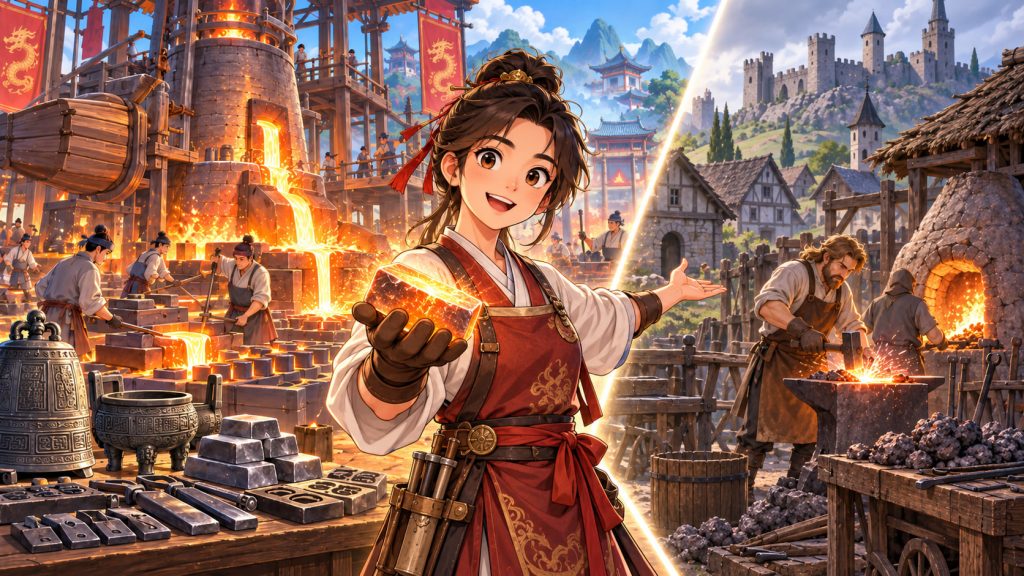
The history of ironmaking is one of the clearest examples of how technological development can move at very different speeds in different civilizations.
Ancient China learned to produce cast iron on a large scale centuries before the same technology became common in Europe. Chinese metallurgists also developed sophisticated methods for refining iron and producing different grades of steel.
By the time European ironworkers were still relying mainly on bloomery furnaces, Chinese workshops were already using high-temperature furnaces capable of melting iron completely.
In cast-iron technology, China was ahead of Europe by many centuries, in some respects close to a millennium.
The Key Difference: Melting Iron
The most important technological breakthrough was temperature.
Iron has a very high melting point. Early furnaces in many parts of the world could heat iron ore enough to chemically reduce it, but not enough to melt the resulting metal completely.
This produced a spongy mass of iron called a bloom.
The bloom contained slag and impurities and had to be hammered repeatedly.
This bloomery process was widely used in ancient and medieval Europe.
Chinese metallurgists developed furnaces that operated at much higher temperatures.
These furnaces could produce liquid iron with relatively high carbon content.
That material could then be poured into molds.
The result was cast iron.
China Produced Cast Iron Very Early
Evidence suggests that cast iron was being produced in China by around the 5th century BCE, and possibly earlier in experimental forms.
This was an extraordinary achievement.
Instead of hammering every object into shape, molten iron could be poured into molds and produced in standardized forms.
Chinese foundries manufactured tools, agricultural equipment, cooking vessels, weapons, fittings, and large structural objects.
Casting made mass production easier.
A mold could be reused or recreated, allowing workshops to produce many similar objects much more efficiently than by forging each one individually.
Why Chinese Furnaces Became Hotter
Chinese furnace design was one major reason for the breakthrough.
Early blast furnaces used powerful airflows to intensify combustion.
Air was forced into the furnace using bellows.
More oxygen meant hotter burning fuel.
Higher temperatures increased the amount of carbon absorbed by the iron, lowering its effective melting temperature and allowing the metal to become liquid.
Chinese engineers also built increasingly sophisticated furnaces with carefully controlled airflow and fuel supplies.
The combination of furnace design, forced air, suitable ores, and carbon-rich fuel made large-scale cast-iron production possible.
Cast Iron Was Useful but Difficult
Cast iron has advantages, but it also has limitations.
Because it contains more carbon than wrought iron, it is hard but relatively brittle.
A cast-iron object can resist compression and wear well, but it can crack under sudden impact.
Chinese metallurgists therefore learned to modify cast iron.
One method involved heating cast iron for long periods under controlled conditions to remove some of its carbon.
This could transform brittle cast iron into tougher forms of iron.
Chinese workshops also developed techniques for combining iron with different carbon contents.
These processes gave metalworkers much more control over material properties.
The Chinese Learned to Refine Iron
One important process was decarburization.
Cast iron contains a relatively high percentage of carbon.
By exposing molten or heated iron to oxygen, some of that carbon can be removed.
Chinese metallurgists developed methods for refining high-carbon iron into lower-carbon iron and steel-like materials.
Another approach involved combining cast iron with lower-carbon wrought iron.
The carbon content could partially balance between the two materials.
This allowed craftsmen to create metal with characteristics between brittle cast iron and soft wrought iron.
The ability to control carbon was the real foundation of advanced iron metallurgy.
What Exactly Is Steel?
Steel is primarily iron containing a controlled amount of carbon.
Too little carbon produces relatively soft wrought iron.
Too much carbon produces hard but brittle cast iron.
Between these extremes lies steel.
Steel can combine strength, hardness, and toughness.
Ancient steelmaking was not based on modern chemical measurements, but experienced smiths learned to judge metal through color, sparks, hardness, sound, and behavior during forging.
China developed several methods for producing useful steel centuries before industrial steelmaking.
However, steel itself was not uniquely Chinese.
Ancient India, the Middle East, Central Asia, and parts of Europe also developed important steel traditions.
China’s exceptional early advantage was particularly strong in large-scale cast-iron production and the refining of molten iron.
Europe Followed a Different Path
European ironworking remained dominated for centuries by bloomery technology.
A bloomery furnace produced solid iron rather than molten iron.
The resulting bloom had to be removed from the furnace and hammered to squeeze out slag.
This process could produce excellent wrought iron and, with careful carburization, steel.
But production volumes were limited.
The process was labor-intensive.
European smiths became highly skilled at forging, pattern welding, heat treatment, and weapon manufacture.
The difference was not simply that Europeans lacked knowledge of iron.
They developed a different technological system.
What Europe lacked for many centuries was widespread blast-furnace production of molten cast iron.
When Cast Iron Became Common in Europe
Blast furnaces appeared in Europe during the Middle Ages and spread more widely from roughly the 13th to 15th centuries.
By then, China had already possessed a long tradition of cast-iron production.
European blast furnaces eventually became increasingly efficient.
They produced pig iron, which could be cast directly or refined into wrought iron.
This technology became especially important in cannon production, construction, tools, and eventually industrial machinery.
The gap gradually closed.
By the early modern period, European iron production was rapidly expanding.
Agriculture Helped Drive Chinese Metallurgy
Agriculture was one important source of demand.
China had large populations and intensive farming systems.
Iron plowshares, hoes, sickles, and other agricultural tools could increase productivity.
Cast iron made it possible to manufacture durable tools in significant quantities.
Government administrations also needed weapons, coins, infrastructure, and equipment.
Large markets encouraged specialization.
Specialized foundries could invest in more efficient furnaces and skilled labor.
Demand from agriculture, warfare, construction, and government created strong incentives for metallurgical innovation.
The Role of the Chinese State
During several Chinese dynasties, governments became deeply involved in iron production.
At different times, authorities taxed, regulated, controlled, or directly operated iron industries.
The Han dynasty is especially famous for major government involvement in iron and salt production.
Large-scale organization could concentrate workers, fuel, ore, transportation, and technical knowledge.
Industrial production was therefore not always limited to small village smithies.
Some Chinese ironworks operated on a scale that can reasonably be described as proto-industrial.
Water Power Increased Production
Another important development was mechanical power.
Chinese engineers used waterwheels to operate bellows in some ironworks.
Instead of relying entirely on human labor, flowing water could drive machinery that forced air into furnaces.
This provided more consistent airflow.
It could also increase furnace temperature and production capacity.
By the early centuries CE, descriptions survive of water-powered systems connected with metallurgical production.
This demonstrates an important principle of technological development: progress came not from one invention, but from combining metallurgy, mechanical engineering, energy, and organization.
Coal Also Became Important
Charcoal was a traditional fuel for ironmaking, but producing large quantities required enormous amounts of wood.
In regions with growing industrial demand, this could put pressure on forests.
Chinese industries gradually expanded the use of mineral coal.
Coal became increasingly important during the Song dynasty, especially in northern China.
This helped support large-scale iron production.
By the 11th century, Chinese iron output had reached remarkable levels.
The scale of production reflects an economy with advanced mining, transport, furnace technology, and strong demand for metal goods.
Expert Perspective
Historians of technology often emphasize that China’s early metallurgical advantage came from a complete technological system rather than a single secret invention.
High-temperature furnaces, forced-air bellows, casting techniques, carbon control, large markets, organized production, and eventually water power and coal all reinforced one another.
The result was a metallurgical tradition capable of producing cast iron at a time when most European iron was still being made in solid blooms.
This is why China’s advantage lasted for centuries.
Why Europe Eventually Caught Up
Europe did not remain technologically behind forever.
Medieval blast furnaces gradually improved, and demand for iron increased.
Water-powered bellows and hammers became increasingly common.
Mining expanded.
Cannon production created demand for large quantities of cast metal.
Later, the use of coke instead of charcoal revolutionized ironmaking in Britain.
During the Industrial Revolution, European metallurgists developed new methods for producing iron and steel in enormous quantities.
Processes such as puddling, the Bessemer process, and later open-hearth steelmaking eventually transformed global industry.
By the 19th century, Europe had moved from catching up in cast-iron production to leading a new era of industrial steelmaking.
Interesting Facts
- Cast iron was produced in China by approximately the 5th century BCE, many centuries before it became widespread in Europe.
- Cast iron contains more carbon than wrought iron and most steels.
- High carbon content makes cast iron easier to melt but also more brittle.
- Ancient Chinese foundries could pour molten iron directly into reusable molds.
- Chinese metallurgists developed methods for reducing the carbon content of cast iron.
- Water power was used to operate furnace bellows in ancient and medieval China.
- Iron agricultural tools helped support increasingly intensive farming.
- The Han government at times directly controlled major iron industries.
- Chinese iron production expanded dramatically during the Song dynasty.
- Mineral coal became an increasingly important industrial fuel in medieval China.
- European bloomery iron could be extremely high quality even though the production method differed from Chinese blast furnaces.
- The widespread European blast furnace appeared many centuries after China’s first cast-iron industry.
Glossary
- Cast Iron — Iron containing a relatively high proportion of carbon, allowing it to melt readily and be poured into molds.
- Steel — An alloy made primarily of iron with a controlled amount of carbon, usually combining strength and toughness.
- Wrought Iron — Low-carbon iron that is relatively soft, tough, and suitable for forging.
- Bloomery — An early furnace that reduces iron ore without completely melting the resulting metal.
- Bloom — A porous mass of iron and slag produced in a bloomery furnace.
- Blast Furnace — A tall furnace in which forced air creates temperatures high enough to produce molten iron.
- Pig Iron — High-carbon iron produced by a blast furnace and used for casting or further refining.
- Carbon Content — The proportion of carbon contained in iron, which strongly affects hardness, brittleness, and melting behavior.
- Decarburization — The removal of carbon from iron through heating and controlled exposure to oxygen.
- Bellows — A device used to force air into a furnace and increase combustion temperature.
- Smelting — The process of extracting metal from ore using heat and chemical reactions.
- Forging — Shaping metal through hammering, pressing, and heating.
- Foundry — A workshop or industrial site where metal is melted and cast into molds.
- Proto-Industrial — Describing large-scale organized production that existed before modern industrial factories.