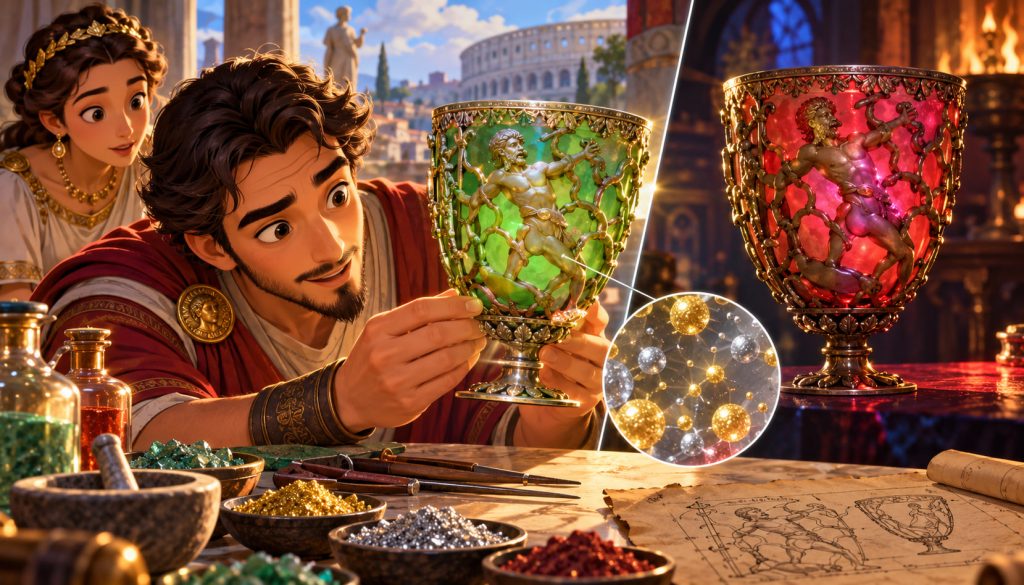
Among the most extraordinary surviving objects from the Roman world is a glass vessel known as the Lycurgus Cup.
At first glance, it looks like a finely carved piece of late Roman luxury glass. But when light passes through it, something remarkable happens: the cup appears to change color.
Viewed in reflected light, it looks greenish. Viewed with light shining through it, it turns a deep red.
For decades, this unusual optical effect fascinated historians, chemists, and materials scientists. Modern analysis revealed that the glass contains extremely tiny particles of gold and silver.
These particles are measured on the nanometer scale.
That discovery led to a striking description: the Romans had created a material that behaves like a modern nanotechnology product almost 1,700 years ago.
What Is the Lycurgus Cup?
The Lycurgus Cup is generally dated to the 4th century CE, during the late Roman Empire.
It is a type of luxury vessel known as a cage cup, or diatretum.
These cups were made by cutting away large portions of thick glass while leaving an outer decorative network connected to the inner vessel by small glass bridges.
The craftsmanship required enormous precision.
The Lycurgus Cup is particularly famous because its decoration depicts the mythical King Lycurgus entangled by vines after opposing the god Dionysus.
The figures are carved in dramatic relief around the vessel.
Yet its most surprising feature is not the carving.
It is the glass itself.
Why Does the Cup Change Color?
The Lycurgus Cup is made from dichroic glass.
Dichroic materials can appear as different colors depending on how light interacts with them.
When ordinary light reflects from the cup, it appears mostly green.
When light passes through the glass from behind, the cup appears red.
This is not caused by paint, a coating, or a hidden layer.
The color-changing effect comes from microscopic particles dispersed inside the glass.
Modern scientific examination found tiny particles containing gold and silver.
These particles interact with visible light in different ways depending on whether the light is reflected or transmitted.
The Hidden Nanoparticles
The metal particles inside the Lycurgus Cup are extraordinarily small.
Many are only tens of nanometers across.
A nanometer is one billionth of a meter.
At this scale, materials can behave differently from the same substances in larger pieces.
Gold provides a famous example.
A large piece of gold looks metallic yellow.
But extremely small gold particles suspended in another material can produce red, purple, or other optical effects.
This happens because electrons in the nanoparticles interact collectively with incoming light.
The resulting phenomenon is related to what scientists call surface plasmon resonance.
In simple terms, the tiny metal particles selectively absorb and scatter different wavelengths of light.
Did Roman Craftsmen Understand Nanotechnology?
No Roman glassmaker would have described the process using modern physics.
They did not know about nanoparticles, electrons, or electromagnetic waves.
Calling the Lycurgus Cup “Roman nanotechnology” is therefore a modern analogy.
However, that does not make the achievement less impressive.
Roman glassworkers somehow developed a manufacturing process that introduced nanoscale metal particles into glass in concentrations capable of producing a controlled optical effect.
The key question is whether this happened intentionally.
Many researchers think the glassmakers probably understood the practical result even if they did not understand its scientific mechanism.
Ancient craftsmen could master a process through experience long before science could explain why it worked.
How Could the Romans Have Made It?
The exact manufacturing procedure remains uncertain.
Roman glassmakers already had extensive knowledge of mineral additives, metallic compounds, furnace temperatures, and glass coloring.
Gold, silver, copper, manganese, iron, and other materials could influence the appearance of glass.
One possibility is that tiny quantities of gold and silver entered the molten glass during a carefully controlled production process.
Heating conditions may then have allowed the metals to form nanoparticles rather than remaining evenly dissolved.
The concentration had to be extremely small.
Too much metal could make the glass opaque or produce completely different colors.
The successful result depended on a delicate combination of composition, temperature, and cooling conditions.
Roman Glassmaking Was Highly Advanced
The Lycurgus Cup was not created in technological isolation.
Roman glassmaking had already reached an impressive level.
Roman workshops produced:
- Transparent glass vessels
- Colored decorative glass
- Mosaics
- Window glass
- Cameo glass
- Blown bottles and cups
- Molded glass
- Elaborately cut cage cups
The spread of glassblowing during the Roman period made glass objects much easier to manufacture.
At the same time, elite workshops created highly specialized luxury pieces requiring extraordinary skill.
The Lycurgus Cup belongs to this elite tradition.
It combined sophisticated glass chemistry with exceptionally difficult carving.
The Art of Cage Cups
Cage cups are among the most technically impressive forms of Roman glass.
A thick glass blank had to be carefully ground and cut.
Craftsmen removed material until a decorative outer cage remained separated from the inner wall.
Only small connecting bridges prevented the decoration from breaking away.
One mistake could destroy weeks or months of work.
Very few complete examples survive.
This scarcity suggests that cage cups were expensive prestige objects, possibly owned by wealthy aristocrats or members of the imperial elite.
The Lycurgus Cup represents both advanced materials science and extraordinary craftsmanship.
Why Gold Produces Red Glass
Gold has been used to create red glass in later historical periods as well.
The effect comes from tiny metallic particles.
When gold particles reach an appropriate size and distribution, they strongly interact with green and blue wavelengths while allowing more red light to dominate.
The precise color depends on several factors:
- Particle size
- Particle shape
- Metal concentration
- Distribution within the glass
- Surrounding glass composition
The Lycurgus Cup also contains silver particles, which influence the final optical effect.
The result is a complex combination rather than a simple gold pigment.
Expert Perspective
Materials scientists studying ancient glass often emphasize that the importance of the Lycurgus Cup lies in the accidental or empirical control of matter at extremely small scales.
The Romans did not possess a modern theory of nanoscience.
However, the finished material demonstrates a phenomenon now deliberately engineered in laboratories.
This highlights an important distinction between scientific explanation and technological skill.
A craftsman can discover that a process works through repeated experimentation long before anyone understands the underlying physics.
Ancient metallurgy, ceramics, pigments, and glassmaking contain many similar examples.
Could the Color Change Have Been Intentional?
This remains one of the most interesting questions.
Producing the effect consistently would have required careful control.
The cup’s dramatic red-green transformation also fits its theatrical design.
Because the object was probably used in elite settings, the changing color may have been intended to surprise viewers during banquets or ceremonial events.
Imagine the cup illuminated first from the front and then from behind by lamps or sunlight.
The transformation would have appeared almost magical.
Whether the glassmaker understood every part of the process is impossible to know.
But the visual effect may well have been deliberately appreciated.
Modern Nanotechnology Uses Similar Principles
Today, metallic nanoparticles are studied for applications in medicine, sensors, electronics, imaging, optical devices, and advanced materials.
Gold nanoparticles are especially useful because their optical properties can change depending on their size and environment.
This can allow scientists to detect tiny chemical or biological changes.
In some experimental sensors, even a slight change in the surroundings of nanoparticles can produce a visible color shift.
The same general physics helps explain why the Lycurgus Cup behaves so unusually.
A Roman luxury vessel therefore demonstrates principles that remain relevant to cutting-edge materials research today.
Why the Lycurgus Cup Is So Important
The cup is valuable because it connects ancient craftsmanship with modern science.
It shows that sophisticated materials can emerge from practical experimentation without theoretical knowledge of atoms or nanoparticles.
It also challenges simplistic assumptions about ancient technology.
Roman artisans were not merely decorating objects.
They were controlling furnace chemistry, glass composition, metal additives, temperature, and craftsmanship at extremely high levels.
The Lycurgus Cup remains one of the clearest examples of how ancient technology can still surprise modern scientists.
Interesting Facts
- The Lycurgus Cup dates to approximately the 4th century CE.
- It appears green in reflected light and red in transmitted light.
- The color effect comes partly from extremely small gold and silver particles.
- Some of these particles are measured in tens of nanometers.
- The cup is carved as a highly complex Roman cage cup.
- Its decoration shows the mythical King Lycurgus being trapped by vines.
- Gold nanoparticles can produce red or purple colors instead of metallic gold.
- The Romans had no concept of modern nanotechnology, despite creating a material with nanoscale structures.
- Similar optical principles are now used in advanced scientific sensors.
- Very few complete Roman cage cups survive.
- The exact manufacturing method used for the Lycurgus Cup is still not fully known.
- The object demonstrates how ancient experimentation could produce effects that modern science only much later explained.
Glossary
- Lycurgus Cup — A late Roman glass vessel famous for changing color depending on how it is illuminated.
- Dichroic Glass — Glass that shows different colors under different lighting conditions.
- Nanoparticle — A particle with dimensions measured in nanometers, typically between about 1 and 100 nanometers.
- Nanometer — One billionth of a meter.
- Surface Plasmon Resonance — An optical effect caused by collective movements of electrons in tiny metallic particles when they interact with light.
- Cage Cup — A Roman glass vessel with a decorative outer network carved from the same original piece of glass.
- Diatretum — The Latin-derived term commonly used for a Roman cage cup.
- Reflected Light — Light that bounces off the surface of an object toward the observer.
- Transmitted Light — Light that passes through a material before reaching the observer.
- Glassblowing — A technique for shaping molten glass by blowing air into it through a tube.
- Metallic Nanoparticle — An extremely small particle made from a metal such as gold or silver.
- Optical Properties — The ways a material absorbs, reflects, scatters, or transmits light.
- Glass Composition — The specific mixture of silica, minerals, metals, and other substances used to make glass.
- Empirical Knowledge — Practical knowledge gained through observation, repetition, and experience rather than theoretical explanation.