Cinema did not begin with Hollywood, movie theaters, or even cameras. Its roots go back to simple optical toys that created the illusion of movement from a sequence of still images.
Over time, these experiments evolved into photographic motion studies, film cameras, projectors, synchronized sound, color, widescreen formats, digital filmmaking, and finally giant-format systems such as IMAX.
The history of cinema is really the history of humanity learning how to capture motion, reproduce time, and transform moving images into a shared experience.
Before Film: The Illusion of Motion
Long before movies existed, inventors experimented with visual persistence.
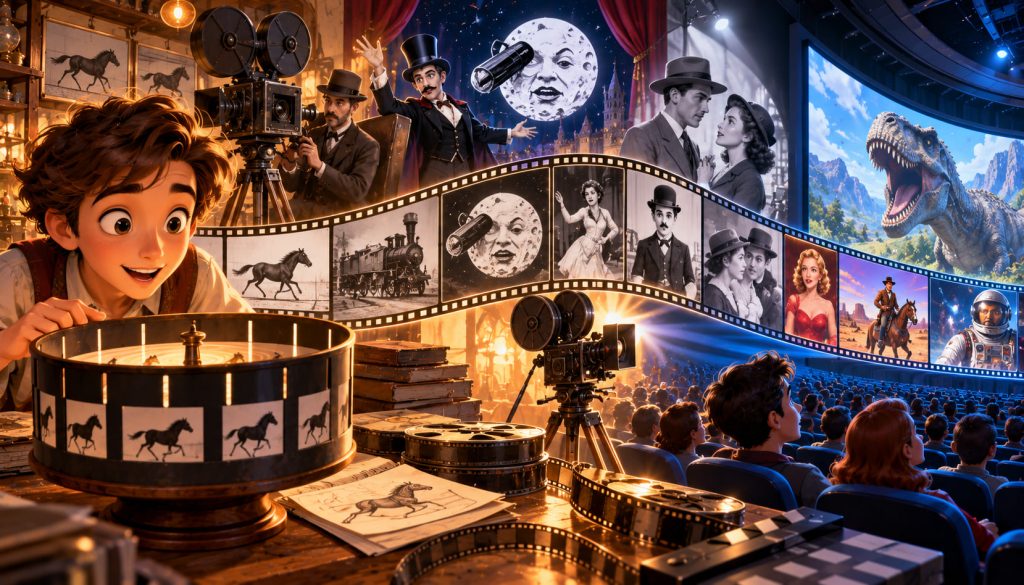
One famous device was the zoetrope, a spinning cylinder with a sequence of drawings placed around the inside. Viewers looked through narrow slots while the cylinder rotated.
The drawings appeared to move.
The principle was simple: when a series of slightly different images is shown quickly, the brain interprets them as continuous motion.
Other optical toys, including the phenakistiscope and praxinoscope, explored the same idea.
These devices were not cinema yet, but they established a crucial principle: motion could be created from a rapid sequence of still pictures.
Photography Made Motion Recordable
The invention of photography changed everything.
Instead of drawing each stage of movement by hand, inventors could now capture real people, animals, and events.
During the 19th century, photographers began experimenting with sequences of images.
Eadweard Muybridge famously photographed a galloping horse using multiple cameras arranged along a track.
His images demonstrated phases of movement that the human eye could not easily separate.
Étienne-Jules Marey developed other techniques for recording movement over time.
These experiments were scientifically important, but they also brought the world closer to motion pictures.
Flexible Film Was a Major Breakthrough
Early photographic plates were rigid and inconvenient.
Cinema needed a material that could move rapidly through a camera and projector.
Flexible photographic film provided the solution.
Roll film made it possible to capture long sequences of images on a continuous strip.
Perforations along the edges helped machines pull the film forward at regular intervals.
This allowed cameras to expose frame after frame with increasing precision.
Without flexible film, practical cinema would have been extremely difficult to develop.
Edison, Dickson, and the Kinetoscope
In the United States, Thomas Edison and William Kennedy Laurie Dickson played major roles in early motion-picture technology.
Dickson developed the Kinetograph camera and the Kinetoscope viewing machine.
The Kinetoscope allowed one person at a time to watch short moving images through a viewing window.
These early films showed dancers, athletes, performers, and staged scenes.
The system was commercially successful, but it was not yet the cinema experience we recognize today because the images were not projected for a large audience.
The Lumière Brothers and Public Projection
A major turning point came in France.
Auguste and Louis Lumière developed the Cinématographe, a lightweight device that could function as camera, film printer, and projector.
In 1895, they presented projected moving pictures to paying audiences in Paris.
Their short films showed everyday scenes such as workers leaving a factory, people walking, and trains arriving at stations.
The films were brief, but the experience was revolutionary.
For the first time, large groups of people could gather in a darkened room and watch recorded movement projected onto a screen.
This shared viewing experience became the foundation of modern cinema.
Georges Méliès Turned Film into Fantasy
Early cinema quickly moved beyond simple documentation.
French filmmaker Georges Méliès realized that film could create illusions.
He used stop-camera effects, multiple exposures, painted scenery, dissolves, and elaborate stage sets.
His films introduced audiences to impossible journeys, magical transformations, and fantastical worlds.
A Trip to the Moon became one of the most iconic films of early cinema.
Méliès demonstrated that film was not merely a recording technology.
It could also be storytelling, theater, illusion, and visual imagination.
Editing Created a New Language
Cinema became much more powerful when filmmakers learned to edit shots together.
Instead of recording an entire event from one fixed position, directors could show different locations, angles, and moments.
Cross-cutting allowed films to alternate between simultaneous events.
Close-ups revealed emotions and details.
Wide shots established environments.
Montage could compress time or create meaning through contrast.
Filmmakers such as Edwin S. Porter and D. W. Griffith helped develop narrative editing techniques, though cinema evolved through the work of many creators across several countries.
Editing transformed film from photographed theater into a unique visual language.
Silent Cinema Was Never Truly Silent
Films before synchronized dialogue are called silent films, but screenings were rarely silent.
Movie theaters often used pianists, organists, small ensembles, or full orchestras.
Large productions sometimes included specially composed musical scores.
Sound-effects performers could add noises behind the screen.
Intertitles displayed dialogue and important information.
Actors such as Charlie Chaplin, Buster Keaton, and Harold Lloyd developed highly expressive visual styles that worked without spoken dialogue.
Silent cinema became a sophisticated international art form.
The Arrival of Sound
Attempts to combine film and recorded sound began early, but synchronization was difficult.
The major breakthrough came during the late 1920s.
Films such as The Jazz Singer demonstrated commercially successful synchronized dialogue and music.
The transition was rapid.
Studios rebuilt stages to control unwanted noise.
Actors had to adjust to microphones.
Cameras were initially placed inside soundproof enclosures because they were too noisy.
Theater owners installed new sound systems.
Within only a few years, the silent-film era was largely over.
Color Changed the Screen
Early filmmakers experimented with color by hand-painting frames or tinting entire scenes.
Later, more sophisticated photographic color processes appeared.
Technicolor became especially famous.
Three-strip Technicolor recorded color information through separate components and produced highly saturated images.
Films in the 1930s and 1940s demonstrated how powerful color could be for spectacle, costume, landscape, and fantasy.
Eventually, simpler color-film systems replaced the complex early processes.
By the second half of the 20th century, color had become standard for mainstream cinema.
Widescreen Fought Back Against Television
After television became common in homes, movie studios looked for ways to make theaters feel more spectacular.
One response was widescreen.
Formats such as CinemaScope created much wider images than traditional film frames.
Large screens became ideal for epics, landscapes, battles, and musicals.
Other systems experimented with curved screens, multiple synchronized projectors, and large-format photography.
Cinema was becoming not just a moving image but an immersive environment.
Special Effects Became More Sophisticated
Visual effects evolved alongside filmmaking.
Early filmmakers used miniatures, matte paintings, rear projection, stop-motion animation, optical compositing, and mechanical effects.
These methods produced everything from giant monsters to spaceships.
Later, computers changed the field.
Digital imagery made it possible to create creatures, environments, explosions, and entire worlds that would have been impossible to film physically.
However, modern productions often combine practical effects with digital techniques.
Cinema has always relied on illusion; only the tools have changed.
The Digital Revolution
For most of film history, movies were captured on photographic film.
Digital cameras gradually transformed production.
High-resolution digital sensors became capable of producing images suitable for theatrical release.
Editing also moved from physically cutting film strips to computer-based nonlinear systems.
Digital projection then transformed theaters.
Instead of shipping heavy reels of film, distributors could deliver movies as digital files.
This made distribution easier and allowed more consistent projection quality.
What Makes IMAX Different?
IMAX was developed to create a much larger and more immersive cinematic experience.
Traditional 70 mm IMAX film runs horizontally through the camera and projector, creating an exceptionally large image area.
This allows extremely high visual detail when genuine large-format film is used.
IMAX theaters also use specialized projection systems, large screens, steep seating arrangements, and powerful sound.
Modern IMAX includes both film-based and digital systems.
Some filmmakers use IMAX-certified digital cameras, while others still shoot selected sequences on large-format film.
IMAX represents the same ambition that drove cinema from the beginning: making moving images feel more immediate, spectacular, and real.
Expert Perspective
Film historians often describe cinema as both an artistic medium and a technological system.
Its evolution depended on cameras, film stock, lenses, projectors, sound recording, lighting, editing, architecture, and distribution.
But technology alone did not create cinema.
Directors, actors, cinematographers, editors, designers, musicians, and audiences continually shaped how those technologies were used.
The most important breakthroughs happened when technical invention met creative experimentation.
Cinema Keeps Reinventing Itself
Cinema has survived radio, television, home video, streaming, smartphones, and virtual reality.
Each new technology has changed how people watch moving images.
Yet movie theaters still offer something unusual: a large image, controlled sound, darkness, and a group of people experiencing the same story together.
From a spinning zoetrope to a giant IMAX screen, the basic fascination remains unchanged.
Humans still want to see still images come alive.
Interesting Facts
- The zoetrope creates apparent movement using a rotating sequence of still images.
- Eadweard Muybridge used multiple cameras to study animal motion in the 19th century.
- The Lumière brothers held famous public film screenings in Paris in 1895.
- Georges Méliès helped establish special effects and fantasy filmmaking.
- Silent films were usually accompanied by live music.
- Early sound cameras were so noisy that they sometimes had to be enclosed in soundproof booths.
- Technicolor became famous for its rich and highly saturated colors.
- Widescreen formats expanded partly as a response to the growing popularity of television.
- Traditional IMAX 70 mm film uses a much larger image area than standard 35 mm film.
- Many modern movies combine practical effects, miniatures, computer-generated imagery, and digital compositing.
- Digital projection largely replaced film projection in commercial cinemas during the 21st century.
- IMAX can refer to several different projection systems, including both film and digital technologies.
Glossary
- Zoetrope — A rotating optical device that creates the illusion of motion from sequential drawings.
- Phenakistiscope — An early spinning-disc device that produces apparent animation from a sequence of images.
- Kinetoscope — An early motion-picture viewing machine designed for individual viewing.
- Cinématographe — A compact early motion-picture camera, printer, and projector developed by the Lumière brothers.
- Frame — A single still image in a sequence of motion-picture images.
- Intertitle — A card inserted into silent films to display dialogue or information.
- Montage — The arrangement of shots through editing to compress time, create rhythm, or produce meaning.
- Cross-Cutting — Editing between two or more scenes presented as occurring at the same time.
- Technicolor — A family of color-film processes famous for vivid color reproduction.
- Widescreen — A film format with a wider image proportion than earlier standard cinema formats.
- Practical Effects — Physical effects created on set using models, makeup, mechanisms, pyrotechnics, or other real objects.
- CGI — Computer-generated imagery used to create or alter visual elements digitally.
- Digital Projection — The display of movies from digital files rather than traditional photographic film.
- IMAX — A large-format cinema system designed for very large screens, high image detail, and immersive sound.
- 70 mm Film — A large photographic film format used for higher-resolution motion pictures and specialized projection systems.