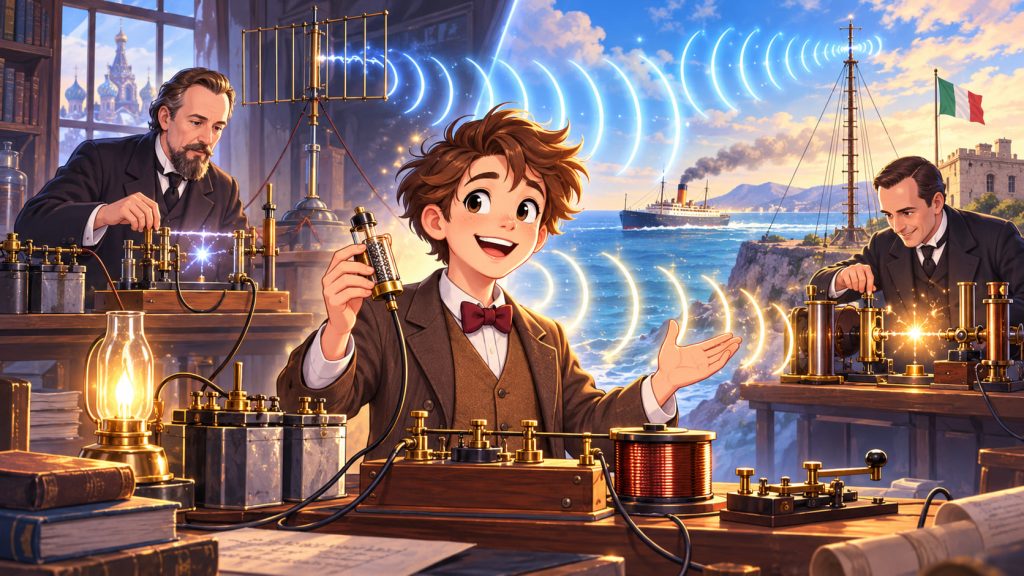
Radio changed the world by making it possible to send information through the air without wires. It transformed communication at sea, military coordination, news, entertainment, science, and eventually everyday life.
But who invented radio?
The answer is more complicated than naming one person.
Alexander Popov in Russia and Guglielmo Marconi in Italy were both pioneers of wireless communication in the 1890s. Their work developed at nearly the same time, and the question of who deserves priority became a long-running historical dispute.
Radio was not invented in a single moment. It emerged from a chain of discoveries in physics, electrical engineering, signaling, antennas, detectors, and practical communication systems.
Radio Began Before Popov and Marconi
The scientific foundations of radio were established before either man began his famous experiments.
In the 1860s, Scottish physicist James Clerk Maxwell developed a mathematical theory showing that changing electric and magnetic fields could travel through space as electromagnetic waves.
This was a theoretical prediction.
Several decades later, German physicist Heinrich Hertz experimentally demonstrated electromagnetic waves in the laboratory.
Hertz generated sparks in one circuit and detected electrical effects in another circuit at a distance.
His experiments proved that electromagnetic waves were real.
However, Hertz was primarily interested in physics rather than creating a communication system.
Popov and Marconi inherited the crucial scientific insight that invisible electromagnetic waves could travel through space.
The Problem Was Turning Waves Into Messages
Producing radio waves was only part of the challenge.
Inventors needed a device capable of detecting weak signals reliably.
One important component was the coherer.
A coherer typically contained metal filings inside a small tube. When exposed to a radio signal, its electrical resistance changed, allowing the signal to trigger another circuit.
French physicist Édouard Branly helped develop this detector, while British physicist Oliver Lodge demonstrated improvements and practical applications.
These developments created the technical foundation on which both Popov and Marconi built their systems.
Alexander Popov and His Early Experiments
Alexander Stepanovich Popov was a Russian physicist and electrical engineer.
He became interested in Hertzian waves and methods for detecting them.
Popov constructed a receiver using a coherer connected to an antenna and grounding system.
On May 7, 1895, according to the Gregorian calendar date traditionally commemorated in Russia, he publicly demonstrated a device capable of detecting electromagnetic disturbances.
His apparatus was initially associated with detecting atmospheric electrical activity such as lightning.
The antenna was especially important.
By using a vertical wire connected to the receiver, Popov increased its sensitivity and range.
Popov’s work was an important step toward practical radio reception.
Did Popov Send a Radio Message?
This question is central to the dispute.
Popov later developed his equipment for wireless signaling.
In 1896, he demonstrated the transmission of a signal between buildings in St. Petersburg.
Russian accounts have traditionally emphasized that he transmitted the words “Heinrich Hertz” in Morse code.
Popov’s supporters therefore argue that he had demonstrated practical wireless telegraphy independently and very early.
However, the exact chronology and documentation of some demonstrations have been debated by historians.
What is clear is that Popov was conducting serious experiments in wireless reception and signaling in the mid-1890s.
Marconi Took a Different Approach
Guglielmo Marconi was an Italian inventor with a strong focus on practical long-distance communication.
Working at his family estate in Italy, he experimented with spark transmitters, coherer receivers, antennas, and grounding.
Marconi’s major achievement was not simply detecting radio waves.
He systematically improved range.
He experimented with antenna height, grounding, transmitter power, tuning, and circuit design.
By 1895 and 1896, he was achieving increasingly long transmission distances.
Marconi also recognized something extremely important: wireless telegraphy could become a commercial communication system.
The Patent That Changed the Debate
In 1896, Marconi traveled to Britain.
He filed a patent for a system of wireless telegraphy.
This became one of the most important moments in radio history.
Patents provide formal documentation, and Marconi’s filings helped establish his international reputation.
He worked with the British Post Office and conducted increasingly ambitious public demonstrations.
Messages were transmitted across open land, waterways, and eventually the sea.
Marconi combined invention, engineering, patents, demonstrations, and business organization in a way that turned wireless experiments into an operational technology.
Why Popov Did Not Patent His Work Early
Popov worked mainly as a scientist and educator rather than as a commercial entrepreneur.
His early experiments were presented within scientific and naval environments.
He published descriptions of his equipment but did not initially pursue aggressive international patent protection.
This difference mattered enormously.
Marconi built a company and commercialized wireless telegraphy.
Popov continued improving radio equipment, particularly for communication associated with the Russian Navy.
The contrast between them helps explain why Marconi became internationally famous while Popov remained more strongly celebrated in Russia and parts of Eastern Europe.
Wireless Communication at Sea
Radio became especially valuable for ships.
Before wireless telegraphy, vessels far from shore could become completely isolated.
If a ship encountered danger, there might be no way to call for help.
Popov participated in experiments connecting ships and shore stations.
In Russia, wireless systems were used in maritime and naval communication.
Marconi’s systems also became increasingly important aboard ships.
Wireless telegraphy soon demonstrated its value in rescues, navigation, weather reporting, and emergency communication.
The sea became one of the first environments in which radio proved that it was far more than a laboratory curiosity.
Marconi’s Transatlantic Experiment
One of Marconi’s most famous achievements came in 1901.
He claimed to have received a radio signal transmitted from Cornwall in England at St. John’s, Newfoundland.
The signal was the Morse-code letter “S,” consisting of three dots.
The experiment became famous because many scientists believed radio waves could not travel such a great distance beyond the horizon.
Later research showed that the ionosphere can reflect or refract certain radio frequencies back toward Earth, allowing long-distance communication.
The exact conditions and interpretation of the 1901 experiment have been discussed by historians, but Marconi quickly followed it with increasingly convincing long-distance demonstrations.
So Who Invented Radio?
There is no simple answer.
If the question is who first demonstrated an early practical radio receiver with an antenna, Popov has a strong historical claim.
If the question is who created, patented, commercialized, and internationally deployed a complete wireless telegraphy system, Marconi has a stronger claim.
Other scientists also made essential contributions.
Maxwell predicted electromagnetic waves.
Hertz proved their existence.
Branly developed important detector technology.
Lodge improved radio-wave detection and tuning.
Nikola Tesla worked on wireless systems and patented related technologies.
Radio emerged from the combined work of many people rather than from one isolated invention.
Why the Priority Dispute Became So Important
The disagreement over Popov and Marconi was influenced not only by technology but also by national pride.
In Russia and the Soviet Union, Popov was widely presented as the inventor of radio.
May 7 became Radio Day in the Soviet Union and remains associated with the history of radio in several countries.
In Western Europe and much of the English-speaking world, Marconi became the dominant figure because of his patents, company, international demonstrations, and commercial success.
Both narratives contain important parts of the story.
The dispute shows how technological history can depend on what exactly counts as “invention”: first experiment, first public demonstration, first message, first patent, or first practical commercial system.
Expert Perspective
Historians of technology generally prefer to describe radio as a multi-stage invention.
No single experiment created modern radio.
It required theoretical physics, detectors, antennas, transmitters, grounding, tuning, amplification, signaling protocols, and eventually industrial infrastructure.
Popov was a major early experimenter who demonstrated sophisticated wireless reception and communication.
Marconi became the most successful early system builder and entrepreneur.
This distinction explains why both men remain central to the story.
From Telegraph Signals to Broadcasting
Early radio was mainly wireless telegraphy.
Operators transmitted Morse code rather than speech or music.
Later developments made voice transmission possible.
Vacuum tubes enabled stronger and more controllable signals.
By the early 20th century, experimental radio broadcasts began transmitting music and speech.
During the 1920s, commercial broadcasting expanded rapidly.
Families gathered around radio receivers for news, concerts, drama, sport, and political speeches.
Radio had evolved from a scientific experiment into a mass medium.
Radio Still Surrounds Us
Modern radio technology goes far beyond traditional broadcasting.
Radio waves are used in:
- Mobile phones
- Wi-Fi
- Bluetooth
- Satellite communication
- Aviation
- Radar
- GPS
- Emergency systems
- Space communication
The devices are completely different from Popov’s and Marconi’s spark transmitters.
But the basic principle remains the same.
Information is encoded into electromagnetic waves and transmitted through space without a physical wire connecting sender and receiver.
Interesting Facts
- James Clerk Maxwell predicted electromagnetic waves mathematically before they were experimentally observed.
- Heinrich Hertz proved the existence of electromagnetic waves in the late 19th century.
- Alexander Popov publicly demonstrated a radio-wave detection device in 1895.
- Popov used a vertical antenna to improve signal reception.
- Guglielmo Marconi filed an important wireless telegraphy patent in Britain in 1896.
- Early radio systems transmitted Morse code rather than voice.
- Ships were among the first major users of wireless communication.
- Marconi’s 1901 transatlantic experiment became one of the most famous events in radio history.
- Long-distance radio became possible partly because radio waves can interact with the ionosphere.
- Popov is traditionally honored as a radio pioneer in Russia and several neighboring countries.
- Marconi received the 1909 Nobel Prize in Physics jointly with Karl Ferdinand Braun for contributions to wireless telegraphy.
- Modern Wi-Fi, Bluetooth, radar, and mobile communications all rely on radio-frequency electromagnetic waves.
Glossary
- Radio — The transmission and reception of information using electromagnetic waves.
- Electromagnetic Wave — A traveling disturbance of electric and magnetic fields that can move through space.
- Wireless Telegraphy — The transmission of coded telegraph signals without wires.
- Coherer — An early radio-wave detector containing conductive particles whose electrical resistance changes when exposed to a radio signal.
- Antenna — A structure used to transmit or receive electromagnetic waves.
- Grounding — Connecting an electrical system to Earth, often to improve performance or safety.
- Morse Code — A communication system representing letters and numbers with combinations of short and long signals.
- Spark Transmitter — An early radio transmitter that generated electromagnetic waves using electrical sparks.
- Receiver — A device that detects and processes transmitted radio signals.
- Transmitter — A device that generates and sends electromagnetic signals.
- Ionosphere — A region of Earth’s upper atmosphere containing electrically charged particles that can affect radio-wave propagation.
- Radio Frequency — A range of electromagnetic frequencies commonly used for wireless communication.
- Patent — A legal right protecting an invention for a limited period.
- Broadcasting — The transmission of audio, video, or other information to a large audience.