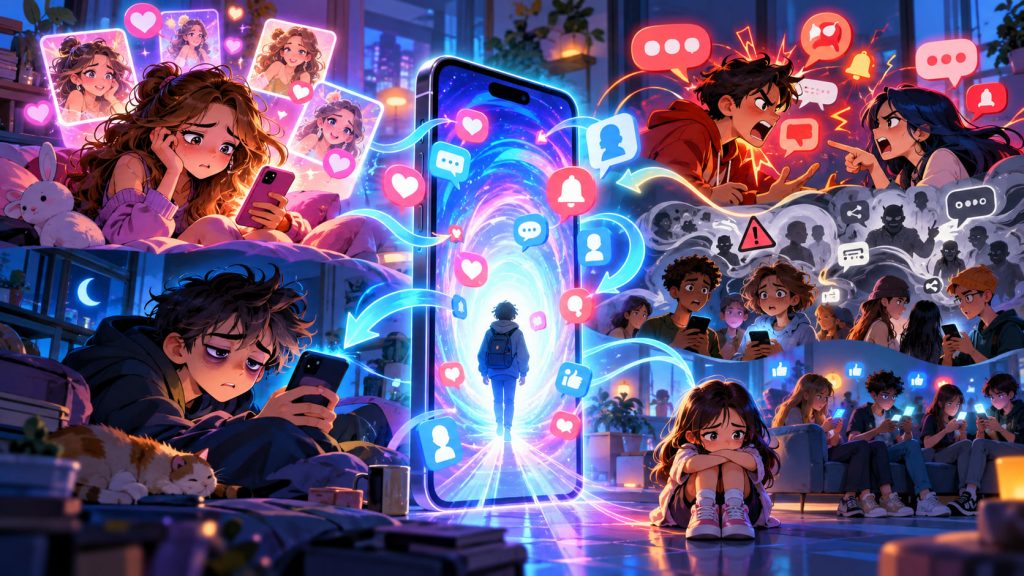
Social media has transformed the way people communicate, consume news, build relationships, and participate in public life. Billions of people can now share information instantly, connect across continents, and discover communities that would once have been impossible to reach.
But the same systems that make social media powerful can also produce serious social costs.
Platforms compete for attention, algorithms reward highly engaging content, and public approval is often reduced to measurable signals such as likes, shares, views, and follower counts.
The negative effects of social media are not caused by one single feature. They emerge from the interaction between human psychology, algorithmic systems, commercial incentives, and enormous online networks.
The Attention Economy Changes How Platforms Are Designed
Most major social platforms depend heavily on advertising or engagement-based business models.
The longer people remain on a platform, the more opportunities the company has to show advertisements, collect behavioral data, or encourage additional interaction.
This creates what is often called the attention economy.
Features such as infinite scrolling, autoplay, personalized recommendations, notifications, and rapidly refreshing feeds can make it difficult to stop using a platform.
These tools are not accidental additions. They are designed to reduce friction and keep users engaged.
When attention becomes a commercial resource, platforms have a financial incentive to capture as much of it as possible.
Algorithms Can Amplify Emotionally Powerful Content
Modern social-media feeds are rarely arranged simply by time.
Algorithms decide which posts are likely to attract attention.
Content that causes surprise, anger, fear, amusement, or outrage can generate large numbers of comments and shares.
As a result, emotionally provocative material may spread faster than calm or nuanced information.
This does not mean algorithms intentionally create conflict in every case. However, systems optimized for engagement can unintentionally reward content that provokes strong emotional reactions.
Over time, this can make online environments appear more hostile, dramatic, and polarized than everyday life.
Misinformation Can Spread Extremely Quickly
Social networks allow accurate information to travel rapidly, but false information can move just as easily.
A misleading claim can be copied thousands of times before experts, journalists, or institutions have time to examine it.
Images can be removed from their original context.
Old videos can be presented as current events.
Artificial intelligence can generate convincing photographs, voices, and text that make verification even more difficult.
Repeated exposure creates another problem.
Psychological research shows that familiar statements may sometimes feel more credible simply because people have encountered them repeatedly.
Virality is a measure of attention, not a measure of truth.
Social Comparison Can Damage Well-Being
Social media encourages constant comparison with other people.
Users often share carefully selected moments: vacations, achievements, attractive photographs, celebrations, expensive purchases, and professional success.
Viewers may compare these polished highlights with their own ordinary lives.
This can create the impression that everyone else is happier, wealthier, more attractive, or more successful.
For adolescents and young adults in particular, appearance-focused platforms may intensify concerns about body image and social status.
Filters and image-editing tools can make these comparisons even more unrealistic.
The result can be reduced self-esteem, dissatisfaction, anxiety, and pressure to maintain an idealized online identity.
Likes Turn Social Approval Into a Number
Human beings naturally care about social acceptance.
Social media converts this ancient psychological need into visible statistics.
Likes, follower counts, views, reactions, and shares provide immediate feedback about how other people respond to a post.
This numerical system can encourage users to evaluate themselves through public approval.
A successful post may produce excitement, while a post receiving little attention may feel like rejection.
For some users, this can create repetitive checking behavior.
Instead of simply sharing an experience, people may begin asking how well that experience will perform online.
When social approval becomes measurable, popularity can start to feel like a score.
Social Media Can Fragment Attention
Many platforms deliver extremely short pieces of rapidly changing information.
A user may move from a news story to a comedy video, advertisement, argument, photograph, and private message within less than a minute.
This constant switching places demands on attention.
Notifications can interrupt studying, conversations, work, and sleep.
Even when a phone is not being actively used, the expectation of new messages can encourage frequent checking.
Over time, habitual interruption can make sustained concentration more difficult.
Long periods of focused reading, problem-solving, or creative work compete with platforms designed to offer immediate stimulation.
Sleep Can Be Disrupted
Social media can interfere with sleep in several ways.
People may continue scrolling long after they intended to stop.
Emotionally stimulating content can make relaxation more difficult.
Notifications may interrupt sleep during the night.
Using a bright screen shortly before bedtime can also influence the body’s normal preparation for sleep.
Poor sleep affects memory, emotional regulation, concentration, and physical health.
For teenagers, whose sleep needs are already substantial, late-night social-media use can become particularly disruptive.
Cyberbullying Extends Conflict Beyond Physical Spaces
Before social media, bullying at school or work often ended when someone left the physical environment.
Online communication can follow people everywhere.
Humiliating photographs, insulting messages, rumors, and coordinated harassment can reach enormous audiences within minutes.
Anonymous accounts can reduce social restraint because users may feel protected from immediate consequences.
Victims may also find it difficult to escape harmful material once it has been copied or widely shared.
Digital harassment can be persistent, searchable, shareable, and visible to audiences far larger than those involved in the original conflict.
Online Communities Can Become Echo Chambers
Personalized algorithms learn what users tend to watch, like, and share.
This can gradually create information environments dominated by familiar viewpoints.
People may encounter fewer arguments that challenge their existing assumptions.
Groups can become increasingly confident that their own perspective is obvious because most of the content they see appears to support it.
These environments are often called echo chambers.
They can increase misunderstanding between social groups and make compromise more difficult.
Extreme communities can also use social networks to recruit members and normalize ideas that would receive much greater resistance in ordinary social environments.
Privacy Has Become a Social Issue
Social-media platforms can collect detailed behavioral information.
This may include what users click, how long they watch videos, which accounts they follow, where they interact from, and which advertisements attract their attention.
Even seemingly insignificant actions can contribute to sophisticated behavioral profiles.
Users also voluntarily publish information about relationships, workplaces, travel, routines, interests, and personal beliefs.
Once information is online, controlling it becomes difficult.
Screenshots, data leaks, facial recognition, automated analysis, and third-party tracking can extend the life of information far beyond the moment when it was posted.
Expert Perspective: Jonathan Haidt and Adolescent Social Life
Social psychologist Jonathan Haidt has argued that the rapid spread of smartphones and social media dramatically changed adolescent social environments.
He has particularly emphasized the effects of constant social comparison, reduced face-to-face interaction, public reputation systems, and continuous online connectivity.
His broader argument highlights an important issue: digital environments do not merely provide new communication tools; they can change the social conditions in which young people develop.
Researchers continue to examine exactly how different types of use affect different individuals, but concerns about sleep, bullying, compulsive use, body image, and excessive social comparison have become central topics in youth mental-health research.
Social Media Can Influence Public Trust
Information once passed through relatively limited numbers of newspapers, broadcasters, and institutions.
Social platforms allow almost anyone to become a publisher.
This has expanded access to information, but it has also weakened traditional systems of verification.
Rumors can compete directly with professional reporting.
Fake accounts can imitate real people.
Coordinated networks can artificially increase the apparent popularity of particular claims.
When people repeatedly encounter contradictory information, they may eventually distrust not only false sources but reliable ones as well.
A society in which citizens cannot agree on basic facts becomes more difficult to coordinate.
The Problem Is Often the Design, Not Simply Screen Time
Counting total hours online does not capture the full impact of social media.
Different activities can have very different effects.
Having a meaningful conversation with a close friend is not equivalent to spending two hours comparing appearance-focused photographs or arguing with strangers.
Passive scrolling, compulsive checking, nighttime use, hostile interactions, and algorithmically amplified content can create different risks.
The quality and structure of social-media use can matter as much as the number of minutes spent online.
Building Healthier Digital Habits
Individuals can reduce some risks by disabling unnecessary notifications, keeping phones away from the bedroom, limiting highly distracting applications, and setting periods without social media.
Curating feeds can also help.
Unfollowing accounts that repeatedly create anger, anxiety, or unhealthy comparison can change the emotional character of the online environment.
For families, discussing online behavior openly can be more useful than treating technology as something completely separate from everyday life.
Platforms also have an important role.
Better privacy controls, safer defaults for minors, clearer advertising, stronger moderation tools, transparent recommendation systems, and limits on manipulative design can reduce harm at a much larger scale.
Interesting Facts
- Social-media platforms can personalize feeds using thousands of behavioral signals.
- Infinite scrolling removes natural stopping points that once helped users decide when to leave a website.
- Notifications use visual and auditory cues to attract attention even when a person is doing something unrelated.
- Online misinformation can continue circulating long after the original false claim has been corrected.
- Image filters can create facial proportions and skin appearances that are difficult or impossible to reproduce naturally.
- Cyberbullying can reach audiences far larger than traditional face-to-face bullying.
- Repeated exposure can increase familiarity with a claim, which may affect how believable it feels.
- Social-media algorithms can create very different information environments for two people using the same platform.
- Deleting a post does not guarantee that copies, screenshots, or archived versions have disappeared.
- Social networks can simultaneously strengthen real communities and intensify harmful social comparison.
Glossary
- Social Media — Digital platforms that allow users to create, share, and interact with content and other users.
- Attention Economy — An economic system in which human attention becomes a valuable resource that companies compete to capture.
- Algorithm — A set of computational rules used to process information and make decisions, such as ranking posts in a feed.
- Recommendation System — Software that predicts which content a user is most likely to engage with.
- Engagement — User interactions such as clicks, comments, likes, shares, viewing time, and reactions.
- Echo Chamber — An environment in which people are repeatedly exposed to similar opinions while encountering relatively little opposing information.
- Misinformation — False or inaccurate information regardless of whether it was created deliberately.
- Disinformation — False or misleading information deliberately created or distributed to deceive.
- Cyberbullying — Harassment, intimidation, humiliation, or abuse conducted through digital communication.
- Social Comparison — The process of evaluating oneself by comparing personal qualities or achievements with those of others.
- Infinite Scroll — A design system that continuously loads new content as the user moves down a page.
- Algorithmic Amplification — The increased visibility of content caused by automated recommendation and ranking systems.
- Digital Footprint — The collection of data and information created through a person’s online activities.
- Behavioral Profiling — The analysis of user activity to infer interests, preferences, habits, or likely future behavior.