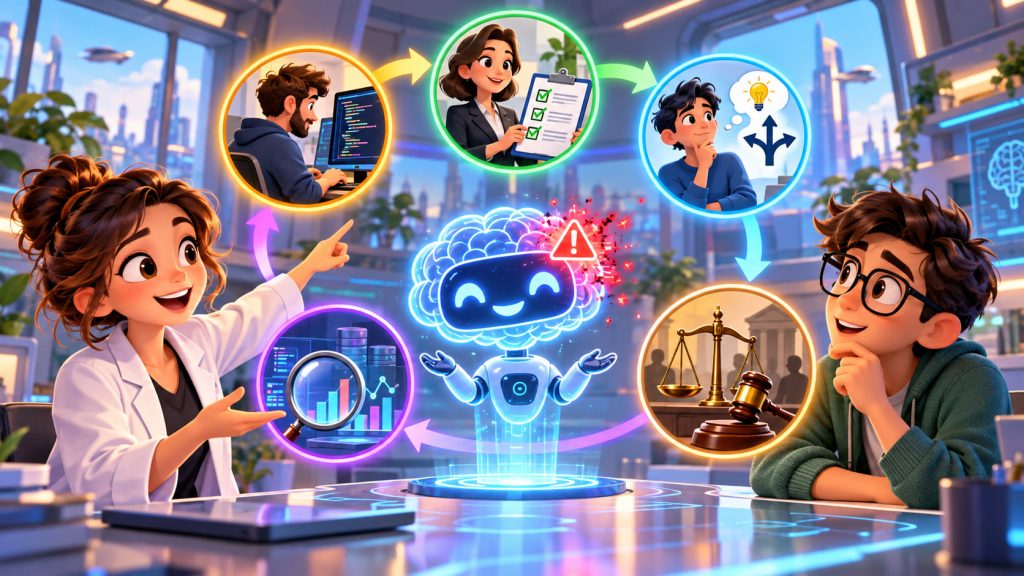
Artificial intelligence can recommend medical treatments, approve financial transactions, generate legal documents, control industrial systems, screen job candidates, and assist people with thousands of everyday decisions.
But what happens when an AI system makes a serious mistake?
If an algorithm rejects someone unfairly, an autonomous system causes damage, or an AI-generated recommendation leads to a costly decision, responsibility cannot simply be assigned to “the machine.”
AI systems do not operate independently of human choices. They are designed, trained, deployed, configured, monitored, and used by people and organizations.
That makes responsibility for AI errors one of the most important legal and ethical questions of the modern technology industry.
AI Is Usually Not a Legal Person
The first important principle is that an AI system is generally not treated as a legal person.
A corporation can own property and enter contracts. A human can be prosecuted, sued, or held professionally responsible.
An AI model normally cannot.
If an AI system causes harm, investigators therefore look at the humans and organizations involved in creating and using it.
Responsibility may fall on developers, software providers, companies deploying the system, professional users, equipment manufacturers, or several parties at the same time.
The fact that an AI system made the immediate decision does not automatically remove human responsibility.
The Developer’s Responsibility
AI developers decide how a system is designed and trained.
They choose training methods, data sources, evaluation procedures, safety mechanisms, and technical limitations.
If a system contains a serious defect that could reasonably have been discovered through testing, its developer or provider may bear part of the responsibility for resulting harm.
Developers are also responsible for communicating limitations.
An AI system designed for general information should not be marketed as if it were guaranteed to provide professional medical or legal advice.
Clear documentation becomes especially important when other organizations depend on the technology.
The Company Deploying the AI
The organization that puts an AI system into real-world use can have substantial responsibility.
Imagine a bank using an automated system to evaluate loan applications.
Even if another company created the underlying model, the bank decides to use it for that purpose.
The bank may determine which information is provided to the system, how its recommendations are interpreted, whether humans review decisions, and what happens when the software produces uncertain results.
Organizations cannot necessarily avoid responsibility simply by saying that an algorithm made the decision.
Deployment is itself a human decision.
Responsibility of the Human User
Users can also be responsible for how AI-generated information is used.
Suppose an engineer asks an AI system to perform a technical calculation and then approves a design without checking the result.
If the calculation is wrong, responsibility may depend partly on whether professional standards required independent verification.
The same principle can apply to doctors, lawyers, accountants, researchers, programmers, and other professionals.
AI can assist professional judgment, but it does not automatically replace professional duties.
The greater the potential consequences, the more important verification becomes.
Automation Bias: When Humans Trust AI Too Much
One major problem is known as automation bias.
People sometimes give excessive credibility to automated recommendations simply because they came from a computer.
If an AI system produces a confident-looking answer, users may assume it has checked information more thoroughly than it actually has.
This can be dangerous.
Language models can generate convincing but incorrect statements. Computer-vision systems can misclassify objects. Predictive algorithms can reproduce patterns from flawed historical data.
Human oversight only works when people are genuinely capable of questioning the machine.
Simply placing a person somewhere in the decision process does not guarantee meaningful supervision.
What If the AI Was Used Exactly as Intended?
Responsibility becomes more complicated when everyone appears to have followed the instructions.
Suppose a company uses an AI system exactly as recommended, yet the system produces an unexpected harmful result.
Investigators may examine whether the system was adequately tested, whether risks were foreseeable, whether warnings were sufficient, and whether appropriate monitoring existed.
Product liability principles may sometimes become relevant when AI is integrated into commercial products.
Contract law, negligence rules, professional liability, consumer protection, privacy law, and sector-specific regulations may also apply.
The exact legal answer depends on the country, industry, type of AI system, and nature of the harm.
What If the User Misuses the AI?
Not every AI-related problem is the developer’s responsibility.
Users can deliberately ignore warnings or use software for purposes it was never designed to handle.
For example, someone might use an entertainment chatbot as the sole basis for a high-stakes engineering decision despite explicit limitations.
In such circumstances, the user or organization deploying the system may carry greater responsibility.
However, simply placing a warning in the terms of service does not automatically eliminate every obligation of the provider.
The key question is usually whether the risks were reasonably foreseeable and whether appropriate precautions were taken.
Shared Responsibility Is Common
AI systems are often built through long chains of technology.
One company may create the foundation model.
Another may customize it.
A third company may provide data.
A fourth may integrate the system into business software.
An employer may then use that software to make decisions affecting customers or employees.
When something goes wrong, responsibility may therefore be distributed across several organizations.
This is sometimes described as an AI accountability chain.
Understanding who controlled which decision becomes essential.
The Importance of Human Oversight
Human oversight is one of the most widely discussed safeguards in responsible AI.
But effective oversight means more than providing an emergency stop button.
A supervisor should understand the system’s purpose, limitations, possible errors, and circumstances in which its recommendations should not be trusted.
Organizations also need escalation procedures.
If an AI system repeatedly produces unusual results, employees should know who can investigate the issue and whether the system should temporarily stop operating.
Responsible AI requires humans who have both the authority and the knowledge to intervene.
Logs, Audits, and Traceability
Determining responsibility becomes much easier when organizations keep detailed records.
Logs can show what information the AI received, which version of the model was running, what output it produced, and what actions humans took afterward.
Audits can evaluate whether a system behaves differently across populations or situations.
Testing can identify dangerous failure modes before deployment.
Traceability is particularly important in high-risk environments because investigators need to reconstruct what happened after an incident.
Without records, assigning responsibility may become extremely difficult.
Expert Perspective: Responsibility Cannot Be Delegated to a Machine
Responsible-AI researcher Virginia Dignum has emphasized that the use of autonomous systems does not remove human accountability.
A central idea in responsible AI is that humans and organizations remain responsible for decisions about how intelligent systems are designed, deployed, and governed.
This distinction is important.
An AI system may operate autonomously in a technical sense, meaning it can perform actions without constant human commands.
But technical autonomy does not automatically create moral or legal independence.
Humans still decide where that autonomy is allowed.
High-Risk AI Requires Stronger Controls
Not every AI mistake has the same consequences.
A recommendation system suggesting the wrong movie is very different from an AI system influencing medical treatment, transportation, employment, credit, or critical infrastructure.
The greater the potential harm, the stronger the safeguards should normally be.
High-risk uses may require more extensive testing, monitoring, documentation, security controls, and human review.
This approach is increasingly important because AI systems are becoming integrated into environments where mistakes can affect health, safety, finances, and fundamental rights.
Why “The AI Did It” Is Not Enough
AI can make responsibility appear confusing because complex models sometimes produce results that even their developers cannot predict in detail.
But unpredictability does not mean responsibility disappears.
Society already deals with complex technologies such as aircraft, medical devices, financial systems, and industrial machinery.
Responsibility is assigned by examining design, maintenance, professional duties, foreseeable risks, and organizational decisions.
AI is likely to follow a similar principle.
The central question is not whether the machine acted independently, but which humans or organizations created, controlled, approved, or failed to manage the conditions that allowed the harm to occur.
Interesting Facts
AI accountability can involve several areas of law at the same time, including product liability, negligence, privacy, employment law, consumer protection, and professional regulation.
A single AI service may involve several independent companies, making responsibility more complicated than with traditional software.
Keeping detailed system logs can be crucial when investigators need to reconstruct an AI-related incident.
Human supervision is ineffective if supervisors are not trained to recognize when an AI recommendation may be wrong.
Automation bias can cause people to accept incorrect computer-generated recommendations even when contradictory evidence is available.
Higher-risk AI applications generally require stronger testing and governance than low-impact entertainment systems.
An AI model can be technically autonomous while humans remain legally and ethically responsible for deciding where and how it operates.
Glossary
AI Accountability — The principle that identifiable people and organizations should be answerable for how AI systems are developed, deployed, and used.
Liability — Legal responsibility for harm, damage, or loss.
Negligence — Failure to exercise a level of reasonable care expected under particular circumstances.
Product Liability — Legal responsibility that may arise when a defective product causes harm.
Automation Bias — The tendency to trust automated recommendations too strongly or accept them without sufficient verification.
Human Oversight — Supervision by people who can evaluate, challenge, or stop an automated system.
Human-in-the-Loop — A system design in which a human participates directly in certain stages of an automated process.
Audit — A structured examination of a system’s behavior, processes, risks, or compliance.
Traceability — The ability to reconstruct how a system reached or executed a particular result.
Accountability Chain — The sequence of organizations and individuals involved in developing, supplying, deploying, and operating an AI system.
High-Risk AI — AI used in contexts where errors or misuse could significantly affect safety, rights, health, finances, or other important interests.
Model Provider — An organization that develops or supplies an AI model to other users or businesses.
Deployer — An organization or individual that integrates and uses an AI system in a real-world process.
Technical Autonomy — The ability of a system to perform actions without continuous direct human control.