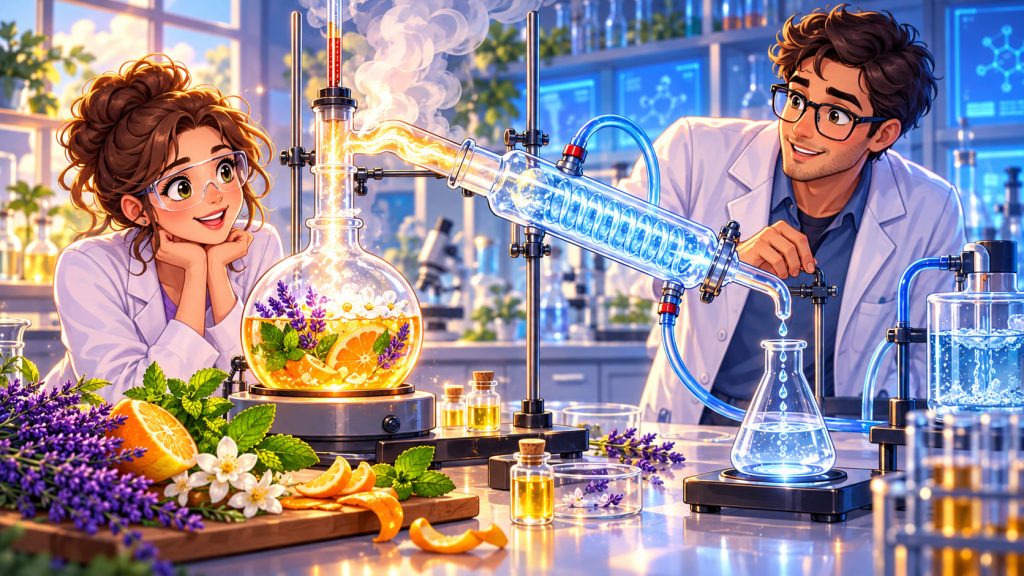
Distillation is one of the oldest and most useful separation technologies ever developed. It is used to purify water, manufacture chemicals, refine petroleum, produce fragrances, concentrate essential oils, prepare laboratory solvents, and create many alcoholic beverages.
The basic idea is surprisingly simple: heat a liquid mixture, allow part of it to become vapor, and then cool that vapor back into liquid form.
Behind this simple principle is a highly sophisticated science involving temperature, pressure, molecular behavior, energy efficiency, and engineering.
What Is Distillation?
Distillation is a separation process based mainly on differences in how easily substances evaporate.
When a liquid mixture is heated, some components enter the vapor phase more readily than others. The vapor can then be separated from the original mixture and cooled until it becomes liquid again.
This allows one substance to become more concentrated in the collected liquid while less volatile materials remain behind.
A familiar example is salt water. Heating salt water produces water vapor, but ordinary dissolved salt does not evaporate with the water under normal distillation conditions.
When the vapor is cooled, relatively pure water can be collected.
Why Different Liquids Evaporate Differently
Every liquid has a characteristic boiling point at a given pressure.
Water boils at about 100°C at standard atmospheric pressure, while ethanol boils at approximately 78°C under similar conditions.
However, distillation is not simply a matter of waiting until one liquid reaches its boiling point before another does.
Liquids continuously produce vapor even below their boiling temperatures. The tendency of molecules to escape from a liquid into the gas phase is related to vapor pressure.
A more volatile substance generally produces a larger proportion of vapor than a less volatile substance in the same mixture.
Distillation works because the vapor above a liquid mixture often has a different composition from the liquid itself.
The Basic Distillation Apparatus
A simple laboratory distillation system contains several important parts.
The liquid mixture is placed in a flask and heated. As vapor forms, it travels through a connecting path toward a condenser.
The condenser is cooled, commonly with flowing water.
As hot vapor moves through it, thermal energy is removed. The vapor changes back into liquid and flows into a receiving container.
The material that remains in the original flask is called the residue, while the collected condensed liquid is called the distillate.
This basic system can efficiently separate a volatile liquid from dissolved solids or from another liquid with a substantially different boiling behavior.
Why Simple Distillation Has Limits
Simple distillation does not perfectly separate every mixture.
If two liquids have relatively similar boiling points, both can enter the vapor phase in significant amounts.
A single evaporation-and-condensation step may therefore produce only partial separation.
Industrial and laboratory systems solve this problem using fractional distillation.
Instead of allowing vapor to travel directly into a condenser, it passes through a fractionating column.
Inside the column, repeated evaporation and condensation occur.
Each cycle can increase the concentration of the more volatile component in the rising vapor.
How Fractional Distillation Works
A fractionating column creates many miniature separation stages.
As vapor rises, it cools and partially condenses. More volatile molecules are more likely to return to the vapor phase and continue upward, while less volatile substances tend to move downward.
Part of the condensed liquid may deliberately be returned to the column. This returning liquid is called reflux.
Higher reflux can improve separation, although it also increases energy use and slows production.
Modern chemical plants may use distillation towers tens of meters high because separating complex mixtures can require many repeated equilibrium stages.
Oil Refineries Depend on Distillation
One of the largest applications of distillation is petroleum refining.
Crude oil is not a single substance. It contains an enormous mixture of hydrocarbons with different molecular sizes and boiling ranges.
Refineries heat crude oil and feed it into large fractionation towers.
Lighter components tend to leave higher sections of the tower, while heavier fractions are collected lower down.
Distillation helps separate materials later processed into products such as gasoline, jet fuel, diesel, lubricants, and petrochemical feedstocks.
Modern transportation and chemical manufacturing would be extremely difficult without large-scale distillation.
Distillation in Perfume and Essential Oils
Distillation also has a long history in fragrance production.
Steam distillation is commonly used to extract volatile aromatic substances from certain plants.
Steam passes through plant material and carries aromatic molecules with it. The mixture is then cooled, producing condensed water and essential oil.
Depending on their properties, the oil and water can often be physically separated afterward.
Lavender, peppermint, eucalyptus, rosemary, and many other aromatic plants can be processed this way.
Not every fragrance material tolerates steam distillation, however. Delicate flowers may lose important aromatic compounds when exposed to heat, so other extraction methods are sometimes preferred.
Lowering the Pressure Changes Distillation
Boiling temperature depends strongly on pressure.
Water boils at lower temperatures at high altitude because atmospheric pressure is lower. Engineers can exploit the same principle deliberately.
In vacuum distillation, pressure inside the equipment is reduced.
This lowers the temperatures required to vaporize liquids.
Vacuum distillation is especially valuable when processing substances that would decompose, react, or become damaged if heated to their normal atmospheric boiling temperatures.
Large oil refineries use vacuum distillation to separate heavy petroleum fractions without subjecting them to unnecessarily extreme heat.
Why Some Mixtures Cannot Be Completely Separated
Distillation has another important limitation.
Certain liquid mixtures form an azeotrope.
At a particular composition, the vapor produced by an azeotropic mixture has approximately the same composition as the liquid. Ordinary fractional distillation can therefore no longer continue increasing the purity beyond that point.
Ethanol and water provide a famous example.
Conventional fractional distillation cannot produce completely pure ethanol from an ethanol-water mixture because the system eventually approaches an azeotropic composition.
Producing extremely dry ethanol requires additional separation techniques.
Distillation and Drinking Water
Distillation can remove many dissolved salts, metals, and other nonvolatile contaminants from water.
For this reason, distillation has applications in laboratory water purification, ships, industrial facilities, and desalination systems.
However, boiling large quantities of water requires substantial energy.
Modern seawater desalination therefore often uses membrane-based reverse osmosis instead of conventional thermal distillation.
In regions where heat or waste energy is readily available, thermal desalination can still be useful.
Why Industrial Distillation Uses So Much Energy
Large-scale distillation is extremely effective, but heating and repeatedly vaporizing liquids requires significant energy.
Chemical engineers therefore work continuously to improve efficiency.
Heat exchangers can recover thermal energy from hot outgoing streams and transfer it to incoming material. Better column designs can improve separation while reducing energy consumption.
Experts in chemical engineering consistently emphasize that distillation efficiency depends on balancing purity, production rate, pressure, reflux, equipment size, and energy consumption.
This is especially important because distillation remains one of the most energy-intensive operations in many chemical and refining industries.
Distillation Is More Than Boiling a Liquid
At first glance, distillation may appear to be little more than boiling and collecting vapor.
In reality, successful separation requires understanding how several substances behave together.
Temperature, pressure, concentration, molecular interactions, column design, and heat transfer all influence the final result.
A laboratory apparatus may fit on a small table, while an industrial distillation tower may process thousands of tonnes of material.
The scale changes dramatically, but the fundamental principle remains the same: use differences in volatility to separate substances more efficiently.
Interesting Facts
- Distillation techniques have been used in different forms for thousands of years.
- Water can boil far below 100°C when surrounding pressure is sufficiently reduced.
- Large petroleum fractionation towers can separate many groups of hydrocarbons during continuous operation.
- Steam distillation allows aromatic plant compounds to be recovered at temperatures lower than their individual normal boiling points.
- Distilled water contains far fewer dissolved minerals than ordinary tap water.
- Multiple distillation stages can achieve much greater separation than a single evaporation-and-condensation cycle.
- Distillation columns in large industrial plants can operate continuously for months between major shutdowns.
- Ethanol and water cannot be completely separated by ordinary fractional distillation because they form an azeotropic mixture.
Glossary
- Distillation — A separation process in which components are selectively vaporized and then condensed.
- Boiling Point — The temperature at which a liquid’s vapor pressure becomes sufficient for boiling under a given external pressure.
- Vapor Pressure — The pressure produced by vapor molecules above a liquid at equilibrium.
- Condenser — Equipment that cools vapor and converts it back into liquid.
- Fractional Distillation — Distillation involving repeated vaporization and condensation to separate substances with relatively similar volatility.
- Reflux — Condensed liquid returned to a distillation column to improve separation.
- Steam Distillation — A technique using steam to extract or separate volatile, heat-sensitive compounds, especially from plant materials.
- Vacuum Distillation — Distillation performed under reduced pressure to lower boiling temperatures.
- Azeotrope — A liquid mixture whose vapor has essentially the same composition as the liquid at a particular composition, limiting separation by ordinary distillation.