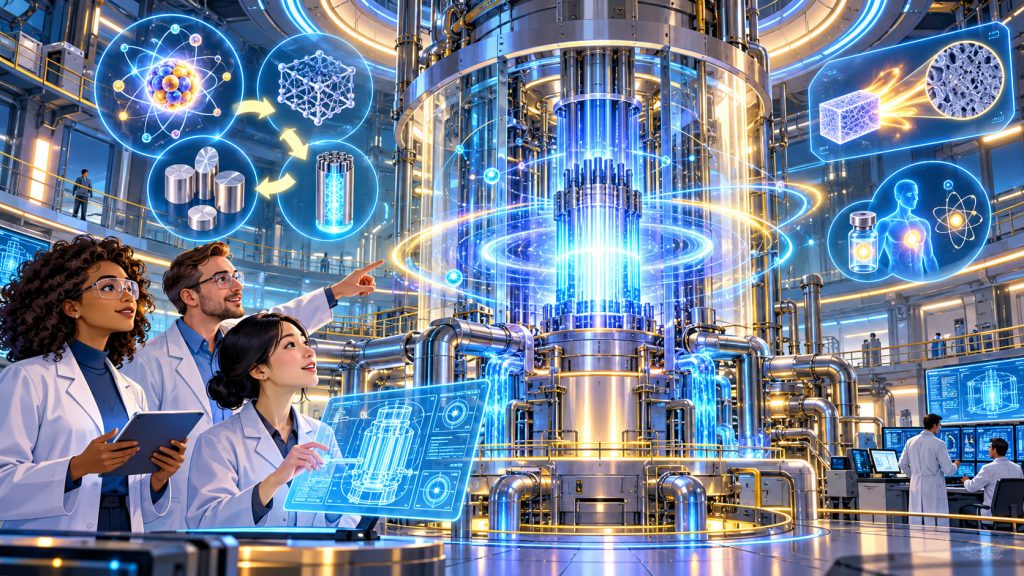
Russia is building one of the world’s most powerful and technologically advanced nuclear research reactors, designed to explore the next generation of atomic energy.
Known as MBIR, the Multipurpose Fast Research Reactor, this enormous scientific facility is being constructed in Dimitrovgrad, Russia.
Unlike conventional nuclear power plants, which primarily generate electricity, MBIR is designed to investigate nuclear fuels, advanced materials, radioactive isotopes, and future reactor technologies.
Its exceptional neutron intensity will allow scientists to study processes that would otherwise require many years of experimentation.
With a thermal power of 150 megawatts and a planned operating life of 50 years, MBIR could become one of the most important research facilities in global nuclear science.
The project also plays a significant role in Russia’s strategy to develop advanced nuclear energy systems.
What Is the MBIR Nuclear Reactor?
MBIR is a multipurpose research reactor developed within Russia’s state nuclear corporation, Rosatom.
It is being built at the Research Institute of Atomic Reactors in Dimitrovgrad, located in the Ulyanovsk region.
The facility is designed primarily for scientific experiments rather than commercial electricity generation.
Its main purpose is to provide a highly intense stream of neutrons for investigating how different materials and nuclear fuels behave under extreme conditions.
MBIR belongs to the category of fast-neutron reactors.
Unlike most conventional nuclear reactors, it does not rely on slowing neutrons down to thermal energies before they sustain the main nuclear chain reaction.
This difference creates valuable opportunities for nuclear research.
Fast neutrons allow scientists to investigate technologies that could improve fuel efficiency, reduce certain categories of nuclear waste, and support future reactor designs.
Why Fast Neutrons Are So Important
Neutrons are electrically neutral particles found inside atomic nuclei.
In nuclear reactors, they play a central role in sustaining nuclear fission.
During fission, a heavy atomic nucleus splits into smaller nuclei, releasing energy and additional neutrons.
Most commercial nuclear reactors use moderators, such as ordinary water, to slow neutrons.
MBIR uses a different approach.
Its fast-neutron spectrum makes it especially valuable for testing materials intended for advanced reactor environments.
One of its most remarkable characteristics is its extremely high neutron flux.
The reactor is designed to reach a maximum neutron flux density of approximately 5.3 × 10¹⁵ neutrons per square centimeter per second.
This intense radiation environment can accelerate certain material-damage processes.
Experiments that would require extended periods in less intense research environments may be completed much faster.
Why MBIR Uses Liquid Sodium Instead of Water
One of MBIR’s most unusual engineering features is its cooling system.
The reactor uses liquid sodium as its primary coolant.
Sodium has several properties that make it suitable for fast-reactor technology.
It transfers heat efficiently and has a boiling temperature of approximately 883°C at atmospheric pressure.
This allows a sodium-cooled reactor to operate at high temperatures without requiring the extremely high coolant pressures typical of many water-cooled reactors.
Sodium also interacts relatively weakly with neutrons, helping preserve the fast-neutron spectrum.
However, sodium reacts vigorously with water and can burn in air.
Engineers must therefore employ carefully designed systems to prevent leaks, separate incompatible substances, and manage abnormal operating conditions.
MBIR uses a three-circuit heat-transfer arrangement, with sodium in the first two circuits and a water-steam system in the third.
Liquid sodium offers important nuclear engineering advantages, but it requires specialized safety systems and operational procedures.
How Powerful Is the MBIR Reactor?
MBIR has a designed thermal power of 150 megawatts.
This makes it exceptionally powerful for a research reactor.
Its design also includes an electrical generation capacity of approximately 55 megawatts.
However, electrical production is not the facility’s principal mission.
Its scientific value comes primarily from the neutron environment available for experiments.
The reactor is designed to support multiple experimental installations operating under different conditions.
Researchers will be able to investigate materials inside the reactor core and use specialized experimental channels outside it.
MBIR is intended to function as a large scientific laboratory powered by a nuclear reactor, rather than simply as another electricity-producing station.
Testing Materials for Future Nuclear Reactors
Materials inside nuclear reactors experience demanding operating conditions.
They must withstand high temperatures, radiation exposure, mechanical stress, and chemical interactions with surrounding substances.
Over time, neutron irradiation can change the microscopic structure of metals and other materials.
This may influence strength, flexibility, swelling, and resistance to cracking.
MBIR will support extensive irradiation testing of materials intended for advanced nuclear systems.
Scientists plan to investigate specialized steels, structural alloys, ceramics, and components used in reactor equipment.
The facility can also support research into new nuclear fuel designs.
By exposing samples to intense neutron radiation, researchers can investigate how they change under conditions relevant to future reactors.
These experiments are essential for developing technologies capable of operating reliably over long periods.
Could MBIR Help Reduce Nuclear Waste?
One of the most ambitious areas of research involves the closed nuclear fuel cycle.
In conventional nuclear energy systems, spent nuclear fuel contains valuable materials alongside radioactive waste products.
Advanced fuel-cycle technologies aim to recover usable nuclear materials and recycle them into new fuel.
Fast-neutron systems can play an important role in this approach.
They can support research into the use of plutonium and the transformation of selected long-lived radioactive elements.
Another relevant process is transmutation, in which nuclear reactions convert one isotope into another.
MBIR will allow researchers to investigate technologies that may eventually reduce the long-term burden associated with certain radioactive waste components.
However, such systems do not eliminate all nuclear waste.
The objective is to use nuclear resources more efficiently while improving the management of radioactive materials.
Medical Isotopes and Other Scientific Applications
MBIR’s capabilities extend beyond nuclear electricity generation.
Its intense neutron environment could support the production of valuable radioisotopes.
These are radioactive forms of chemical elements used in medicine, science, and industry.
One important example is molybdenum-99, which decays into technetium-99m, widely used in diagnostic medical imaging.
Other isotopes can support industrial measurement, scientific research, and specialized medical applications.
The reactor is also intended to support research into radiation-modified materials and innovative technologies for isotope production.
These applications demonstrate how advanced nuclear facilities can contribute to fields far beyond power generation.
Construction Progress and Planned Launch
Construction of MBIR began in 2015.
The facility is being developed at an established Russian nuclear research center with decades of experience operating experimental reactors.
A major milestone occurred in 2023, when the reactor vessel was installed in its design position.
Subsequent work has focused on installing the primary cooling system, pipelines, supporting equipment, and safety infrastructure.
During 2026, two large emergency heat exchangers were installed as part of the reactor’s safety-related systems.
As of October 2026, MBIR remains under construction, with commissioning planned for 2028.
The project is designed to operate for approximately five decades after entering service.
International Scientific Cooperation
Although MBIR is a Russian project, its developers intend it to serve a broader international research community.
The International Research Center based on MBIR is organized around a scientific consortium.
Its purpose is to provide participating research organizations with access to experimental facilities and support collaborative studies.
The initiative involves cooperation with scientific institutions and organizations from multiple countries.
The Joint Institute for Nuclear Research and organizations from China and Uzbekistan are among the participants.
Such cooperation can support investigations into advanced nuclear fuels, structural materials, and future energy systems.
Expert Perspective: The Importance of MBIR for Nuclear Science
Yuri Olenin, Rosatom’s Deputy Director General for Science and Strategy, has emphasized MBIR’s importance for developing advanced nuclear technologies and expanding scientific research infrastructure.
His assessment places particular importance on the facility’s role in supporting next-generation nuclear energy systems.
This includes research related to Generation IV reactors, a group of advanced nuclear reactor concepts intended to improve performance in areas such as resource utilization, sustainability, and safety.
MBIR could provide the experimental environment needed to evaluate many of the materials and engineering solutions associated with these technologies.
Its long-term significance lies in enabling experiments that can inform the development of future nuclear power systems.
Interesting Facts
- MBIR has a designed thermal power of 150 megawatts, making it one of the most powerful research reactors being developed.
- The reactor’s maximum designed neutron flux density is approximately 5.3 × 10¹⁵ neutrons per square centimeter per second.
- Liquid sodium is used in its primary cooling system instead of ordinary water.
- The reactor’s planned service life is approximately 50 years.
- MBIR can accommodate experimental systems using different coolants, including sodium, helium, lead, and lead-bismuth.
- The facility is designed to support nuclear fuel testing, material irradiation, isotope production, and fundamental scientific research.
- Its reactor vessel was installed in 2023.
- The project includes international scientific cooperation through a dedicated research consortium.
- The planned commissioning date is 2028.
Glossary
- Fast-Neutron Reactors — Nuclear reactors in which most fission reactions are sustained by high-energy neutrons without substantial moderation.
- Nuclear Fission — A nuclear reaction in which a heavy atomic nucleus splits into smaller nuclei, releasing energy and neutrons.
- Neutron Flux — The number of neutrons passing through a unit area during a given period, commonly expressed per square centimeter per second.
- Coolant — A substance used to transfer heat away from a nuclear reactor core.
- Irradiation Testing — The process of exposing materials to radiation to investigate changes in their physical and mechanical properties.
- Closed Nuclear Fuel Cycle — A nuclear fuel management approach involving recovery and recycling of usable materials from spent fuel.
- Transmutation — The conversion of one isotope into another through nuclear reactions or radioactive decay.
- Radioisotopes — Radioactive forms of chemical elements used in medicine, scientific research, industry, and other applications.
- Generation IV Reactors — Advanced nuclear reactor concepts being developed to improve sustainability, resource utilization, performance, and safety.