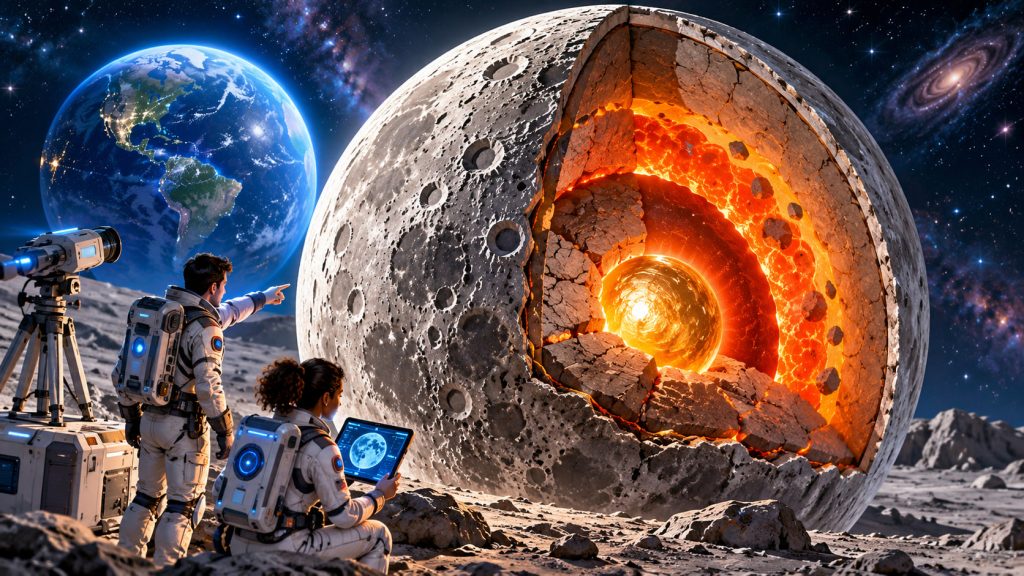
The Moon appears to be a quiet, lifeless world covered with craters, mountains, and vast gray plains.
But beneath its surface lies a surprisingly complex interior containing thick layers of rock, ancient geological structures, and a small metallic core.
For decades, scientists have investigated the Moon’s internal structure using seismic instruments, gravity measurements, and samples collected during space missions.
Modern research reveals that the Moon is not simply a solid ball of rock. It has a layered structure remarkably similar to Earth’s, although its interior is much smaller and less geologically active.
Understanding what lies beneath the lunar surface also provides important clues about how the Moon formed approximately 4.5 billion years ago.
The Moon Has Three Main Internal Layers
Like Earth, the Moon is divided into three principal geological regions.
These are:
- The lunar crust, which forms the outer solid shell.
- The lunar mantle, a thick layer of rocky material beneath the crust.
- The lunar core, a relatively small metallic region at the center.
The Moon has a radius of approximately 1,737 kilometers.
Most of its volume consists of rocky mantle material.
Its metallic core occupies a much smaller proportion of the interior than Earth’s core.
This difference provides valuable information about the Moon’s formation and chemical composition.
The Lunar Crust: A Rocky Outer Shell
The Moon’s crust is composed primarily of solid silicate rocks.
Gravity measurements from NASA’s GRAIL mission suggest an average global crustal thickness of approximately 34–43 kilometers.
However, the thickness varies considerably across the lunar surface.
The far side generally has a thicker crust than the hemisphere facing Earth.
Much of the ancient highland crust consists of anorthosite, a light-colored rock rich in plagioclase feldspar.
This helps explain why the lunar highlands appear brighter than the darker volcanic plains.
Above the bedrock lies regolith, a loose mixture of dust, broken rock, and impact debris produced by billions of years of meteorite collisions.
The Lunar Mantle: The Moon’s Largest Layer
Beneath the crust lies the mantle, which occupies most of the Moon’s interior.
It contains minerals such as olivine and pyroxene, composed mainly of magnesium, iron, silicon, and oxygen.
Although the mantle is mostly solid today, it was much hotter early in lunar history.
Scientists believe extensive melting occurred as the young Moon formed.
Over time, cooling allowed minerals to crystallize and separate into different layers.
Some research indicates that the deepest mantle contains a partially molten layer surrounding the metallic core.
This region may help explain certain seismic and gravitational observations.
Is the Moon Still Hot Inside?
Despite its cold surface, the Moon has retained some internal heat.
This energy comes partly from its early formation and partly from the decay of naturally occurring radioactive elements.
However, the Moon has cooled considerably over billions of years.
Its small size allows internal heat to escape more efficiently than in larger planets.
As a result, the Moon no longer experiences the widespread volcanism that shaped its ancient landscape.
The lunar interior remains thermally active enough to undergo gradual contraction, but the Moon is not filled with a giant underground ocean of magma.
What Is at the Very Center of the Moon?
The Moon possesses a relatively small, iron-rich core.
Current interior models indicate that it contains a solid inner region surrounded by a liquid outer layer.
NASA describes a solid inner core approximately 240 kilometers in radius, surrounded by a liquid iron-rich shell roughly 90 kilometers thick.
In 2023, researchers published an independent analysis supporting a solid inner core with an estimated radius of 258 ± 40 kilometers.
The core probably contains iron along with smaller quantities of other elements, potentially including nickel and sulfur.
The exact composition and dimensions remain subjects of ongoing research.
How Did Scientists Discover the Moon’s Interior?
Scientists cannot directly observe the Moon’s deepest layers.
Instead, they use methods similar to those employed to study Earth’s interior.
One important technique is seismology, the scientific investigation of vibrations traveling through planetary materials.
During the Apollo missions, astronauts installed instruments capable of detecting lunar seismic activity.
These instruments recorded moonquakes, meteorite impacts, and other vibrations.
Researchers analyzed how seismic waves traveled through the Moon.
Waves move differently through solid rock, partially molten material, and liquid regions.
These differences helped scientists identify boundaries between internal layers.
What Did the GRAIL Mission Discover?
NASA launched the twin GRAIL spacecraft in 2011 to investigate the Moon’s gravitational field.
The spacecraft orbited the Moon and measured tiny changes in the distance between them.
These changes revealed variations in lunar gravity caused by differences in the distribution of material beneath the surface.
The mission produced detailed maps of the Moon’s internal mass distribution.
It also improved estimates of crustal thickness and revealed extensive fracturing within lunar rocks.
GRAIL demonstrated that extremely precise gravity measurements can reveal geological structures hidden deep beneath a planetary surface.
Expert Perspective: Evidence for a Solid Inner Core
In 2023, geophysicist Arthur Briaud and his colleagues published a detailed investigation of the Moon’s internal structure.
The researchers combined gravitational measurements, lunar deformation data, and mathematical models of material properties.
Their results provided strong evidence supporting the existence of a solid inner core.
The study also supported the possibility that dense minerals shifted downward during the Moon’s early evolution.
This process is associated with mantle overturn, a major rearrangement of materials inside a planetary body.
The research strengthened the scientific understanding of how the Moon cooled and developed its present structure.
Was the Moon Once Covered by an Ocean of Magma?
Scientists believe the young Moon experienced an enormous period of melting.
According to the lunar magma ocean hypothesis, much of the early Moon was covered by molten rock.
As this material cooled, different minerals crystallized.
Dense minerals tended to sink, while lighter minerals could rise toward the surface.
This process helped produce the Moon’s layered structure.
It also explains the abundance of light-colored anorthosite in the ancient highlands.
Later volcanic activity brought molten material to the surface, forming many of the dark plains visible today.
These plains are known as lunar maria and consist largely of ancient basaltic lava flows.
Why Does the Moon Experience Earthquakes?
The Moon experiences seismic activity even though it lacks Earth’s active system of moving tectonic plates.
Deep moonquakes can occur because Earth’s gravitational attraction periodically deforms the lunar interior.
Other events result from meteorite impacts, temperature changes, and gradual contraction as the Moon cools.
Some shallow moonquakes can be surprisingly strong.
NASA research indicates that certain shallow events may reach approximately magnitude 5.5.
Because lunar rock is extremely dry and seismic vibrations dissipate differently than on Earth, some moonquakes can produce shaking lasting more than ten minutes.
Did the Moon Once Have a Magnetic Field?
Today, the Moon has no strong global magnetic field comparable to Earth’s.
However, ancient lunar rocks preserve evidence of magnetic activity.
Scientists believe the Moon once possessed a lunar dynamo, a process in which moving electrically conductive material within its interior generated a magnetic field.
This probably involved movement in its liquid metallic core.
Evidence indicates that the Moon maintained a magnetic field during parts of its early history.
Understanding when this magnetic activity weakened helps scientists reconstruct the cooling and evolution of the lunar interior.
Why Studying the Moon’s Interior Matters
Knowledge of the Moon’s internal structure is essential for future exploration.
Scientists need to understand lunar geology when selecting landing locations, planning surface infrastructure, and evaluating seismic hazards.
The Moon also preserves evidence of processes that shaped the early Solar System.
Unlike Earth, where erosion and plate tectonics have transformed much of the ancient surface, the Moon retains extensive geological records.
By studying its hidden layers, scientists can reconstruct not only lunar history but important stages in the formation and evolution of rocky planetary bodies.
Interesting Facts
- The Moon’s radius is approximately 1,737 kilometers.
- Its average crustal thickness is estimated at approximately 34–43 kilometers.
- The far side generally has a thicker crust than the near side.
- The Moon contains a small metallic core with both solid and liquid regions.
- Apollo astronauts installed seismometers that recorded thousands of lunar seismic events.
- Some moonquakes can produce vibrations lasting more than ten minutes.
- Ancient lunar rocks contain evidence that the Moon once generated a magnetic field.
- The Moon has contracted by approximately 50 meters in diameter over the past several hundred million years.
Glossary
- Lunar Crust — The Moon’s outermost solid rocky layer.
- Lunar Mantle — The thick rocky region extending beneath the crust toward the core.
- Lunar Core — The Moon’s central metallic region, containing solid and liquid components.
- Anorthosite — A light-colored rock rich in plagioclase feldspar, abundant in the lunar highlands.
- Regolith — Loose dust, broken rock, and debris covering the lunar surface.
- Olivine — A magnesium- and iron-rich silicate mineral found in planetary interiors.
- Pyroxene — A group of silicate minerals common in lunar rocks.
- Partially Molten Layer — A region containing both solid and molten material.
- Seismology — The scientific study of seismic vibrations and their propagation through planetary materials.
- Moonquakes — Seismic events occurring within or near the Moon.
- Seismic Waves — Vibrations that travel through rock and other materials.
- Mantle Overturn — The large-scale rearrangement of dense and less dense materials within a planetary mantle.
- Lunar Magma Ocean — The proposed extensive layer of molten rock that existed during the Moon’s early history.
- Lunar Dynamo — A process in which movement of electrically conductive material inside the Moon generated a magnetic field.