When we look at the night sky, we see stars, planets, and distant galaxies. Between these luminous objects lies an enormous region that appears completely empty.
But appearances are misleading.
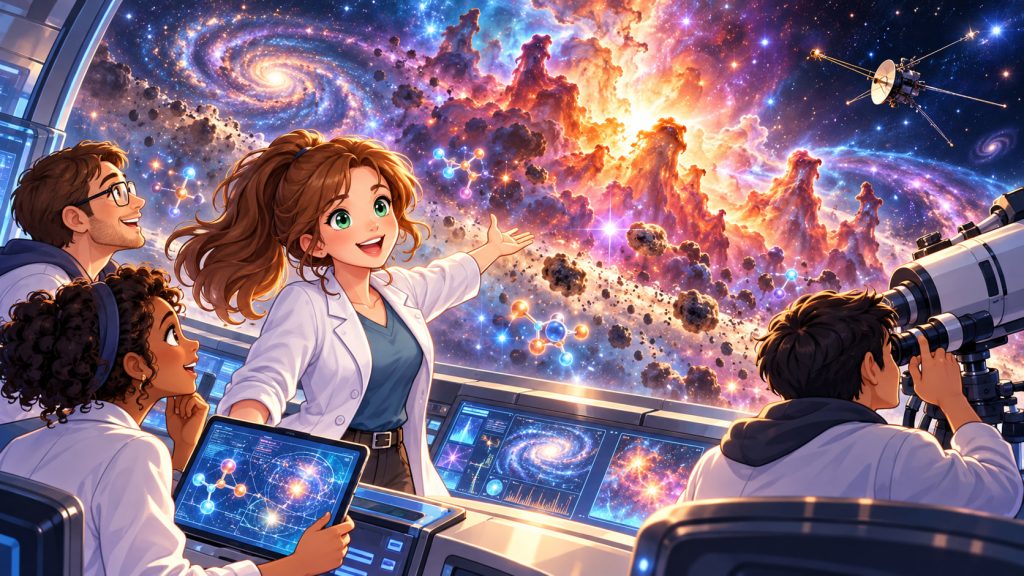
Interstellar space contains vast clouds of gas, microscopic dust particles, magnetic fields, energetic radiation, and surprisingly complex molecules.
Some of these ingredients existed long before our Solar System formed. Others were created by dying stars and scattered across the galaxy.
Scientists have discovered that the seemingly empty regions between stars play an essential role in cosmic evolution.
Interstellar space is not an empty void. It is a dynamic environment where stars are born, chemical elements circulate, and the ingredients of future planetary systems accumulate.
Understanding its hidden structures helps explain how galaxies evolve and how the material that eventually formed Earth reached our corner of the universe.
What Is Interstellar Space Made Of?
The space between stars contains a mixture called the interstellar medium.
This material consists primarily of hydrogen and helium, with smaller quantities of heavier elements and solid particles.
Although it is extremely thin compared with Earth’s atmosphere, it extends across enormous distances.
Its main components include:
- Hydrogen and helium gas
- Microscopic dust grains
- Molecules and charged particles
- Magnetic fields
- High-energy cosmic radiation
Approximately 99% of ordinary interstellar matter by mass is gas, while about 1% is dust.
The material is distributed unevenly.
Some regions contain very little matter, while others form enormous clouds dense enough to become stellar nurseries.
How Empty Is the Space Between Stars?
A typical region of interstellar space may contain roughly one atom per cubic centimeter, although actual densities vary tremendously.
By comparison, Earth’s atmosphere at sea level contains approximately 10 quintillion times as many particles in the same volume.
This extraordinary emptiness creates unusual physical conditions.
Particles can travel long distances before colliding with one another.
Yet interstellar space is not uniformly cold.
Some regions contain gas at temperatures near 10 kelvin, approximately minus 263 degrees Celsius.
Others contain extremely thin plasma heated to millions of degrees by powerful stellar explosions.
Interstellar space can be both incredibly cold and extraordinarily hot, depending on the environment.
The Mysterious Clouds That Create New Stars
One of the most remarkable structures in interstellar space is the molecular cloud.
These enormous collections of gas and dust contain regions where atoms combine into molecules.
Some stretch across hundreds of light-years.
Within their cold interiors, gravity can gradually draw material together.
When a sufficiently dense region collapses, its center becomes hotter and denser.
Eventually, a young star may form.
The Orion Molecular Cloud Complex, located roughly 1,300 to 1,500 light-years from Earth, is a famous example of an active star-forming region.
Stars are not created from nothing. They emerge from material that has accumulated within interstellar space.
Cosmic Dust: The Tiny Particles That Shape Galaxies
Interstellar dust consists of microscopic solid particles containing materials such as silicates and carbon compounds.
This cosmic dust may appear insignificant, but it has an enormous influence on astronomy.
Dust absorbs and scatters starlight, sometimes making distant objects appear dimmer and redder.
This effect is called interstellar extinction.
Dense dust clouds can even conceal entire star-forming regions from visible-light telescopes.
However, infrared radiation can pass through some of these clouds more effectively.
That is why infrared observatories can reveal developing stars hidden inside dusty environments.
Dust also provides surfaces where certain chemical reactions can occur.
Hydrogen molecules, for example, can form when hydrogen atoms interact on grain surfaces.
Are the Ingredients of Life Hidden Between the Stars?
One of the most fascinating discoveries in astronomy is that interstellar space contains complex organic molecules.
The scientific field investigating these processes is called astrochemistry.
Researchers have detected substances such as methanol, formaldehyde, and other carbon-containing compounds in interstellar environments.
Some molecules form through reactions in the gas.
Others develop on the surfaces of extremely cold dust grains coated with ice.
These processes demonstrate that surprisingly complex chemistry can occur without planets, oceans, or living organisms.
However, the discovery of organic molecules does not mean that extraterrestrial life has been discovered.
Instead, it shows that some chemical ingredients relevant to life’s origins can form before planets themselves exist.
How Exploding Stars Transform Interstellar Space
Massive stars can dramatically change their surroundings when they explode as supernovae.
The expanding debris creates a supernova remnant.
These structures send shock waves through surrounding gas, compressing some regions while dispersing others.
Supernova explosions also distribute elements produced during stellar evolution and explosive nuclear reactions.
Elements such as oxygen, silicon, and iron become incorporated into future generations of stars and planets.
Over millions of years, this recycling enriches galaxies with heavier elements.
Some shock waves may help compress nearby gas clouds, although explosions can also disrupt regions where stars might otherwise form.
The material in planets and living organisms is part of a cosmic recycling process that has continued for billions of years.
Invisible Magnetic Fields and Powerful Cosmic Rays
Interstellar space contains magnetic fields that influence the movement of electrically charged particles.
These fields help shape gas clouds and affect how material moves through galaxies.
Another important component is cosmic rays.
These are energetic particles, primarily protons and atomic nuclei, traveling through space at extremely high speeds.
Many originate from energetic astrophysical environments, including regions associated with supernova remnants.
Cosmic rays can penetrate interstellar clouds and ionize atoms and molecules.
This process helps drive chemical reactions even in regions where ordinary starlight cannot penetrate.
Magnetic fields also influence the paths these particles follow.
What Did the Voyager Spacecraft Discover?
For most of human history, interstellar space could only be studied remotely.
That changed when the Voyager spacecraft crossed the heliopause, the boundary where the outward-flowing solar wind gives way to the surrounding interstellar environment.
Voyager 1 crossed this boundary in 2012.
Voyager 2 followed in 2018.
Their instruments provided direct measurements of particles, magnetic fields, and plasma conditions beyond the heliopause.
The spacecraft revealed important differences between the solar environment and the surrounding interstellar medium.
However, crossing the heliopause does not mean escaping every influence of the Sun.
Both spacecraft remain far inside the enormous region associated with the Sun’s distant gravitational influence.
How Scientists Study Something Almost Invisible
Astronomers cannot easily collect samples of distant interstellar clouds.
Instead, they analyze light and radiation passing through them.
One of their most powerful tools is spectroscopy, the study of how matter emits, absorbs, or interacts with electromagnetic radiation at different wavelengths.
Different atoms and molecules leave characteristic patterns in the radiation astronomers observe.
Hydrogen is particularly important.
Neutral hydrogen produces a radio signal known as the 21-centimeter line.
Astronomers use this emission to map hydrogen gas across the Milky Way, including regions hidden from optical telescopes.
Radio, infrared, ultraviolet, and X-ray observations reveal different components of the interstellar environment.
Together, these methods transform apparently empty space into a detailed physical landscape.
Expert Perspective: Chemistry Connects Stars and Planets
Astrochemist Ewine van Dishoeck has made major contributions to understanding molecules in interstellar clouds and planet-forming environments.
Her research demonstrates the importance of tracing chemical processes from cold molecular clouds into the disks of gas and dust surrounding young stars.
This work reveals that planetary systems inherit material shaped by earlier interstellar chemistry.
Understanding how molecules form and survive in space is essential for understanding the chemical origins of planets.
The Mysteries Scientists Are Still Investigating
Despite decades of research, interstellar space still contains unresolved questions.
Scientists continue investigating how complex molecules develop in extremely cold environments, how turbulence affects star formation, and how cosmic rays travel through galactic magnetic fields.
Another mystery involves the many unidentified absorption features known as diffuse interstellar bands.
These patterns suggest the presence of numerous molecules or particles whose identities remain uncertain.
Some features have been connected to particular carbon molecules, but many others remain unexplained.
Future observations will help reveal how the material between stars evolves and how it eventually contributes to new solar systems.
Interesting Facts
- Voyager 1 became the first spacecraft to cross the heliopause into interstellar space in 2012.
- Some interstellar clouds have temperatures only about 10 degrees above absolute zero.
- The Orion Nebula is part of a much larger complex of gas and dust where stars continue to form.
- Interstellar dust can hide newborn stars from visible-light observations.
- Scientists have detected more than 300 different molecular species in interstellar and circumstellar environments.
- Radio waves emitted by neutral hydrogen allow astronomers to map large portions of the Milky Way.
- Cosmic rays can trigger chemical reactions inside dark clouds that receive almost no direct starlight.
- Many atoms found on Earth were produced in earlier generations of stars before becoming part of the Solar System.
Glossary
- Interstellar Medium — The gas, dust, radiation, and other material occupying the space between stars.
- Molecular Cloud — A cold, relatively dense interstellar region containing molecules and capable of forming new stars.
- Cosmic Dust — Microscopic solid particles distributed throughout space.
- Interstellar Extinction — The absorption and scattering of starlight by material between an astronomical object and an observer.
- Astrochemistry — The scientific study of chemical substances and reactions in space.
- Supernova Remnant — The expanding material and shock waves left behind by a supernova explosion.
- Cosmic Rays — High-energy particles traveling through space, mostly protons and atomic nuclei.
- Heliopause — The boundary separating the region dominated by the solar wind from the surrounding interstellar environment.
- Spectroscopy — A scientific technique that analyzes electromagnetic radiation to investigate the composition and physical properties of matter.
- 21-Centimeter Line — Radio emission from neutral hydrogen caused by a transition between two closely spaced energy states.