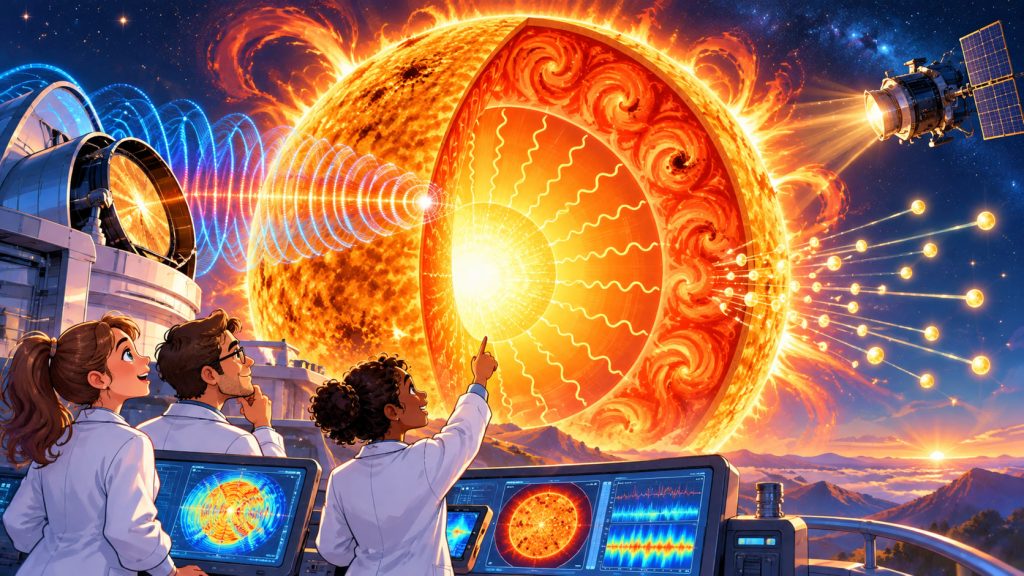
The Sun is an enormous glowing sphere of hot gas that has powered life on Earth for billions of years.
Its surface is already incredibly hot, but the temperatures and pressures deep inside are far more extreme than anything humans have experienced.
At the center, atomic nuclei fuse together, releasing the energy that eventually reaches Earth as sunlight.
But how do scientists know what exists beneath the Sun’s surface when no spacecraft can travel into its interior?
The answer lies in a remarkable combination of physics, solar vibrations, invisible particles, and sophisticated space observations.
These methods have allowed researchers to reconstruct the internal structure of our star with extraordinary accuracy.
What Is the Sun Actually Made Of?
The Sun is composed primarily of hydrogen and helium.
Approximately 73% of its mass is hydrogen, while around 25% is helium. The remaining fraction consists of heavier elements, including oxygen, carbon, neon, and iron.
Unlike Earth, the Sun has no solid surface or rocky interior.
Most of its material exists as Plasma, a state of matter in which atoms are partially or completely separated into electrically charged particles.
The Sun is organized into several distinct layers:
- The core, where energy is generated
- The radiative zone, where radiation transports energy outward
- The convective zone, where moving plasma carries energy
- The atmosphere, including the visible photosphere and the outer corona
Each region performs a different role in the Sun’s complex internal processes.
The Solar Core: An Extraordinary Nuclear Furnace
At the center lies the Solar Core, the hottest and densest region of our star.
Temperatures reach approximately 15 million degrees Celsius.
The density is around 150 grams per cubic centimeter, more than ten times the density of lead under ordinary conditions.
These extreme conditions allow Nuclear Fusion to occur.
During the main fusion process, hydrogen nuclei are gradually transformed into helium through a series of nuclear reactions.
A small amount of mass is converted into energy.
Every second, the Sun converts approximately four million metric tons of mass into energy.
This process generates the enormous power that keeps the Sun shining and makes life on Earth possible.
What Prevents the Sun From Collapsing?
The Sun contains an extraordinary amount of matter.
Its gravitational attraction continuously pulls material toward the center.
Without an opposing force, this gravity would compress the star.
However, the intensely hot interior produces enormous pressure that pushes outward.
The balance between inward gravity and outward pressure is called Hydrostatic Equilibrium.
This balance maintains the Sun’s overall structure.
If the central temperature changes, the rate of fusion and the resulting pressure respond accordingly.
These interactions help regulate the star’s energy production over extremely long periods.
The Radiative Zone: Energy’s Long Journey Outward
Surrounding the core is the Radiative Zone.
This region extends from approximately 25% to 70% of the Sun’s radius.
Energy travels through it primarily by radiation.
A Photon is a particle of electromagnetic radiation, including visible light.
Inside the dense solar interior, photons are repeatedly absorbed, scattered, and reemitted by surrounding matter.
Instead of traveling directly outward, radiation follows an extraordinarily complicated path.
As a result, energy can take tens of thousands to hundreds of thousands of years to move through the Sun’s interior, depending on the model and definition used.
The energy reaching Earth’s surface today began its journey deep inside the Sun long before modern human civilization existed.
The Convective Zone: A Giant Ocean of Moving Plasma
Above the radiative zone lies the Convective Zone.
Here, plasma becomes less efficient at transporting energy through radiation alone.
Instead, hot material rises toward the surface while cooler material sinks.
This process is called convection.
The movement resembles the circulation of water inside a heated cooking pot, although the physical conditions are enormously different.
These motions create large-scale patterns within the solar interior.
At the visible surface, scientists observe bright cellular structures known as granules.
They are evidence of convection occurring beneath the photosphere.
Does the Sun Have a Solid Surface?
The Sun has no solid ground on which a spacecraft could land.
What we see as its surface is the photosphere, a relatively thin atmospheric layer from which most visible sunlight escapes.
Its temperature is approximately 5,500 degrees Celsius.
Above it lie the chromosphere and the corona.
Surprisingly, the corona can reach temperatures exceeding one million degrees Celsius.
This makes the outer atmosphere much hotter than the visible surface.
Explaining how energy heats the corona remains an important area of solar physics.
How Scientists Look Inside the Sun Using Sound
One of the most powerful methods for investigating the Sun’s interior is Helioseismology.
The technique resembles the use of seismic waves to study Earth’s internal structure.
The Sun constantly vibrates because sound waves travel through its interior.
These waves are influenced by temperature, density, pressure, and internal motion.
Scientists measure tiny oscillations on the solar surface.
By analyzing their frequencies and patterns, researchers reconstruct properties of the hidden layers.
This has revealed the depth of the convection zone, variations in internal rotation, and the distribution of sound speed throughout the Sun.
Helioseismology allows scientists to study regions they cannot directly observe.
Solar Neutrinos: Messages From the Core
An even more remarkable source of information comes from Solar Neutrinos.
These extremely lightweight particles are produced during nuclear reactions inside the Sun.
Unlike photons, neutrinos interact very weakly with ordinary matter.
Most escape directly from the solar interior without being absorbed.
They reach Earth approximately eight minutes after being created.
Scientists detect them using highly sensitive instruments, often located deep underground to reduce interference from other particles.
Facilities such as Super-Kamiokande in Japan and the Sudbury Neutrino Observatory in Canada have made major contributions to this research.
Neutrinos provide direct evidence that fusion reactions occur inside the Sun.
The Solar Neutrino Mystery
For decades, scientists detected fewer solar neutrinos than theoretical calculations predicted.
This became known as the solar neutrino problem.
The explanation involved Neutrino Oscillation, a quantum phenomenon in which neutrinos change between different types while traveling.
Early experiments were particularly sensitive to electron neutrinos, so they did not detect the complete neutrino population.
Later measurements confirmed that neutrinos were changing type.
This discovery supported the accuracy of solar fusion models while revealing new properties of fundamental particles.
The research also contributed to the 2015 Nobel Prize in Physics.
Expert Perspective: How John Bahcall Helped Reveal the Sun
American astrophysicist John Bahcall played a fundamental role in understanding the solar interior.
He developed detailed theoretical models predicting the production of neutrinos in the Sun’s core.
His calculations helped scientists compare nuclear fusion theory with observations from underground detectors.
For decades, discrepancies between predicted and observed neutrino numbers challenged researchers.
The eventual discovery of neutrino oscillations demonstrated the importance of combining astrophysics with particle physics.
Bahcall’s work helped establish solar neutrinos as a powerful tool for investigating nuclear reactions hidden deep inside stars.
How Scientists Determine the Sun’s Chemical Composition
Another important technique is Spectroscopy.
Sunlight contains information about the atoms and ions present in the solar atmosphere.
When scientists separate sunlight into its different wavelengths, they observe characteristic absorption lines.
Different chemical elements produce recognizable spectral patterns.
These patterns allow astronomers to determine the composition of the Sun’s visible atmosphere.
Researchers then combine these measurements with models of stellar structure, meteorite chemistry, and solar oscillations to investigate the composition of deeper layers.
What Creates the Sun’s Magnetic Field?
The Sun also contains powerful magnetic fields.
Their behavior is associated with the Solar Dynamo, a process involving the movement of electrically conducting plasma.
Convection and differences in rotational speed help generate and organize magnetic fields.
These fields contribute to sunspots, solar flares, and other forms of solar activity.
The Sun’s magnetic activity follows an approximately 11-year cycle.
Spacecraft such as NASA’s Solar Dynamics Observatory help scientists study these changing patterns.
Understanding the magnetic field also improves our ability to investigate space weather that can affect satellites, communications, and electrical infrastructure.
What Will Happen Inside the Sun in the Future?
The Sun formed approximately 4.6 billion years ago.
It is currently in the main-sequence stage of its life, steadily converting hydrogen into helium in its core.
Scientists estimate that it has roughly another five billion years before its central hydrogen supply becomes depleted.
As its internal structure changes, the Sun will eventually expand into a red giant.
Its outer layers will become enormous, while the core contracts and heats.
Later stages will include helium fusion and major changes to the surrounding planets.
By understanding the Sun’s interior today, scientists can predict how our star will evolve billions of years into the future.
Interesting Facts
- The Sun’s core reaches approximately 15 million degrees Celsius.
- The Sun converts around four million metric tons of mass into energy every second.
- Its core is more than ten times denser than ordinary lead.
- Energy can take tens of thousands to hundreds of thousands of years to travel through the Sun’s interior.
- Solar neutrinos reach Earth about eight minutes after leaving the core.
- The Sun’s corona can be much hotter than its visible surface.
- The Sun contains approximately 99.86% of all the mass in the Solar System.
- Scientists can investigate the Sun’s interior by measuring tiny vibrations across its visible surface.
- The Sun has enough central hydrogen to continue main-sequence fusion for approximately five billion more years.
Glossary
- Plasma — A state of matter containing electrically charged particles, common inside stars.
- Solar Core — The central region of the Sun where nuclear energy is generated.
- Nuclear Fusion — A process in which lightweight atomic nuclei combine and release energy.
- Hydrostatic Equilibrium — The balance between inward gravitational attraction and outward pressure inside a star.
- Radiative Zone — The solar interior layer where energy is transported mainly through radiation.
- Photon — A particle of electromagnetic radiation, including visible light.
- Convective Zone — The solar layer where circulating plasma transports energy toward the surface.
- Helioseismology — The scientific study of solar vibrations used to investigate the Sun’s internal structure.
- Solar Neutrinos — Extremely weakly interacting particles produced during nuclear reactions inside the Sun.
- Neutrino Oscillation — A quantum phenomenon in which neutrinos change between different types.
- Spectroscopy — A scientific technique that studies light at different wavelengths to identify substances and physical conditions.
- Solar Dynamo — The process through which moving electrically conducting plasma generates and maintains the Sun’s magnetic field.