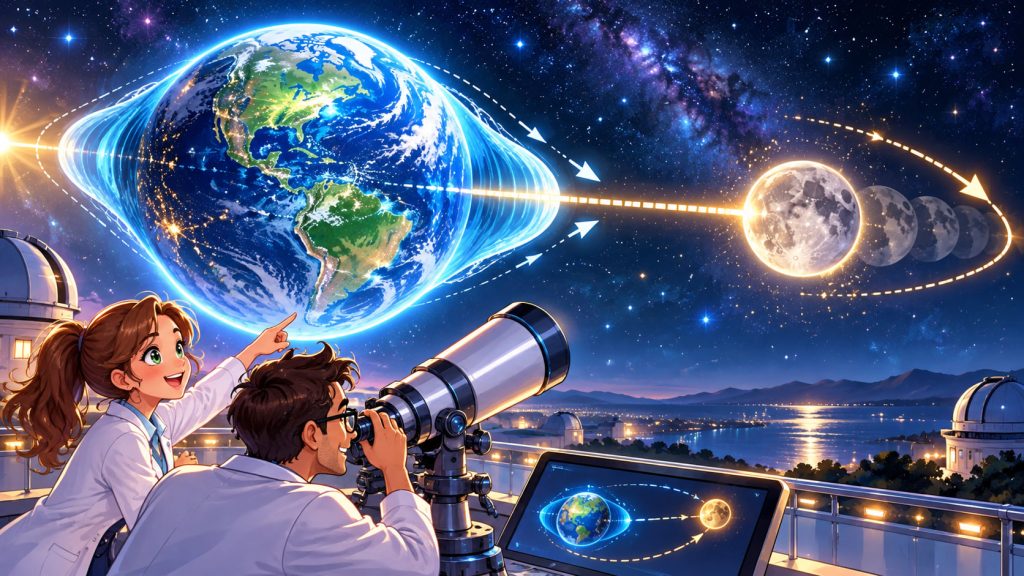
The Moon has accompanied Earth for billions of years, illuminating our night skies, influencing ocean tides, and helping stabilize our planet’s rotation.
Yet something remarkable is happening that most people never notice.
The Moon is slowly moving away from Earth at an average rate of approximately 3.8 centimeters (1.5 inches) per year.
This movement is so gradual that it cannot be detected with the naked eye. However, modern scientific instruments can measure it with extraordinary precision.
The explanation involves gravity, ocean tides, Earth’s rotation, and a fascinating exchange of energy between our planet and its natural satellite.
Understanding why the Moon is drifting away also reveals how Earth has changed throughout its history and what might happen millions of years into the future.
How Far Away Is the Moon Today?
The Moon orbits Earth at an average distance of approximately 384,400 kilometers (238,855 miles).
However, its orbit is not perfectly circular.
The distance varies as the Moon travels along its elliptical path.
At its closest point, called perigee, the Moon approaches approximately 363,000 kilometers from Earth on average.
At its farthest point, known as apogee, it reaches approximately 405,000 kilometers.
These variations happen every lunar orbit.
The long-term recession of the Moon is a different process.
It represents a gradual increase in the average size of its orbit over many years.
What Causes the Moon to Move Away?
The main reason is the gravitational interaction between Earth and the Moon.
This process involves tidal forces, which arise because the Moon’s gravitational attraction is slightly stronger on Earth’s near side than on its far side.
These differences stretch Earth’s oceans and solid body.
The familiar rise and fall of ocean tides are among the most visible consequences.
However, Earth’s rotation creates an additional effect.
Our planet completes one rotation in approximately 24 hours, while the Moon takes about 27.3 days to orbit Earth relative to distant stars.
Because Earth rotates much faster than the Moon moves around it, the planet’s tidal response becomes shifted slightly ahead of the Moon.
This offset creates a gravitational interaction that gradually transfers rotational energy and angular momentum from Earth to the Moon’s orbit.
How Ocean Tides Push the Moon Away
The Moon’s gravity creates a pattern of tidal deformation around Earth.
This deformation is often described using a tidal bulge, although real ocean tides are much more complicated because of continents, seabed geography, and water movement.
Earth’s rotation and the delayed response of the oceans cause the tidal pattern to become displaced relative to the Moon.
The gravitational attraction of this displaced mass exerts a small forward pull on the Moon.
That pull adds energy to its orbit.
As a result, the Moon gradually moves into a larger orbit.
Meanwhile, the Moon exerts an opposing gravitational torque on Earth.
This process, involving tidal friction, gradually slows Earth’s rotation.
The effects are tiny over a human lifetime, but significant across geological timescales.
The Role of Angular Momentum
One of the fundamental principles explaining this process is the conservation of angular momentum.
Angular momentum describes rotational motion, including both the spin of a planet and the orbital movement of a satellite.
Earth and the Moon continuously exchange angular momentum through gravitational interactions.
As Earth loses some of its rotational angular momentum, the Moon gains orbital angular momentum.
Consequently, its orbit expands.
Interestingly, as the Moon moves farther away, its average orbital speed decreases slightly.
This may seem surprising, but objects in larger, nearly circular gravitational orbits generally travel more slowly.
The Moon gains orbital angular momentum while moving into a wider, slower orbit around Earth.
How Scientists Measure the Moon’s Movement
The Moon’s recession is not merely a theoretical prediction.
Scientists measure it directly using lunar laser ranging.
During the Apollo missions, astronauts placed special reflective instruments on the lunar surface.
These devices, called retroreflectors, send incoming light back toward its source.
Observatories on Earth fire powerful laser pulses toward the reflectors.
A small fraction of the light returns to Earth, allowing researchers to measure the round-trip travel time.
Because the speed of light is known precisely, scientists can calculate the Earth-Moon distance with remarkable accuracy.
Long-term measurements reveal that the Moon is receding at approximately 3.8 centimeters per year.
Expert Perspective: Measuring the Moon With Lasers
Physicist Thomas W. Murphy Jr. of the University of California, San Diego, has played a leading role in the Apache Point Observatory Lunar Laser-ranging Operation.
This research program uses precise laser measurements to study the Moon’s orbit and test fundamental principles of gravitational physics.
The measurements help researchers understand tidal interactions, Earth’s rotation, and the long-term behavior of the Earth-Moon system.
The research demonstrates that extremely small changes in planetary motion can reveal important physical processes.
The Moon’s gradual recession provides direct evidence that gravitational interactions can reshape planetary systems over enormous periods of time.
Was the Moon Much Closer in the Past?
Yes. Scientists believe the Moon formed approximately 4.5 billion years ago following a massive collision involving the young Earth and a Mars-sized planetary body.
According to the leading giant impact hypothesis, debris from this collision eventually assembled into the Moon.
The newly formed Moon orbited much closer to Earth than it does today.
Tidal interactions gradually expanded its orbit.
Geological evidence also indicates that Earth’s rotation was faster in the distant past.
Approximately 1.4 billion years ago, Earth’s day may have lasted around 18 hours.
However, the Moon’s recession rate has changed throughout geological history.
Scientists cannot simply extend today’s recession rate backward for billions of years because Earth’s ocean basins, tidal patterns, and rotation have evolved.
Is Earth’s Rotation Slowing Down?
Yes, the transfer of angular momentum to the Moon contributes to the gradual slowing of Earth’s rotation.
Over very long periods, this makes the length of Earth’s day increase.
The tidal contribution is commonly estimated at roughly two milliseconds per century.
However, the actual length of a day also changes because of other influences, including movements within Earth’s interior, ice redistribution, and atmospheric circulation.
These effects can temporarily accelerate or slow Earth’s rotation.
The long-term tidal trend nevertheless remains clear.
As the Moon moves farther away, Earth’s rotational speed generally decreases.
Why Does the Moon Always Show Us the Same Side?
Another consequence of tidal interactions is tidal locking.
The Moon rotates around its own axis in approximately the same time it takes to complete one orbit around Earth.
This synchronization means that the same lunar hemisphere generally faces our planet.
Long ago, tidal forces slowed the Moon’s rotation until this stable relationship developed.
Earth, however, is not tidally locked to the Moon.
Our planet still rotates much faster than the Moon orbits it, allowing the ongoing transfer of angular momentum.
Will the Moon Eventually Escape Earth?
The Moon is moving outward, but that does not mean it will escape Earth’s gravity anytime soon.
The recession rate is extremely small compared with the size of the lunar orbit.
Even over one million years, a constant recession rate of 3.8 centimeters annually would increase the average distance by only about 38 kilometers.
Scientists expect the Earth-Moon system to continue evolving.
However, the Sun’s long-term evolution will eventually become a much more important factor.
In approximately five billion years, the Sun will enter its red giant phase, radically changing conditions throughout the inner Solar System.
Therefore, the Moon is not expected to simply drift away and escape Earth’s gravity through its present tidal recession process.
Will Total Solar Eclipses Disappear?
One fascinating consequence of lunar recession concerns solar eclipses.
A total solar eclipse occurs when the Moon completely covers the visible disk of the Sun from an observer’s position on Earth.
This is possible because the Moon and Sun have remarkably similar apparent sizes in our sky.
As the Moon moves farther away, its apparent diameter gradually decreases.
Eventually, the Moon will become too small to completely cover the Sun, even under the most favorable orbital conditions.
Scientists estimate that total solar eclipses could disappear in roughly 600 million years, although the exact timing depends on future orbital changes.
Annular solar eclipses, which leave a bright ring of sunlight visible around the Moon, would still be possible.
What the Moon’s Recession Reveals About Our Planet
The Moon’s gradual movement demonstrates how gravitational interactions continue shaping the Solar System.
Earth’s oceans, rotation, and lunar orbit are connected through processes operating over billions of years.
Similar tidal interactions affect other planetary systems, including Jupiter’s and Saturn’s moons.
By studying these relationships, scientists gain insights into planetary evolution, orbital stability, and the history of celestial bodies.
The Moon may appear almost motionless in our night sky, but it is participating in a continuous gravitational exchange that slowly changes both worlds.
Interesting Facts
- The Moon moves away from Earth by approximately 3.8 centimeters every year.
- Its average distance from Earth is approximately 384,400 kilometers.
- Astronauts placed laser reflectors on the lunar surface during the Apollo 11, Apollo 14, and Apollo 15 missions.
- Soviet Lunokhod robotic missions also carried lunar laser reflectors.
- The Moon completes one rotation around its axis in approximately 27.3 days.
- Earth’s day was considerably shorter billions of years ago.
- The Moon’s recession rate has varied throughout geological history.
- Total solar eclipses may become impossible in approximately 600 million years.
- Tidal interactions occur throughout the Solar System, not only between Earth and the Moon.
Glossary
- Perigee — The point in the Moon’s orbit where it is closest to Earth.
- Apogee — The point in the Moon’s orbit where it is farthest from Earth.
- Tidal Forces — Differences in gravitational attraction across an object that cause deformation.
- Tidal Bulge — A region of tidal deformation produced by gravitational forces.
- Tidal Friction — Energy dissipation associated with tidal deformation and movement, contributing to changes in rotational and orbital motion.
- Angular Momentum — A physical quantity describing rotational or orbital motion.
- Lunar Laser Ranging — A technique that measures the Earth-Moon distance by timing laser pulses reflected from the lunar surface.
- Retroreflectors — Optical devices that reflect incoming light back toward its source.
- Giant Impact Hypothesis — The leading scientific model proposing that the Moon formed from debris produced by a massive collision with early Earth.
- Tidal Locking — A condition in which an object’s rotation becomes synchronized with its orbital motion.
- Total Solar Eclipse — An astronomical event in which the Moon completely covers the visible disk of the Sun from a particular location on Earth.