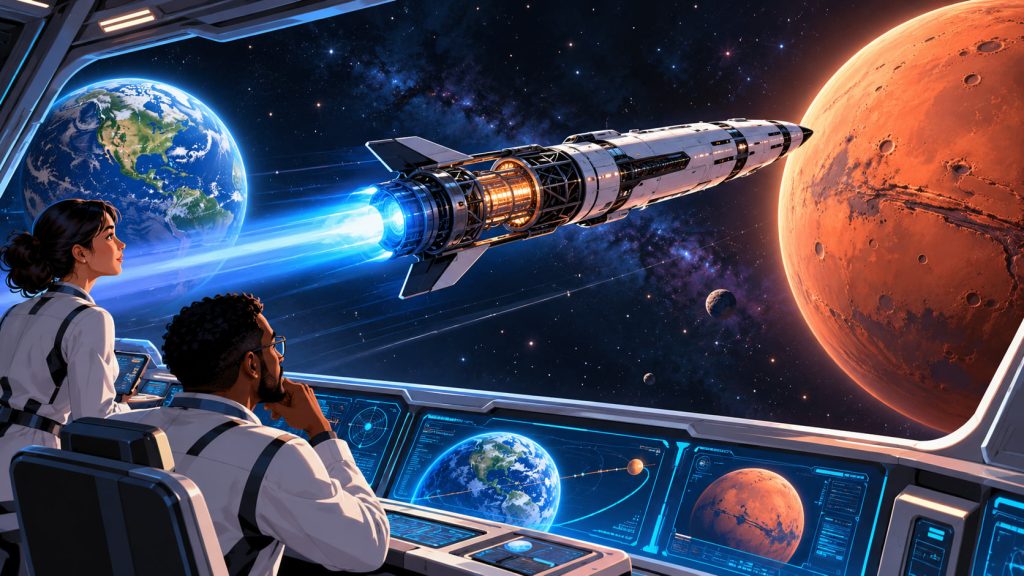
Traveling to another planet is one of the greatest challenges in space exploration.
Even with today’s powerful chemical rockets, reaching Mars typically requires six to nine months, depending on the spacecraft’s trajectory and the positions of the planets.
During these long journeys, astronauts face cosmic radiation, muscle loss, limited supplies, and psychological stress.
But what if spacecraft could travel much faster?
Scientists are developing nuclear propulsion technologies that could make interplanetary journeys more efficient and potentially shorten travel times.
Nuclear rocket engines could revolutionize human exploration of Mars and eventually help spacecraft reach more distant destinations throughout the Solar System.
Why Are Conventional Rockets So Limited?
Traditional rockets generate thrust by burning chemical fuels.
The hot gases produced during combustion escape through a nozzle, pushing the spacecraft forward.
This technology is powerful enough to launch spacecraft from Earth and send robotic missions across the Solar System.
However, chemical rockets have limitations.
They must carry both fuel and oxidizer, and much of a spacecraft’s mass can consist of these substances.
A major challenge is generating enough propulsion for faster journeys without requiring impossibly large fuel tanks.
This is why scientists are investigating nuclear-powered engines.
How Does a Nuclear Thermal Rocket Work?
One of the most promising concepts is nuclear thermal propulsion (NTP).
Instead of burning chemical fuel, this system uses heat from a nuclear reactor.
Inside the reactor, nuclear fission splits heavy atomic nuclei, releasing enormous amounts of thermal energy.
A lightweight substance, usually hydrogen, flows through the hot reactor core.
The hydrogen becomes extremely hot and expands rapidly through a rocket nozzle.
This produces thrust.
The hydrogen acts as the propellant, the material expelled from the engine to accelerate the spacecraft.
The major advantage is that nuclear energy can heat hydrogen to extreme temperatures without requiring chemical combustion.
Why Are Nuclear Rockets More Efficient?
Rocket performance is often measured using specific impulse.
This describes how effectively a propulsion system uses its propellant.
Modern high-performance chemical rocket engines can achieve specific impulses of approximately 450 seconds in vacuum.
Advanced nuclear thermal rocket designs aim for around 900 seconds.
That means nuclear thermal propulsion could achieve approximately twice the propellant efficiency of the best chemical rocket engines.
This advantage allows spacecraft designers to reduce propellant requirements or allocate more mass to equipment and payloads.
It can also provide opportunities for faster trajectories.
However, doubling specific impulse does not automatically mean cutting travel time in half.
The final result depends on spacecraft mass, mission design, available propellant, and orbital mechanics.
Nuclear Electric Propulsion: A Different Approach
Another promising technology is nuclear electric propulsion (NEP).
Instead of heating propellant directly, a nuclear reactor generates electricity.
That electricity powers an electric thruster, which accelerates charged particles to extremely high speeds.
These engines can use propellant much more efficiently than chemical rockets.
However, their thrust is generally much lower.
Rather than producing a short, powerful acceleration, an electric propulsion system can operate continuously for extended periods.
Over time, this gradual acceleration can produce substantial changes in spacecraft velocity.
Nuclear electric propulsion may become particularly valuable for transporting cargo or conducting long-duration missions far from the Sun.
Could a Nuclear Engine Reach Mars in Three Months?
One of the most exciting possibilities is reducing the journey to Mars.
Conventional missions often follow energy-efficient trajectories requiring approximately six to nine months.
Advanced nuclear propulsion could provide greater flexibility.
Some theoretical mission designs suggest that sufficiently capable nuclear spacecraft might reduce one-way travel times to around three or four months.
However, these shorter travel times are engineering projections, not capabilities that have already been demonstrated in space.
Actual performance would depend on reactor power, propulsion efficiency, spacecraft mass, and the trajectory selected.
Even a moderate reduction in travel time could provide substantial benefits.
Astronauts would spend less time exposed to deep-space radiation and microgravity.
Spacecraft might also require fewer consumable supplies for the journey.
Nuclear Rocket Technology Is Not New
Nuclear propulsion research began decades ago.
During the Cold War, the United States developed the Rover and NERVA programs.
Between 1955 and 1972, researchers built and ground-tested approximately 20 nuclear rocket reactors.
These experiments demonstrated important capabilities, including sustained engine operation, reactor heating, and engine restarts.
Some test systems achieved specific impulses exceeding 800 seconds.
However, no nuclear thermal rocket from these programs was launched into space.
The research nevertheless demonstrated that nuclear rocket propulsion was physically achievable.
Modern scientists are building on these historical achievements with improved materials, reactor designs, and computational tools.
NASA and the Development of Modern Nuclear Engines
NASA has investigated nuclear propulsion for future missions to Mars and beyond.
One prominent development effort was DRACO, the Demonstration Rocket for Agile Cislunar Operations, pursued with the Defense Advanced Research Projects Agency.
The project focused on technologies needed for demonstrating a nuclear thermal rocket in space.
Although development plans and funding have changed, the underlying technology remains an important area of aerospace research.
As of 2026, a modern nuclear thermal rocket has not yet completed a spaceflight demonstration.
The next major step is proving that a reactor-based engine can operate safely and reliably under actual space conditions.
What Are the Biggest Engineering Challenges?
Nuclear rocket engines operate under extraordinarily demanding conditions.
One major obstacle is producing reactor materials that withstand extreme temperatures without deteriorating.
Another challenge involves storing cryogenic hydrogen, which must remain at very low temperatures to stay liquid.
Hydrogen is difficult to store for long periods because heat entering the tank can cause evaporation.
Nuclear electric spacecraft face additional difficulties.
Their reactors must produce substantial electricity while remaining lightweight.
They also require effective heat rejection systems to dispose of excess thermal energy.
Large radiators may add considerable mass and complexity.
These challenges explain why practical nuclear propulsion requires advances across multiple engineering disciplines.
Is Nuclear Propulsion Safe?
Nuclear spacecraft require specialized safety systems.
One important component is radiation shielding, which protects sensitive equipment and potentially astronauts from reactor radiation.
Reactor placement can also help reduce exposure.
For example, spacecraft may position the reactor far from occupied compartments.
Launch safety is another essential consideration.
A nuclear propulsion reactor would normally remain inactive during launch and become operational only after the spacecraft reaches an appropriate location in space.
Such systems must also account for possible accidents, radioactive material containment, and safe end-of-mission procedures.
Nuclear propulsion offers important advantages, but successful deployment depends on strict engineering and safety standards.
Expert Perspective: The Future of Nuclear Spaceflight
A 2021 study by the National Academies of Sciences, Engineering, and Medicine examined nuclear propulsion technologies for human Mars exploration.
The expert committee was co-chaired by aerospace specialists Robert D. Braun and Roger M. Myers.
Its assessment highlighted the different advantages of nuclear thermal and nuclear electric propulsion.
Nuclear thermal systems offer relatively high thrust combined with improved propellant efficiency.
Nuclear electric systems offer exceptional propellant efficiency but require major advances in lightweight power generation and thermal management.
The broader engineering lesson is that the best nuclear propulsion system depends on the spacecraft’s mission, required acceleration, and total mass.
Could Nuclear Rockets Take Humans Beyond Mars?
Mars is only the beginning.
Advanced nuclear propulsion could eventually support robotic missions to Jupiter, Saturn, and other distant destinations.
It could also make it easier to transport heavy scientific equipment and supplies between planets.
Future missions might combine nuclear reactors, electric propulsion, and autonomous spacecraft systems.
However, even powerful nuclear engines would not make journeys to other stars practical with existing technology.
The distances between stars remain vastly greater than those between planets.
For now, the most realistic goal is transforming travel within our own Solar System.
Nuclear propulsion could become one of the key technologies enabling faster, more flexible, and more ambitious interplanetary exploration.
Interesting Facts
- Nuclear thermal rocket engines could achieve approximately twice the specific impulse of advanced chemical rockets.
- The United States ground-tested approximately 20 nuclear rocket reactors during the Rover and NERVA programs.
- Nuclear thermal rockets generally use hydrogen because its low molecular mass helps produce high exhaust velocity.
- Nuclear electric engines can accelerate charged particles to speeds far exceeding the exhaust velocity of chemical rockets.
- Nuclear-powered spacecraft would still require propellant because a reactor alone cannot produce thrust.
- Shorter journeys to Mars could reduce astronauts’ exposure time to deep-space radiation.
- Some spacecraft already use nuclear power sources for electricity, but these are not nuclear propulsion engines.
- Solar electric propulsion is already used in space, while reactor-powered electric propulsion remains a developing technology.
Glossary
- Nuclear Thermal Propulsion (NTP) — A rocket system that uses nuclear reactor heat to accelerate propellant.
- Nuclear Fission — The splitting of heavy atomic nuclei, releasing energy.
- Propellant — A substance expelled from a rocket engine to generate motion.
- Specific Impulse — A measure of how efficiently a rocket engine uses its propellant.
- Nuclear Electric Propulsion (NEP) — A propulsion system that uses nuclear-generated electricity to power electric engines.
- Electric Thruster — An engine that accelerates electrically charged particles to generate thrust.
- Thrust — The force produced by a propulsion system to accelerate a spacecraft.
- Cryogenic Hydrogen — Hydrogen stored at extremely low temperatures, typically in liquid form.
- Heat Rejection — The removal of unwanted thermal energy from a spacecraft or reactor system.
- Radiation Shielding — Protective materials used to reduce exposure to harmful radiation.