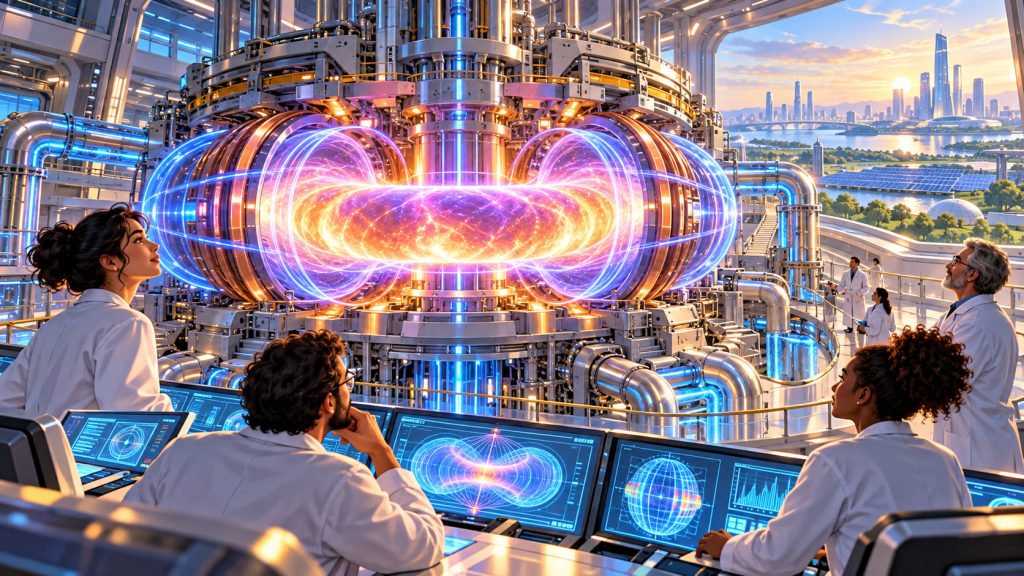
Imagine producing enormous amounts of electricity using the same nuclear reactions that power the Sun and stars.
This is the extraordinary promise of nuclear fusion energy, one of the most ambitious scientific and engineering projects in human history.
Unlike conventional nuclear power plants, which split heavy atoms, fusion combines lightweight atomic nuclei and releases tremendous amounts of energy.
Scientists have already achieved major experimental breakthroughs, including reactions that produce more fusion energy than the laser energy delivered to their fuel.
The ultimate goal is to develop reliable power plants that generate large quantities of low-carbon electricity using fusion reactions.
But transforming this scientific achievement into commercially practical electricity remains a demanding challenge.
What Is Nuclear Fusion?
Nuclear fusion is a process in which two lightweight atomic nuclei combine to form a heavier nucleus, releasing energy.
This reaction powers stars, including our Sun.
Inside the Sun, immense gravitational pressure and extremely high temperatures allow hydrogen nuclei to participate in fusion reactions.
On Earth, scientists generally focus on combining two hydrogen isotopes: deuterium and tritium.
Deuterium contains one proton and one neutron, while tritium contains one proton and two neutrons.
When these nuclei fuse, they produce helium, a neutron, and approximately 17.6 million electron volts of energy.
Even a very small amount of fusion fuel can release an extraordinary quantity of energy.
How Is Fusion Different From Nuclear Fission?
Existing commercial nuclear power stations generate energy primarily through nuclear fission.
Fission involves splitting heavy atomic nuclei, such as uranium, into smaller fragments.
Fusion works in the opposite direction by combining lighter nuclei.
Both processes release energy, but their operating conditions and radioactive waste profiles differ.
Fusion reactions do not sustain the same kind of uncontrolled chain reaction associated with nuclear fission.
If the required temperature and confinement conditions disappear, the fusion reaction rapidly stops.
Fusion also avoids producing the large quantities of long-lived spent nuclear fuel associated with conventional fission reactors.
However, fusion facilities still require radioactive-material management and radiation protection.
Why Do Fusion Reactors Need Extreme Temperatures?
Atomic nuclei carry positive electrical charges and naturally repel one another.
To overcome this repulsion, fusion fuel must reach extraordinarily high temperatures.
Many experimental fusion reactors aim for temperatures around 100 million degrees Celsius or higher.
At these temperatures, ordinary gas becomes plasma, an electrically charged state of matter containing free electrons and ions.
Plasma behaves differently from solids, liquids, and ordinary gases.
Because it responds to magnetic fields, scientists can manipulate it without allowing the hottest material to touch the reactor walls.
Maintaining stable plasma is one of the most important challenges in fusion research.
How Does a Tokamak Fusion Reactor Work?
One of the leading fusion technologies is the tokamak.
This machine uses powerful magnetic fields to confine plasma inside a doughnut-shaped chamber.
The technique is called magnetic confinement.
Magnetic coils surround the chamber, while an electrical current flowing through the plasma helps generate and shape the magnetic field.
The objective is to hold hot plasma long enough for large numbers of fusion reactions to occur.
Scientists must carefully control turbulence, temperature, density, and plasma stability.
Even small disturbances can reduce reactor performance.
A successful fusion reactor must simultaneously achieve extreme temperatures, sufficient fuel density, and effective confinement.
Stellarators: An Alternative Reactor Design
Another promising approach uses a machine called a stellarator.
Like tokamaks, stellarators confine plasma using magnetic fields.
However, their magnetic geometry is produced primarily by complex external coils.
This reduces the need for a large plasma current, potentially making continuous operation easier.
Germany’s Wendelstein 7-X is among the world’s most advanced stellarator experiments.
Its research focuses on plasma confinement and the feasibility of operating future fusion systems for extended periods.
Both tokamaks and stellarators are being investigated as possible foundations for commercial power plants.
Can Powerful Lasers Produce Fusion?
Fusion can also be created using an entirely different method.
Inertial confinement fusion uses extremely powerful lasers to compress tiny capsules containing fusion fuel.
The rapid compression creates extraordinary temperatures and pressures for a fraction of a second.
In December 2022, the National Ignition Facility in California achieved a historic breakthrough.
An experiment delivered 2.05 megajoules of laser energy to a target and produced approximately 3.15 megajoules of fusion energy.
This demonstrated ignition, in which fusion heating becomes sufficiently strong to sustain and amplify the reaction during the brief implosion.
The achievement also represented scientific energy breakeven at the target level.
However, the entire laser facility consumed considerably more electricity than the fusion reaction produced.
The Record-Breaking Fusion Experiments
Fusion research has advanced rapidly.
In October 2023, the Joint European Torus experimental reactor in the United Kingdom produced approximately 69 megajoules of fusion energy during a pulse lasting around five seconds.
This demonstrated controlled fusion using deuterium-tritium fuel.
Another major milestone occurred on April 7, 2025.
Scientists at the National Ignition Facility produced approximately 8.6 megajoules of fusion energy after delivering 2.08 megajoules of laser energy to the target.
That represented a target energy gain of approximately 4.13.
These experiments confirmed that scientists can control fusion reactions and achieve increasingly impressive energy outputs.
Nevertheless, neither experiment demonstrated a commercial power station delivering net electricity to the grid.
ITER: One of the World’s Most Ambitious Scientific Projects
The International Thermonuclear Experimental Reactor, known as ITER, is under construction in southern France.
Its participating members include China, the European Union, India, Japan, South Korea, Russia, and the United States.
ITER is designed to demonstrate large-scale magnetic fusion.
Its principal objective is to produce 500 megawatts of fusion power from 50 megawatts of external plasma-heating power during specified experimental conditions.
ITER itself is not designed to generate commercial electricity.
Its research program is intended to provide scientific and engineering knowledge needed for future fusion power plants.
Under the revised project schedule, deuterium-tritium operations are planned to begin in 2039.
How Would Fusion Electricity Be Generated?
A future fusion power station would transform fusion energy into electricity using equipment similar to that found in other thermal power plants.
High-energy neutrons released during fusion would deposit energy in materials surrounding the plasma.
A cooling system would transfer this heat to a power-conversion system.
Steam turbines or other thermal cycles could then drive electrical generators.
An important component is the breeding blanket.
This lithium-containing system is intended to absorb neutrons, recover heat, and produce additional tritium fuel.
Developing a reliable system that manufactures enough tritium for continuous operation is essential because natural tritium supplies are extremely limited.
Expert Perspective: The Challenge Beyond Ignition
Dr. Tammy Ma, a physicist at Lawrence Livermore National Laboratory, has played an important role in research on laser-driven fusion energy.
Her work emphasizes the engineering challenges involved in progressing from experimental ignition to practical power generation.
A commercial laser-fusion plant would need highly efficient lasers, rapidly manufactured fuel targets, and equipment capable of repeating fusion reactions many times per second.
Researchers must also develop durable reactor materials and reliable energy recovery systems.
Achieving fusion in a laboratory is a scientific milestone; producing affordable electricity continuously requires an entire industrial technology platform.
Is Nuclear Fusion Environmentally Friendly?
Fusion energy has several potential environmental advantages.
Its operating process does not involve burning coal, oil, or natural gas.
Consequently, a fusion power plant could generate electricity with very low direct carbon dioxide emissions.
Deuterium is widely available in seawater, while lithium could help supply tritium through fuel breeding.
However, energetic neutrons can change the structure of reactor materials and make certain components radioactive.
This process is known as neutron activation.
Engineers must design materials that withstand intense radiation, thermal loads, and repeated operating cycles.
Fusion is therefore a promising low-carbon technology, but not one entirely free of environmental impacts.
When Will Fusion Power Become Commercial?
As of 2026, commercial fusion electricity generation has not yet been demonstrated.
Several private companies and national research programs are working toward pilot fusion power plants.
Some developers are targeting the 2030s for early commercial demonstrations.
However, the schedule depends on major advances in plasma confinement, materials engineering, tritium production, and overall plant efficiency.
Fusion must also compete economically with established electricity technologies.
The long-term opportunity is substantial.
If scientists can solve these engineering challenges, fusion could eventually provide dependable low-carbon electricity alongside renewable energy and other power sources.
Interesting Facts
- The Sun generates energy through nuclear fusion reactions occurring in its core.
- Experimental fusion plasmas on Earth can reach temperatures hotter than the Sun’s core.
- Deuterium is naturally present in seawater.
- Tritium is radioactive and has a half-life of approximately 12.3 years.
- The Joint European Torus produced approximately 69 megajoules of fusion energy in its final experimental campaign.
- In April 2025, the National Ignition Facility achieved a fusion target energy gain exceeding four.
- ITER is designed to investigate fusion power at a scale substantially larger than previous tokamak experiments.
- Wendelstein 7-X uses complex magnetic coils to confine extremely hot plasma.
Glossary
- Nuclear Fusion — The combination of lightweight atomic nuclei into heavier nuclei, releasing energy.
- Deuterium — A hydrogen isotope containing one proton and one neutron.
- Tritium — A radioactive hydrogen isotope containing one proton and two neutrons.
- Plasma — An electrically charged state of matter containing free electrons and ions.
- Tokamak — A doughnut-shaped fusion device that confines hot plasma using magnetic fields.
- Magnetic Confinement — The use of magnetic fields to contain and control electrically charged plasma.
- Stellarator — A fusion device using complex external magnetic coils to confine plasma.
- Inertial Confinement Fusion — A technique that compresses small fuel targets rapidly, often using powerful lasers.
- Ignition — A fusion condition in which heating produced by the reaction helps sustain further fusion during the experiment.
- Energy Breakeven — A condition in which fusion energy output equals the energy input under a specified measurement boundary.
- Breeding Blanket — A reactor component designed to absorb fusion neutrons, capture heat, and produce tritium fuel.
- Neutron Activation — The process through which neutron irradiation transforms certain materials into radioactive isotopes.