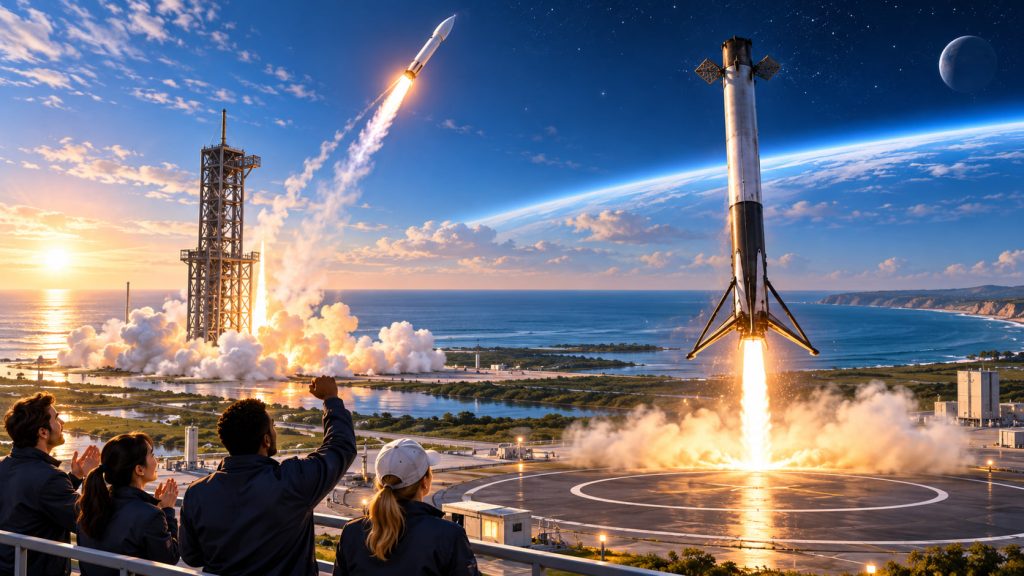
For decades, launching a rocket into space meant sacrificing enormous amounts of expensive equipment. Powerful engines, fuel tanks, and sophisticated guidance systems were used once and then discarded.
Today, that approach is changing dramatically.
Modern reusable rockets can launch satellites, separate from their spacecraft, return through the atmosphere, and land vertically for another mission.
Companies such as SpaceX and Blue Origin have demonstrated that rocket hardware can survive multiple flights.
Reusable rocket technology is transforming space exploration by reducing equipment waste, increasing launch frequency, and creating new possibilities for commercial spaceflight.
But how can a massive rocket return safely to Earth after traveling thousands of kilometers per hour?
Why Traditional Rockets Were Disposable
Conventional rockets usually consist of multiple sections called stages.
Each stage contains engines, fuel tanks, and structural components.
As fuel is consumed, empty stages separate from the vehicle, allowing the remaining rocket to continue accelerating with less weight.
Historically, most discarded stages fell into the ocean or burned up during atmospheric reentry.
This approach was effective but expensive.
A modern rocket engine is an extraordinarily complex machine capable of producing enormous thrust while operating under extreme temperatures and pressures.
Discarding such equipment after a single flight creates significant manufacturing costs.
Reusable rockets address this problem by recovering valuable hardware rather than rebuilding it for every mission.
How a Reusable Rocket Is Built
Many reusable launch vehicles use a two-stage design.
The first stage contains the main engines and large propellant tanks responsible for lifting the rocket through the densest part of the atmosphere.
This section is also called a booster.
Above it sits the upper stage, which continues accelerating the spacecraft after separation.
The upper stage carries the payload, such as a satellite, spacecraft, or cargo destined for orbit.
The first stage must perform two demanding tasks.
It must generate enough thrust to lift the vehicle and then retain sufficient propellant to return safely.
This makes reusable rocket design more complicated than conventional one-way flight.
What Happens After Rocket Separation?
A reusable launch begins much like an ordinary rocket launch.
Engines ignite, generating enormous thrust that accelerates the vehicle upward.
After the first stage consumes most of its propellant, it separates from the upper stage.
The upper stage continues toward its destination.
Meanwhile, the separated booster follows a carefully calculated trajectory back toward Earth.
Its engines may restart to change its direction and control its descent.
The precise return sequence depends on whether the booster is landing near the launch site or on a platform at sea.
The remarkable achievement is that the rocket’s lower section becomes an independently controlled flying vehicle after separation.
How Rockets Return to Their Landing Sites
Returning a booster requires sophisticated navigation and propulsion.
For some missions, the rocket performs a boostback burn.
During this maneuver, engines fire to redirect the booster toward a designated landing area.
On other missions, the booster continues along its trajectory toward an offshore landing platform.
As it approaches the atmosphere, the booster may perform a reentry burn.
This engine firing reduces its velocity and helps manage the extreme aerodynamic and thermal conditions encountered during descent.
The rocket must continuously calculate its position, speed, orientation, and remaining propellant.
Small errors could cause it to miss the landing zone.
Grid Fins: Steering a Rocket Through the Atmosphere
Reusable boosters often use specialized aerodynamic control surfaces called grid fins.
These structures resemble metal lattices attached near the upper section of the booster.
During atmospheric descent, grid fins help control the rocket’s direction.
Unlike conventional aircraft wings, they are compact and can withstand demanding aerodynamic conditions.
SpaceX’s Falcon 9 boosters use grid fins to help guide themselves toward their landing targets.
The fins work together with onboard computers, navigation sensors, and engine controls.
This combination allows the rocket to make rapid adjustments while descending through the atmosphere.
How a Rocket Lands Vertically
Perhaps the most spectacular stage of recovery is the final landing.
Instead of using parachutes, some reusable boosters perform a propulsive landing.
The rocket fires its engines downward, producing thrust that slows its descent.
A carefully timed landing burn reduces vertical speed shortly before touchdown.
Engine direction is adjusted using thrust vector control, allowing the rocket to maintain balance and correct its trajectory.
Deployable landing legs absorb the remaining forces as the booster touches the ground.
The entire maneuver is controlled by onboard computers.
The booster must reach its landing target at an extremely low speed while remaining almost perfectly upright.
What Happens After the Rocket Lands?
Landing successfully is only the beginning of reusability.
Engineers must determine whether the recovered equipment is ready to fly again.
This process is called refurbishment.
Technicians inspect engines, fuel systems, structural components, electronics, and landing equipment.
Some parts may require cleaning, repair, or replacement.
The amount of maintenance varies depending on the rocket design and the conditions experienced during flight.
The ultimate objective is to make rocket preparation more similar to servicing an aircraft than rebuilding a launch vehicle.
However, spacecraft operate under much more extreme conditions than ordinary passenger planes.
SpaceX and the Falcon 9 Breakthrough
SpaceX achieved a major milestone on December 21, 2015, when a Falcon 9 first stage successfully landed after an orbital launch.
In March 2017, the company flew a previously used Falcon 9 booster again, demonstrating that recovered orbital-class rocket hardware could support another mission.
The Falcon 9 uses nine Merlin engines on its first stage.
Its reusable boosters have landed both on solid ground and on autonomous ocean platforms.
Blue Origin also achieved an important milestone in November 2015 when its suborbital New Shepard booster returned successfully to Earth.
These achievements helped establish reusable launch systems as practical aerospace technology.
Are Fully Reusable Rockets Possible?
Most conventional reusable launch systems recover only part of the vehicle.
For example, Falcon 9 routinely reuses its first stage, while its upper stage is normally discarded.
Recovering the upper stage is more difficult because it reaches much higher speeds and faces intense heating during atmospheric reentry.
SpaceX’s Starship program aims to develop a fully reusable launch system.
In October 2024, its Super Heavy booster was successfully caught by mechanical arms at the launch tower during a test flight.
The larger goal is to recover both major stages and prepare them for repeated launches.
Fully reusable orbital rockets remain a demanding engineering objective, but their development could substantially change the economics of reaching space.
Expert Perspective: Why Rocket Engine Reliability Matters
Aerospace engineer Tom Mueller, who played a leading role in developing SpaceX’s Merlin engine, is among the important figures in modern rocket propulsion.
His work illustrates a central engineering requirement of reusable launch systems: engines must withstand demanding operating conditions while remaining reliable across multiple flights.
Reusable boosters also require dependable engine restarts and precise control during descent.
These capabilities are essential because even a relatively small propulsion failure can prevent a successful landing.
The long-term success of reusable rockets depends not simply on recovering them, but on recovering them safely and efficiently enough to justify repeated use.
Why Reusable Rockets Matter for the Future
Reusable launch vehicles can reduce the need to manufacture completely new hardware for every mission.
They also make it possible to increase launch frequency when maintenance, transportation, and operational systems are efficient.
However, reusability involves trade-offs.
The rocket must reserve fuel for its return, carry additional control equipment, and undergo inspections after landing.
These requirements can reduce the payload carried on individual flights.
Despite these challenges, reusable technology is expanding opportunities for satellite deployment, scientific research, and future human exploration.
Its continued development may eventually support more economical missions to the Moon, Mars, and beyond.
Interesting Facts
- SpaceX achieved its first successful Falcon 9 booster landing after an orbital launch in December 2015.
- Blue Origin successfully landed its New Shepard suborbital booster in November 2015.
- Falcon 9 boosters use nine Merlin engines during launch.
- Reusable rockets can land on floating platforms positioned far offshore.
- The Space Shuttle program reused its orbiters and solid rocket boosters, although its large external fuel tanks were discarded.
- In October 2024, a Super Heavy booster was caught by the launch tower’s mechanical arms for the first time.
- Reusable boosters must reserve a portion of their propellant for recovery maneuvers.
- Recovering rocket hardware does not automatically guarantee lower costs; maintenance and operational efficiency are equally important.
Glossary
- First Stage — The lower section of a multistage rocket that provides most of the initial launch thrust.
- Booster — A propulsion section that accelerates a rocket during the early part of its flight.
- Upper Stage — The rocket section that continues accelerating the spacecraft after the lower stage separates.
- Payload — The satellite, spacecraft, cargo, or other equipment transported by a rocket.
- Boostback Burn — An engine firing that redirects a separated booster toward its recovery area.
- Reentry Burn — An engine firing used to reduce a booster’s speed during atmospheric descent.
- Grid Fins — Lattice-shaped aerodynamic control surfaces used to steer a rocket through the atmosphere.
- Propulsive Landing — A landing technique that uses rocket-engine thrust to reduce descent speed.
- Landing Burn — The final engine firing that slows a descending booster before touchdown.
- Thrust Vector Control — A system that changes the direction of engine thrust to control a rocket’s orientation and movement.
- Refurbishment — The inspection, servicing, and repair of recovered hardware before another flight.