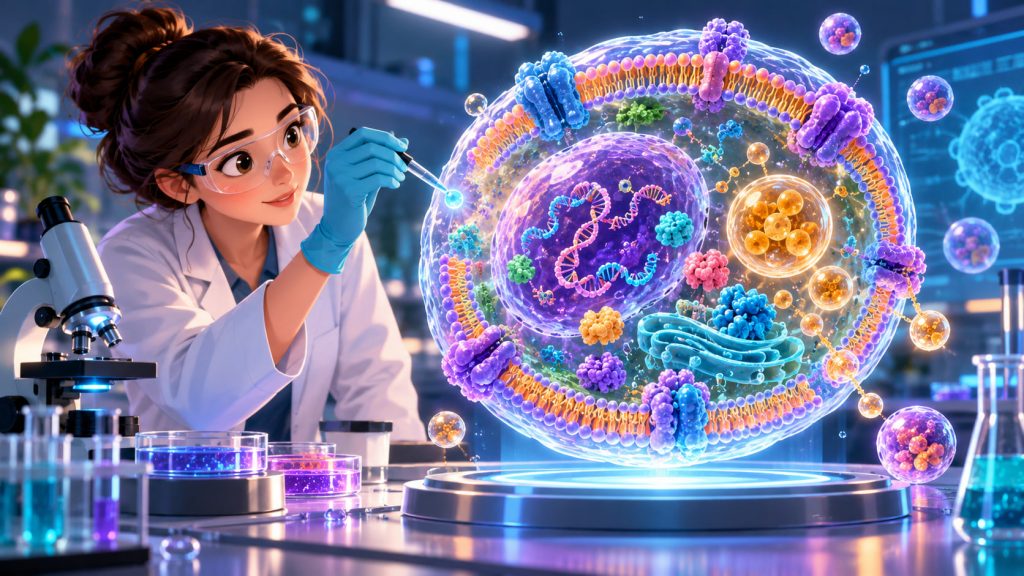
Imagine a microscopic structure assembled in a laboratory that can produce proteins, respond to its environment, and potentially reproduce itself.
This is one of the most ambitious goals of modern biology.
Scientists are developing artificial cells by combining biological molecules, synthetic membranes, and carefully designed genetic systems.
These structures could eventually help manufacture medicines, detect diseases, and reveal how life first emerged on Earth.
Artificial cell research represents a remarkable attempt to understand and recreate the fundamental processes of life.
Although researchers have successfully reproduced several essential cellular functions, building a completely autonomous living cell from nonliving components remains an extraordinary scientific challenge.
What Are Artificial Cells?
Artificial cells are laboratory-created structures designed to reproduce selected functions of living cells.
Natural cells contain genetic information, membranes, proteins, and complex biochemical machinery.
Artificial cells attempt to recreate some of these systems using carefully selected components.
Researchers generally follow two approaches.
The first is bottom-up synthetic biology, in which scientists assemble cell-like structures from individual molecules.
The second is top-down synthetic biology, which involves simplifying or redesigning existing living cells.
Both approaches help researchers understand which biological components are essential for life.
The ultimate objective is not simply to create something resembling a cell, but to reproduce the processes that make cells function.
Step One: Building an Artificial Cell Membrane
Every cell needs a boundary separating its internal environment from the outside world.
In natural organisms, this boundary is the cell membrane.
Scientists recreate it using molecules called phospholipids.
These molecules contain water-attracting and water-repelling regions.
When placed in water, they can spontaneously organize into a lipid bilayer, a double layer resembling the membrane of a natural cell.
Researchers use these structures to create liposomes, tiny membrane-enclosed compartments.
Liposomes can contain water, proteins, DNA, and other substances.
Some artificial cell models are only a few micrometers across, comparable in size to certain living cells.
However, a membrane alone does not create life. Scientists must also introduce the machinery required for biological activity.
Step Two: Adding Genetic Instructions
DNA contains information used by living organisms to manufacture proteins and regulate cellular processes.
Scientists can chemically synthesize DNA sequences designed for specific biological functions.
These sequences can then be placed inside artificial compartments.
Researchers may introduce a synthetic genome, an artificially assembled collection of genetic instructions.
A major breakthrough occurred in 2010 when researchers at the J. Craig Venter Institute created a bacterial cell controlled by a chemically synthesized genome.
The synthetic DNA was introduced into an existing recipient cell.
The resulting organism could grow and reproduce under laboratory conditions.
This was an important milestone, although it did not represent the creation of an entire cell from nonliving ingredients.
Step Three: Making Artificial Cells Produce Proteins
Proteins perform many essential cellular functions.
They act as enzymes, structural components, molecular transporters, and biological signals.
To manufacture proteins, cells normally use specialized molecular machinery.
Scientists can recreate part of this process through cell-free protein synthesis.
This technique uses molecular components extracted from cells or assembled into laboratory systems.
When supplied with appropriate genetic instructions, amino acids, and energy sources, these systems can produce proteins without requiring an intact living organism.
Researchers can place this machinery inside artificial membrane compartments.
The resulting structures can manufacture proteins within their boundaries.
This is a significant step toward constructing artificial cells with independently controlled biochemical functions.
Step Four: Giving Artificial Cells Energy
Living cells continuously require energy to maintain their internal organization.
They use biochemical reactions to generate molecules such as adenosine triphosphate (ATP), which powers many cellular activities.
Artificial cells must also obtain or generate usable energy.
Some experimental systems rely on externally supplied energy-rich molecules.
Others attempt to recreate simplified metabolism, the network of chemical reactions through which cells transform substances and manage energy.
Researchers are investigating enzyme systems that could help artificial cells maintain their own biochemical activity.
Developing sustainable energy production is essential for creating structures capable of functioning without constant laboratory intervention.
Step Five: Teaching Artificial Cells to Divide
One of the defining characteristics of living cells is their ability to reproduce.
Scientists therefore investigate cell division in synthetic compartments.
Natural bacterial cells use specialized proteins to organize the division process.
Researchers have recreated parts of this machinery inside artificial membrane structures.
In 2022, scientists working with biophysicist Petra Schwille demonstrated the assembly and initial contraction of a protein-based division ring inside lipid vesicles.
The experimental system used five proteins to reproduce important features of bacterial division machinery.
Although it did not produce fully autonomous reproduction, it demonstrated that key mechanical processes could be recreated using a limited set of components.
For artificial cells to reproduce independently, they would also need to copy and distribute their genetic information reliably.
The Breakthrough of the Minimal Synthetic Cell
One of the most important achievements came in 2016.
Scientists at the J. Craig Venter Institute introduced JCVI-syn3.0, a bacterial cell carrying a dramatically reduced synthetic genome.
It contained just 473 genes.
For comparison, many common bacteria possess several thousand genes.
The researchers removed genetic elements that were unnecessary for survival under carefully controlled laboratory conditions.
Remarkably, 149 genes initially had functions that researchers could not identify.
The experiment demonstrated that even extremely simple living cells depend on biological processes that scientists do not yet fully understand.
In 2021, researchers reported that restoring a small group of genes helped a related minimal synthetic cell divide more normally.
These discoveries revealed how cellular complexity can emerge from surprisingly small genetic systems.
Expert Perspective: Understanding the Rules of Life
Professor Petra Schwille of the Max Planck Institute of Biochemistry is a leading researcher in artificial cell construction.
Her work explores how basic biological components organize themselves into functional systems.
A central theme of her research is understanding how simple molecules can produce complex cellular behavior, especially membrane organization and division.
Rather than attempting to reproduce every feature of a natural cell immediately, this approach focuses on rebuilding individual biological processes.
The research demonstrates an important principle: understanding life requires discovering how molecular components cooperate, not merely identifying which molecules are present.
Could Artificial Cells Become Medical Treatments?
Artificial cells could eventually offer new possibilities in medicine.
Researchers are investigating cell-like compartments capable of carrying therapeutic molecules, responding to chemical signals, or releasing substances under specific conditions.
Potential applications include:
- Targeted drug delivery
- Detection of disease-related molecules
- Controlled production of therapeutic proteins
- Experimental models for studying cellular diseases
- New systems for biotechnology manufacturing
Some experimental artificial cells can already respond to changes in temperature or other environmental conditions.
However, most sophisticated artificial-cell applications remain laboratory research rather than established medical treatments.
Can Artificial Cells Explain the Origin of Life?
Artificial cell research also connects directly with questions about life’s earliest beginnings.
Scientists study protocells, simple cell-like structures that may resemble transitional stages between nonliving chemistry and the first living organisms.
Early protocells may have consisted of primitive membranes containing molecules capable of chemical reactions or information storage.
By recreating such structures, researchers can investigate how increasingly complex biological systems might have emerged.
This research does not establish exactly how life originated.
Instead, it helps identify plausible physical and chemical processes that could have contributed to life’s emergence.
What Challenges Remain?
Despite remarkable progress, artificial cells cannot yet reproduce the full capabilities of natural living cells when assembled entirely from nonliving components.
Major challenges include maintaining reliable energy production, coordinating genetic activity, building responsive membranes, and achieving self-sustaining reproduction.
Another difficulty involves integrating these processes into one stable system.
A membrane may function successfully in isolation, while a protein-producing system may work under different conditions.
Combining them can introduce unexpected interactions.
The next major breakthrough will depend on integrating multiple biological functions into artificial cells capable of maintaining themselves over extended periods.
Interesting Facts
- The first bacterial cell controlled by a chemically synthesized genome was reported in 2010.
- JCVI-syn3.0 contained only 473 genes, making it a landmark example of a minimal synthetic organism.
- Some artificial cell compartments are similar in size to natural cells.
- Lipid molecules can spontaneously organize into membrane-like structures when placed in water.
- Artificial compartments can produce proteins using molecular machinery obtained from living cells.
- Scientists have recreated parts of bacterial division machinery inside synthetic membrane structures.
- Some artificial cell systems can be programmed to respond to temperature changes.
- Research on artificial cells may also provide clues about the chemical processes that preceded the first living organisms.
Glossary
- Bottom-Up Synthetic Biology — Building biological systems from individual molecular components.
- Top-Down Synthetic Biology — Simplifying or redesigning existing living organisms to create specialized biological systems.
- Phospholipids — Molecules that form major structural components of cellular membranes.
- Lipid Bilayer — A double layer of lipid molecules that forms the basic structure of many biological membranes.
- Liposomes — Small membrane-enclosed compartments used in biological research and drug delivery.
- Synthetic Genome — Genetic material chemically constructed or assembled according to a designed sequence.
- Cell-Free Protein Synthesis — Protein production using biological machinery outside intact living cells.
- Adenosine Triphosphate (ATP) — A molecule that transfers usable energy within biological systems.
- Metabolism — The collection of chemical reactions that sustain biological activity.
- Cell Division — The process through which a cell divides into two or more daughter cells.
- Protocells — Simple cell-like structures studied as possible models of early biological organization.