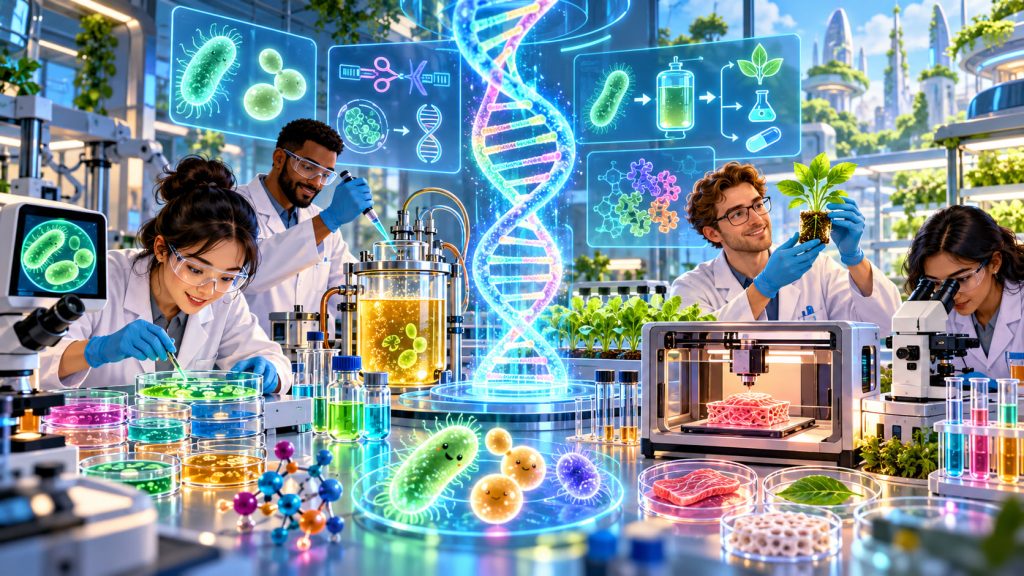
Imagine bacteria that manufacture life-saving medicines, yeast that produces valuable fragrances, or living cells programmed to detect disease.
These technologies may sound futuristic, but they are already emerging from one of the most exciting fields of modern science: synthetic biology.
By combining genetics, molecular biology, computer science, and engineering, researchers are learning to redesign biological systems for specific purposes.
Synthetic biology is transforming living cells into programmable systems capable of producing medicines, sustainable materials, food ingredients, and entirely new biological technologies.
Its potential extends from healthcare and agriculture to environmental protection and industrial manufacturing.
What Is Synthetic Biology?
Synthetic biology is a scientific discipline focused on designing, modifying, and constructing biological systems.
It builds on genetic engineering but often takes a more systematic approach.
Traditional genetic engineering may involve introducing a particular gene into an organism.
Synthetic biology frequently combines multiple genetic components to create coordinated biological functions.
Researchers treat DNA as biological information that can be designed, assembled, tested, and improved.
This approach is sometimes compared to engineering electronic systems, where individual components work together to perform specific tasks.
The central idea is that biological systems can be designed to carry out useful functions in predictable ways.
How Does Synthetic Biology Work?
Scientists begin by identifying a biological function they want to create or improve.
For example, they might want microorganisms to manufacture a pharmaceutical ingredient.
Researchers then identify the genes and biochemical processes required for production.
They may assemble these components into a genetic circuit, a system of interacting DNA elements that controls cellular behavior.
The modified genetic material is introduced into a suitable host organism, often bacteria or yeast.
Scientists then measure how effectively the organism performs its intended function.
If performance is insufficient, the design can be modified and tested again.
This repeated process is known as the design-build-test-learn cycle.
It is one of the fundamental principles of modern synthetic biology.
DNA: The Programming Language of Living Cells
Every living organism contains genetic instructions stored in DNA.
These instructions influence how cells grow, respond to their environment, and manufacture biological molecules.
Modern DNA synthesis technology allows researchers to manufacture designed DNA sequences rather than obtaining every sequence directly from an existing organism.
Scientists can combine these sequences into larger genetic structures.
They can also use CRISPR-Cas9, a genome-editing technology, to make targeted changes to DNA.
Together, these methods give researchers greater control over cellular functions.
However, biological systems remain more complex and less predictable than conventional computer programs.
Cells constantly interact with their environments, and changes to one genetic component can affect other processes.
Synthetic Biology in Medicine
Healthcare is one of the most promising applications.
Scientists can engineer microorganisms to manufacture therapeutic molecules, modify immune cells to attack cancer, and design diagnostic systems that detect biological signals.
One established example of engineered biological production is recombinant human insulin.
Since the early 1980s, genetically modified microorganisms have been used to manufacture insulin for diabetes treatment.
Synthetic biology extends such approaches by creating increasingly sophisticated genetic systems.
A particularly exciting development involves engineered immune cells.
In CAR-T cell therapy, a patient’s T cells are genetically modified to recognize specific targets on cancer cells.
Several CAR-T treatments have received regulatory approval for certain blood cancers.
These technologies demonstrate how modifying living cells can create powerful medical treatments.
How Scientists Engineer Microorganisms to Produce Medicines
A remarkable application involves the production of artemisinin-related antimalarial medicine ingredients.
Artemisinin is an important compound originally obtained from the sweet wormwood plant.
Researchers developed genetically engineered yeast capable of producing artemisinic acid, a precursor that can be chemically converted into artemisinin.
This process was a landmark achievement in metabolic engineering.
Instead of depending entirely on harvesting a plant, researchers redesigned microbial biochemical pathways to manufacture a valuable compound.
The project demonstrated how living cells can become miniature chemical factories.
Synthetic biology can create alternative production routes for medicines that are difficult, expensive, or environmentally demanding to obtain through traditional methods.
Synthetic Biology and the Future of Food
Food production is another rapidly developing area.
Engineered microorganisms can manufacture proteins, flavor compounds, enzymes, and other ingredients used by the food industry.
One important technique is precision fermentation.
In this process, microorganisms are engineered to produce specific molecules under controlled industrial conditions.
For example, engineered yeast can manufacture proteins similar to those naturally found in milk.
These proteins can be used in certain dairy alternatives without requiring conventional dairy farming for their production.
Scientists are also investigating microorganisms capable of producing nutritional ingredients and specialty fats.
Such technologies could diversify food production and reduce dependence on some resource-intensive manufacturing processes.
Can Synthetic Biology Help Protect the Environment?
Environmental applications are attracting increasing attention.
Scientists are studying microorganisms designed to detect pollution, transform waste products, or manufacture biodegradable materials.
Some research focuses on improving bioremediation, the use of biological processes to remove or transform environmental contaminants.
Other projects investigate microorganisms that convert renewable feedstocks into industrial chemicals.
Researchers are also developing biological sensors capable of detecting specific substances in water or soil.
These technologies could provide new tools for pollution monitoring and sustainable manufacturing.
However, introducing engineered organisms into natural ecosystems requires careful evaluation because their behavior may be difficult to control outside laboratory conditions.
Living Materials and Biological Manufacturing
Synthetic biology is also changing how materials are manufactured.
Instead of relying exclusively on petroleum-based processes, researchers can engineer cells to produce useful biological substances.
Examples include:
- Spider silk-inspired proteins
- Biodegradable polymers
- Industrial enzymes
- Specialty pigments
- Fragrance compounds
- Biologically produced chemicals
Some engineered microorganisms can produce bioplastics, including polyhydroxyalkanoates, which can biodegrade under suitable conditions.
Researchers are exploring ways to improve production efficiency and reduce costs.
The broader objective is to develop manufacturing systems that use biological processes as alternatives or complements to conventional industrial chemistry.
Expert Perspective: Engineering Biology as a New Technology Platform
Professor Jay Keasling of the University of California, Berkeley, is one of the leading researchers in synthetic biology and metabolic engineering.
His work has demonstrated how redesigned microorganisms can manufacture complex chemicals, including precursors for important medicines.
Keasling’s research helped establish a fundamental principle of synthetic biology: cells can be engineered to perform useful chemical transformations that would otherwise require agricultural extraction or conventional manufacturing.
His work on microbial production of artemisinin precursors is widely recognized as a major milestone.
The significance of synthetic biology lies not simply in modifying organisms, but in developing reliable biological production systems for real-world applications.
What Are the Biggest Challenges?
Despite rapid progress, synthetic biology faces important technical and practical obstacles.
Biological systems are extraordinarily complex.
A genetic design that works successfully in a laboratory may behave differently during large-scale manufacturing.
Engineered cells can also lose productivity over time because of mutation, resource limitations, or changing growth conditions.
Another challenge is biosafety, the prevention of unintended harm involving biological materials and processes.
Researchers must carefully assess the risks associated with engineered organisms, particularly when environmental release is being considered.
Regulation, manufacturing costs, intellectual property, and public acceptance also influence how quickly new technologies reach commercial use.
Why Synthetic Biology Could Transform the Future
The long-term importance of synthetic biology comes from its ability to connect biological processes with engineering principles.
Researchers are moving beyond studying what living organisms naturally do.
They are learning how to create new biological functions and improve existing ones.
Advances in artificial intelligence, automated laboratories, and DNA manufacturing are making biological design increasingly sophisticated.
Future applications may include more personalized medicines, advanced living materials, more efficient manufacturing systems, and improved environmental technologies.
Synthetic biology could become one of the defining technological platforms of the 21st century, alongside computing, advanced materials, and artificial intelligence.
Interesting Facts
- The first commercial recombinant human insulin received approval in the United States in 1982.
- Researchers have engineered yeast to produce artemisinic acid, a precursor of an important antimalarial medicine.
- Synthetic biology combines ideas from genetics, chemistry, computing, and engineering.
- DNA can now be chemically synthesized according to sequences designed on computers.
- Some engineered microorganisms produce proteins that closely resemble those found naturally in animal products.
- CAR-T cell therapies use genetically modified immune cells to treat certain cancers.
- Bacteria naturally produce some biodegradable polymers that scientists are investigating as alternatives to conventional plastics.
- Automated laboratories can perform repeated biological experiments to improve engineered cell performance.
Glossary
- Genetic Circuit — A collection of interacting genetic components designed to control specific cellular functions.
- Host Organism — A living organism used to carry engineered genetic material or produce a desired biological product.
- Design-Build-Test-Learn Cycle — An iterative engineering process used to develop and improve biological systems.
- DNA Synthesis — The chemical production of DNA sequences according to a specified design.
- CRISPR-Cas9 — A genome-editing system that enables targeted modification of DNA.
- CAR-T Cell Therapy — A cancer treatment that uses genetically modified T cells to recognize specific cancer-associated targets.
- Metabolic Engineering — The modification of cellular biochemical pathways to improve or create the production of desired substances.
- Precision Fermentation — The use of microorganisms, often genetically engineered, to manufacture specific biological molecules.
- Bioremediation — The use of organisms or biological processes to remove, degrade, or transform environmental pollutants.
- Bioplastics — Plastic materials derived partly or entirely from biological sources, some of which are biodegradable.
- Biosafety — Practices and measures designed to prevent unintended harm from biological materials, organisms, and laboratory activities.