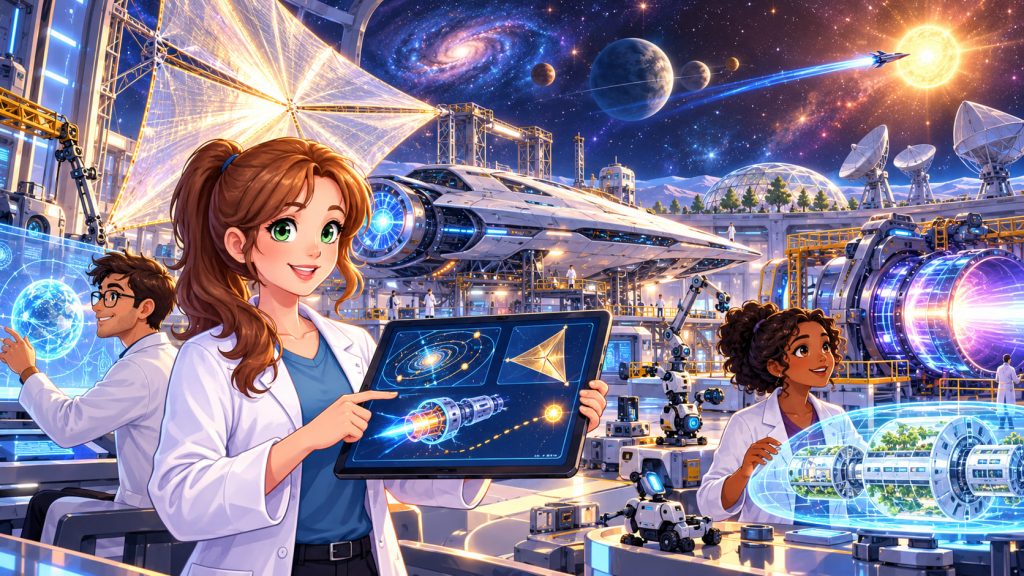
Humanity has already sent spacecraft beyond the planets, landed robots on Mars, and explored distant worlds throughout our Solar System. Yet traveling to another star remains one of the greatest challenges in science and engineering.
The nearest star beyond the Sun, Proxima Centauri, lies approximately 4.24 light-years from Earth. Even our fastest spacecraft would require thousands of years to cross such an enormous distance at their present speeds.
Reaching another star within a human lifetime would require technologies far more advanced than those used by today’s rockets.
Powerful new propulsion systems, artificial intelligence, radiation protection, and autonomous spacecraft could eventually transform interstellar travel from science fiction into reality.
Scientists are already studying several technologies that could make the first missions to neighboring star systems possible.
Why Is Interstellar Travel So Difficult?
The greatest obstacle to interstellar exploration is distance.
A light-year is the distance light travels through a vacuum in one year, approximately 9.46 trillion kilometers.
Proxima Centauri is therefore about 40 trillion kilometers away.
For comparison, Voyager 1 travels through interstellar space at approximately 17 kilometers per second relative to the Sun.
At that speed, covering the distance to Proxima Centauri would take roughly 75,000 years.
To make interstellar missions practical, future spacecraft would need to reach a significant fraction of the speed of light.
Traveling at 10% of light speed would reduce the cruising time to Proxima Centauri to about 42 years, excluding acceleration and braking.
Achieving such speeds requires entirely new approaches to spacecraft propulsion.
Why Conventional Rockets Are Not Enough
Traditional rockets generate thrust by expelling high-speed gases produced by chemical reactions.
This technology works extremely well for launching spacecraft from Earth and traveling through the Solar System.
However, chemical rockets require enormous quantities of propellant.
Engineers measure propulsion efficiency using specific impulse, which describes how effectively a rocket uses its propellant to generate thrust.
Chemical propulsion has fundamental practical limitations because its exhaust velocity is relatively low.
Reaching interstellar speeds using conventional rocket technology would require impractically large amounts of fuel.
This is why researchers are investigating nuclear, electrical, and externally powered propulsion systems.
Nuclear Fusion: Creating Star-Like Energy for Spaceflight
One of the most promising theoretical solutions is fusion propulsion.
Nuclear fusion releases energy when light atomic nuclei combine to form heavier nuclei.
This is the fundamental process that powers the Sun and other stars.
A fusion-powered spacecraft could potentially use controlled nuclear reactions to accelerate propellant to extremely high velocities.
Compared with chemical rockets, such engines could offer substantially greater performance.
During the 1970s, the British Interplanetary Society developed Project Daedalus, a conceptual unmanned interstellar spacecraft powered by fusion reactions.
The proposed vehicle was designed to reach Barnard’s Star within several decades.
However, controlled fusion propulsion has never been demonstrated in an operational spacecraft.
The major engineering challenges include reactor design, heat management, fuel handling, and converting fusion energy into directed thrust.
Nuclear Pulse Propulsion: Riding Controlled Explosions
Another proposed technology is nuclear pulse propulsion.
Instead of producing continuous thrust, a spacecraft would accelerate through a sequence of nuclear energy releases.
Project Orion, studied during the late 1950s and early 1960s, explored the possibility of using nuclear explosive pulses to push a massive spacecraft.
The concept offered potentially enormous thrust and much higher performance than ordinary chemical rockets.
However, nuclear pulse systems face major technological, environmental, legal, and political obstacles.
No operational nuclear pulse spacecraft has ever been built.
Laser-Powered Light Sails
One especially ambitious approach involves spacecraft propelled by powerful beams of light.
A light sail is a thin reflective surface that receives momentum from photons.
Although individual photons carry very little momentum, an intense beam can gradually accelerate an extremely lightweight spacecraft.
A large laser array positioned near Earth could direct energy toward a miniature probe equipped with a sail.
Unlike conventional rockets, the probe would not need to carry most of its propulsion energy onboard.
The Breakthrough Starshot initiative has investigated the possibility of accelerating tiny robotic spacecraft to approximately 20% of light speed.
At that velocity, a probe could reach the Alpha Centauri system in roughly two decades after acceleration.
However, building a sufficiently powerful laser system, maintaining beam accuracy, and protecting the sail remain formidable engineering challenges.
Expert Perspective: Could Lasers Transform Spaceflight?
Physicist Philip Lubin of the University of California, Santa Barbara, has conducted extensive research into directed-energy propulsion.
His work explores how powerful laser systems could accelerate lightweight spacecraft without requiring them to carry large quantities of fuel.
The central advantage is the separation of the energy source from the spacecraft itself.
This could dramatically reduce the mass that must be accelerated.
However, laser-powered interstellar missions remain proposed technologies rather than demonstrated interstellar transportation systems.
Their development would require major advances in lasers, optics, materials, and spacecraft engineering.
Protecting Spacecraft From Interstellar Dust
Space between stars is not completely empty.
It contains extremely thin gas, dust particles, and energetic radiation, collectively associated with the interstellar medium.
At ordinary spacecraft velocities, tiny dust particles are relatively manageable hazards.
At 10–20% of light speed, however, collisions become far more energetic.
Even small particles could severely damage exposed equipment.
Future spacecraft may require specialized forward shields, protective structures, and carefully designed flight orientations.
Reliable radiation shielding would also be essential for protecting sensitive electronics and biological passengers.
Protection becomes especially challenging when spacecraft must remain lightweight enough to reach enormous speeds.
Artificial Intelligence and Autonomous Navigation
Interstellar spacecraft cannot depend on continuous instructions from Earth.
A radio or laser message takes approximately 4.24 years to reach Proxima Centauri.
A response would require another 4.24 years to return.
This communication delay makes real-time human control impossible.
Advanced autonomous navigation systems would allow spacecraft to determine their position, avoid hazards, and adjust their trajectory without waiting for instructions.
Artificial intelligence could also diagnose equipment failures and manage onboard resources.
Robotic maintenance systems might eventually repair damaged components during extremely long missions.
Interstellar spacecraft must be capable of making critical decisions independently.
Communication Across Light-Years
Sending information between stars presents another enormous technical challenge.
Future probes will need highly sensitive receivers, precise antennas, and efficient transmitters.
Laser communication could potentially transmit information through tightly focused optical beams.
Such systems may offer advantages in data transmission efficiency, but maintaining accurate alignment across trillions of kilometers would be difficult.
A spacecraft traveling to another star would also need a reliable power supply capable of operating for decades.
Long-lived nuclear power systems are among the potential solutions.
Keeping Humans Alive Between Stars
Robotic spacecraft are much easier to send to another star than human crews.
People require breathable air, drinking water, food, medical care, living space, and protection from radiation.
A human interstellar spacecraft would need highly reliable closed-loop life support systems.
These systems would recycle air and water while minimizing the need for replacement supplies.
Long missions would also create challenges involving muscle loss, bone health, psychological well-being, and equipment reliability.
Some proposed concepts involve multi-generational spacecraft, where descendants of the original crew would complete the journey.
Other proposals investigate suspended biological activity, although practical long-term human hibernation technology does not currently exist.
The Challenge of Slowing Down at Another Star
Reaching another star is only part of the problem.
A spacecraft traveling at a significant fraction of light speed must also slow down if it intends to enter orbit or remain in the destination system.
This process is called deceleration.
A laser-driven probe might simply fly past its target at enormous speed, collecting observations during a brief encounter.
Slowing down would require an additional propulsion system or another method for transferring momentum.
Researchers have proposed magnetic sails, electric sails, and other braking concepts, but none has been demonstrated for interstellar arrival.
A mission designed to stop at another star is substantially more demanding than a high-speed flyby.
What About Faster-Than-Light Travel?
Science fiction frequently imagines spacecraft traveling faster than light.
However, Einstein’s theory of special relativity establishes that objects with mass cannot be accelerated to the speed of light using ordinary physical processes.
At extremely high velocities, relativistic effects become important.
One is time dilation, where time passes differently for a rapidly moving traveler compared with an observer remaining on Earth.
Theoretical concepts such as warp drives have been explored mathematically, but there is no demonstrated technology capable of creating one.
Near-term interstellar engineering therefore focuses on reaching high fractions of light speed rather than exceeding it.
Which Technologies Are Most Likely to Come First?
The first purposeful missions to neighboring stars will probably involve small robotic probes rather than large crewed spacecraft.
Several technologies appear especially important:
- Highly efficient propulsion systems
- Powerful laser arrays and advanced sail materials
- Miniaturized scientific instruments
- Autonomous spacecraft control
- Long-duration power supplies
- Reliable interstellar communications
- Lightweight protective shielding
Many of these technologies are being investigated independently.
Combining them into a functioning interstellar spacecraft will require advances across multiple scientific disciplines.
The first successful interstellar probes could eventually reveal new details about nearby planets, stellar environments, and the possibility of habitable worlds beyond our Solar System.
P.S. We can make this world a wonderful place and rapidly advance the technologies needed to travel across the universe; all we have to do is end wars and unite. This begins with the actions of each individual—by simply sitting down, relaxing, looking within, and asking oneself: “What can I do today for other people and for society?”
Interesting Facts
- Proxima Centauri is approximately 4.24 light-years from Earth.
- Light takes more than four years to travel between Earth and the nearest star beyond the Sun.
- Voyager 1 entered interstellar space in 2012.
- Project Daedalus proposed an unmanned fusion-powered spacecraft decades before modern reusable rockets.
- Laser-driven spacecraft concepts could theoretically reach significant fractions of light speed.
- A spacecraft moving at 20% of light speed would take about 21 years to travel 4.24 light-years at constant speed.
- Interstellar dust becomes a serious engineering hazard at extremely high velocities.
- A round-trip message exchange with a spacecraft near Proxima Centauri would take at least approximately 8.5 years.
- Human interstellar missions would require far more advanced life-support systems than current spacecraft possess.
Glossary
- Light-Year — The distance light travels through a vacuum in one year, approximately 9.46 trillion kilometers.
- Specific Impulse — A measurement of how efficiently a rocket engine uses propellant to produce thrust.
- Fusion Propulsion — A proposed propulsion method that uses energy released by nuclear fusion reactions.
- Nuclear Pulse Propulsion — A spacecraft propulsion concept based on repeated releases of nuclear energy.
- Light Sail — A reflective structure that uses momentum transferred by light to accelerate a spacecraft.
- Interstellar Medium — The gas, dust, and other material distributed throughout the space between stars.
- Radiation Shielding — Materials or systems designed to protect spacecraft equipment and passengers from harmful radiation.
- Autonomous Navigation — The ability of a spacecraft to determine and control its trajectory without continuous human direction.
- Closed-Loop Life Support — A system that recycles essential resources such as air and water during long-duration missions.
- Deceleration — The process of reducing a spacecraft’s velocity.
- Time Dilation — A relativistic effect in which the passage of time differs between observers in different states of motion or gravitational conditions.