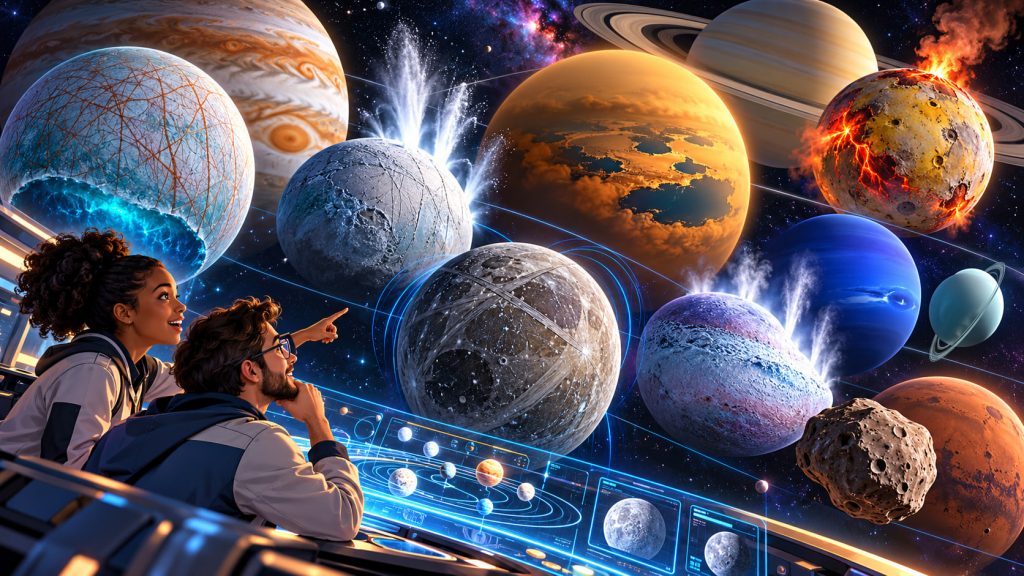
Our Solar System contains far more extraordinary worlds than the eight planets orbiting the Sun.
Hundreds of natural satellites travel around the planets, ranging from tiny irregular rocks to enormous moons larger than some planets.
Some have hidden oceans beneath thick shells of ice. Others feature active volcanoes, methane lakes, towering cliffs, or mysterious geological formations.
Several moons may even possess the chemical ingredients necessary for life.
The most fascinating moons in the Solar System are not simply companions to planets. They are complex worlds with their own geology, atmospheres, and evolutionary histories.
Here are some of the most remarkable natural satellites and the discoveries that make them so interesting.
Europa: Jupiter’s Hidden Ocean World
Europa is one of Jupiter’s four large Galilean moons and a major target in the search for extraterrestrial life.
Its surface consists primarily of water ice, crossed by enormous networks of cracks and ridges.
Beneath this frozen exterior, scientists have strong evidence for a global subsurface ocean.
This hidden ocean may contain more liquid water than all of Earth’s oceans combined.
Europa’s interior is warmed partly through tidal heating, a process in which Jupiter’s gravitational forces repeatedly deform the moon.
The resulting internal friction generates heat that helps prevent its ocean from freezing completely.
Europa is especially intriguing because liquid water, chemical energy, and potentially useful nutrients may coexist beneath its ice.
NASA’s Europa Clipper mission is designed to investigate whether conditions beneath the surface could support life.
Enceladus: Saturn’s Moon That Sprays Water Into Space
Enceladus is a relatively small moon of Saturn, measuring approximately 504 kilometers across.
Despite its modest size, it is one of the most scientifically exciting objects in the Solar System.
NASA’s Cassini spacecraft discovered enormous jets of water vapor and icy particles erupting from fractures near its south pole.
These jets form a plume that carries material from an underground ocean into space.
Scientists have identified water, salts, organic compounds, and phosphorus-bearing materials in particles associated with these eruptions.
The moon also shows evidence of hydrothermal activity, potentially providing chemical energy for biological processes.
Planetary scientist Carolyn Porco, who led the Cassini imaging team, has emphasized the scientific importance of Enceladus because its eruptions provide access to material from a hidden ocean without requiring spacecraft to drill through thick ice.
Enceladus offers an extraordinary opportunity to investigate a potentially habitable environment from space.
Titan: A Moon With Rivers, Lakes, and Rain
Titan is Saturn’s largest moon and the second-largest natural satellite in the Solar System.
It is the only moon known to possess a thick, substantial atmosphere.
That atmosphere consists mainly of nitrogen, with methane and other gases contributing to its complex chemistry.
Titan has lakes, rivers, clouds, and rainfall, but they involve liquid methane and ethane rather than ordinary liquid water.
These substances belong to a class of compounds called hydrocarbons.
Surface temperatures average around −179°C (−290°F), cold enough for methane to remain liquid.
NASA’s Dragonfly mission is designed to investigate Titan’s chemistry and environmental conditions using a rotorcraft.
Titan is especially fascinating because its chemistry may offer clues about processes that occurred on the early Earth.
Io: The Most Volcanically Active World
Io, another of Jupiter’s large moons, is one of the most extreme volcanic environments ever discovered.
Its surface contains hundreds of volcanic centers and constantly changing deposits of sulfur-rich material.
Some eruptions send enormous fountains of gas and particles hundreds of kilometers above the surface.
Io’s remarkable activity results primarily from intense tidal heating.
Jupiter’s gravity, combined with gravitational interactions involving Europa and Ganymede, continually flexes Io’s interior.
This relationship is maintained by an orbital resonance, in which the moons’ orbital periods form a repeating mathematical pattern.
Io demonstrates how gravitational interactions can generate enough internal energy to transform an entire celestial body.
Ganymede: The Largest Moon in the Solar System
Ganymede is Jupiter’s largest moon and the largest natural satellite in the Solar System.
With a diameter of approximately 5,268 kilometers, it is larger than Mercury.
Ganymede is also remarkable because it possesses its own intrinsic magnetosphere, a region where magnetic fields influence charged particles.
No other moon is known to generate a comparable intrinsic magnetic field.
Its surface contains heavily cratered regions alongside brighter areas marked by grooves and ridges.
Scientists also believe that Ganymede contains a deep ocean beneath its icy exterior.
The European Space Agency’s JUICE mission is designed to study Jupiter’s icy moons, with particular emphasis on Ganymede.
Triton: Neptune’s Captured Ice World
Triton, Neptune’s largest moon, follows an unusual path around its planet.
It travels in a retrograde orbit, meaning it moves in the opposite direction to Neptune’s rotation.
This unusual behavior strongly suggests that Triton was captured by Neptune’s gravity rather than forming alongside the planet.
Scientists believe it may have originated in the distant Kuiper Belt.
When Voyager 2 visited Neptune in 1989, it observed dark plumes rising from Triton’s frozen surface.
These eruptions are associated with volatile materials, particularly nitrogen, and are examples of geyser-like activity sometimes discussed in connection with cryovolcanism.
Triton may also contain an underground ocean.
Its unusual history makes it a valuable subject for understanding the evolution of the outer Solar System.
Miranda: Uranus’ Moon With Enormous Cliffs
Miranda is one of Uranus’ most unusual satellites.
Although only about 472 kilometers across, its surface contains a surprising variety of geological structures.
There are enormous canyons, dramatic ridges, ancient craters, and regions that appear to have undergone extensive geological modification.
One famous formation, Verona Rupes, is an enormous cliff-like feature that may extend several kilometers vertically.
Miranda’s complicated appearance suggests that its interior experienced substantial geological activity in the distant past.
Scientists have investigated whether ancient tidal heating could explain these formations.
Miranda shows that even relatively small moons can develop remarkably complex landscapes.
Iapetus: Saturn’s Two-Toned Mystery
Iapetus is famous for its extraordinary contrast between dark and bright surface regions.
One hemisphere is much darker than the other, giving the moon an almost two-colored appearance.
Scientists believe that dark material deposited on its surface, combined with temperature-driven ice migration, helped produce this striking difference.
Iapetus also has an unusual mountainous ridge extending along much of its equatorial region.
In some places, the ridge rises more than 10 kilometers above the surrounding terrain.
Its origin remains an important question in planetary geology.
Phobos: A Moon Slowly Approaching Mars
Phobos is the larger of Mars’ two moons.
It is irregularly shaped, heavily cratered, and only about 22 kilometers across on average.
Phobos orbits Mars in approximately 7 hours and 39 minutes.
Unlike Earth’s Moon, which is gradually moving away from our planet, Phobos is slowly moving closer to Mars.
Over tens of millions of years, tidal forces may eventually break it apart or cause it to collide with the planet.
Japan’s Martian Moons eXploration mission, MMX, aims to collect samples from Phobos and return them to Earth.
These samples could help scientists determine whether Mars’ moons formed from captured asteroids or debris produced by a major ancient collision.
Why Scientists Search for Life on Moons
For many years, the search for extraterrestrial life focused primarily on planets.
Today, moons are central to astrobiology, the scientific investigation of life’s potential existence beyond Earth.
Ocean-bearing moons are particularly interesting because they may contain liquid water, energy sources, and organic compounds.
Europa and Enceladus are among the strongest candidates for potentially habitable environments.
Titan offers a different opportunity: studying complex organic chemistry under extremely cold conditions.
The discovery of life beyond Earth may eventually come from an ocean hidden inside a distant moon rather than from the surface of another planet.
Interesting Facts
- Ganymede is larger in diameter than the planet Mercury.
- Io is the most volcanically active world known in the Solar System.
- Titan has a methane-based weather cycle involving clouds, rain, rivers, and lakes.
- Enceladus releases icy particles that contribute material to Saturn’s E ring.
- Europa’s hidden ocean may contain more water than Earth’s oceans combined.
- Triton orbits Neptune in the opposite direction to the planet’s rotation.
- Miranda has some of the most dramatic geological formations observed on a small moon.
- Iapetus possesses an enormous equatorial mountain ridge.
- Phobos is gradually approaching Mars and may eventually be destroyed by tidal forces.
- Mercury and Venus are the only planets in the Solar System without natural moons.
Glossary
- Subsurface Ocean — A body of liquid water located beneath the frozen or rocky exterior of a celestial object.
- Tidal Heating — Internal heating caused by repeated deformation under gravitational forces.
- Plume — A jet or cloud of gas, vapor, or particles expelled from a celestial body’s surface.
- Hydrocarbons — Chemical compounds consisting primarily of hydrogen and carbon.
- Orbital Resonance — A gravitational relationship in which orbiting objects have periods that form simple numerical ratios.
- Magnetosphere — A region surrounding a celestial body where magnetic fields influence the movement of charged particles.
- Retrograde Orbit — An orbit in the opposite direction to the rotation of the central body.
- Cryovolcanism — The eruption of volatile substances such as water, ammonia, or other materials in very cold environments.
- Astrobiology — The scientific study of the origin, evolution, distribution, and potential existence of life beyond Earth.