Humanity has developed enough nuclear weapons to destroy entire cities, yet the same fundamental nuclear science can also provide electricity to millions of homes.
This raises a fascinating question: could the nuclear weapons already manufactured around the world be transformed into something useful instead of remaining instruments of destruction?
The answer is yes, at least in part.
In fact, one of history’s most remarkable nuclear disarmament programs successfully converted material from thousands of former nuclear warheads into fuel for civilian power plants.
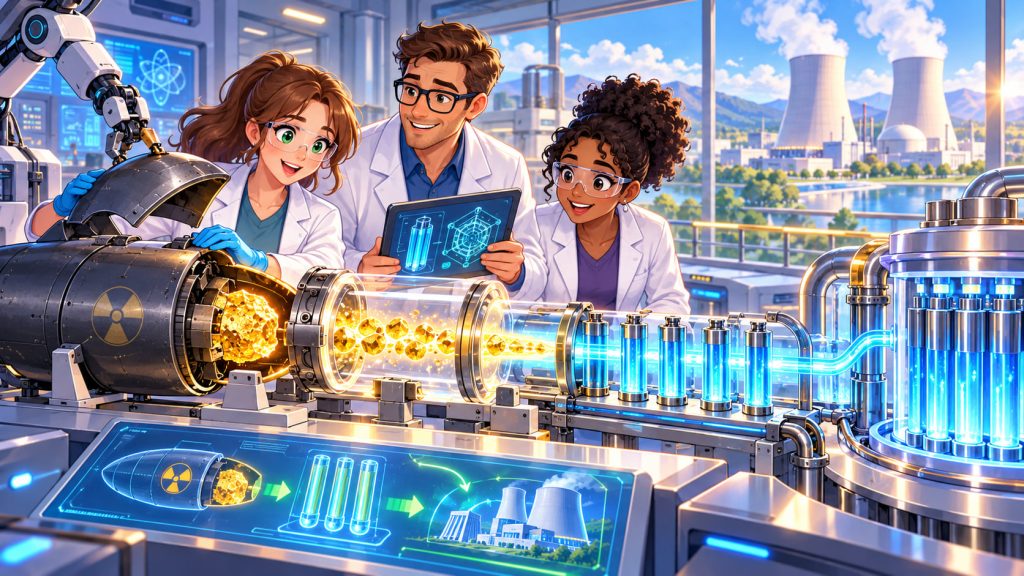
Nuclear weapons cannot simply be installed inside reactors, but some of the nuclear materials they contain can be transformed into fuel for peaceful electricity generation.
This process demonstrates how technology originally developed for warfare can contribute to energy production, international security, and the reduction of nuclear arsenals.
Why Nuclear Weapons and Power Plants Use Similar Materials
Both nuclear weapons and conventional nuclear reactors rely on energy released from atomic nuclei.
The fundamental physical process is called nuclear fission.
During fission, the nucleus of a heavy atom splits into smaller fragments, releasing energy and additional neutrons.
Under suitable conditions, these neutrons can trigger further fission reactions.
The crucial difference is how the process is controlled.
Nuclear weapons are designed to release enormous amounts of energy almost instantaneously.
Civilian nuclear reactors maintain carefully regulated reactions, producing heat over extended periods.
This heat generates steam that drives turbines connected to electrical generators.
The same fundamental source of nuclear energy can therefore serve entirely different purposes depending on how the technology is designed and controlled.
What Nuclear Materials Can Be Reused?
Certain nuclear weapons contain highly enriched uranium (HEU), a material with a high concentration of uranium-235.
Uranium-235 is an isotope capable of sustaining a nuclear chain reaction.
Most commercial nuclear power reactors instead use low-enriched uranium (LEU), which contains a much smaller proportion of uranium-235.
The difference matters because reactor fuel is manufactured to meet specific nuclear, physical, and chemical requirements.
Weapons containing plutonium present a different challenge.
Plutonium can also serve as nuclear fuel, but converting weapons-derived plutonium into suitable reactor material involves additional technical, economic, and security considerations.
How Can Weapons Uranium Become Reactor Fuel?
The broad industrial process of converting highly enriched uranium into material suitable for civilian nuclear fuel is called downblending.
Its purpose is to reduce uranium’s enrichment level to one appropriate for a designated civilian application.
The resulting uranium must then undergo specialized fuel manufacturing and quality control before entering a reactor.
Manufactured reactor fuel is commonly arranged into fuel assemblies containing numerous carefully engineered fuel rods.
These assemblies are placed inside the reactor, where controlled nuclear reactions produce heat.
The work requires licensed nuclear facilities, specialized equipment, rigorous security, and regulatory oversight.
The conversion concerns nuclear material recovered from dismantled weapons, not the physical reuse of an assembled nuclear bomb.
Megatons to Megawatts: The Program That Made History
The most famous example is the Megatons to Megawatts program, established through a 1993 agreement between the United States and Russia.
Following the Cold War, Russia possessed large quantities of nuclear weapons material inherited from the Soviet Union.
Instead of leaving all this material in military stockpiles, the two countries cooperated to transform surplus weapons uranium into commercial reactor fuel.
Between 1993 and 2013, the program converted approximately 500 metric tons of highly enriched uranium into low-enriched uranium for civilian nuclear power.
This was equivalent to material from roughly 20,000 nuclear warheads.
The resulting fuel was purchased for use in American nuclear power plants.
The program became one of the largest practical examples of reducing nuclear weapons material while supporting civilian energy production.
How Much Electricity Did Former Nuclear Weapons Produce?
The Megatons to Megawatts program had an extraordinary impact on American electricity generation.
During its operation, converted Russian weapons uranium supplied fuel accounting for approximately half of U.S. commercial nuclear electricity production.
Because nuclear energy provided around one-fifth of U.S. electricity during much of that period, the converted material supported roughly 10% of the country’s total electricity generation.
This continued over approximately two decades.
Millions of homes and businesses therefore received electricity generated using nuclear fuel derived from former weapons stockpiles.
Material originally reserved for military destruction became a substantial source of civilian electricity.
What About Plutonium From Nuclear Weapons?
Plutonium presents additional possibilities and challenges.
Some civilian reactors can use mixed oxide fuel (MOX), which combines plutonium oxide with uranium oxide.
This technology has been used in countries including France and Japan.
In principle, surplus weapons plutonium can be processed into suitable material for certain civilian fuel systems.
However, the economics, engineering requirements, safeguards, and security risks are more complicated than those associated with uranium downblending.
The United States pursued a major plutonium fuel fabrication project at the Savannah River Site, but the project was ultimately canceled.
Alternative approaches include preparing surplus plutonium for secure long-term disposal rather than using it to generate electricity.
Can Every Nuclear Weapon Be Recycled?
Not necessarily.
Nuclear arsenals contain different weapon designs, materials, and components.
A nuclear warhead includes much more than its nuclear material.
Its non-nuclear components and delivery systems generally cannot be transformed into commercial reactor fuel.
Furthermore, not every recovered nuclear material is suitable for economical civilian energy use.
The condition of the material, available processing facilities, safety requirements, and international agreements all influence the options.
Dismantling weapons and recycling their materials are separate activities, each requiring specialized infrastructure.
Nuclear Disarmament and Energy Security
One of the greatest benefits of converting surplus weapons material is its potential contribution to nuclear nonproliferation.
This refers to international efforts to prevent the spread of nuclear weapons and weapons-usable nuclear materials.
When surplus weapons uranium is permanently converted into appropriate civilian reactor fuel, its direct suitability for nuclear weapons is reduced.
The process also creates an opportunity for international cooperation.
However, reducing the number of deployed warheads is not automatically the same as eliminating weapons-usable material.
Proper accounting, physical protection, and long-term management remain essential.
Expert Perspective: Turning Nuclear Threats Into Energy
American physicist Thomas Neff of the Massachusetts Institute of Technology helped develop the idea of converting former Soviet weapons uranium into fuel for commercial nuclear reactors.
His proposals contributed to the thinking behind the Megatons to Megawatts initiative.
The concept combined two objectives that had traditionally been treated separately: nuclear disarmament and civilian energy production.
The program demonstrated that nuclear security measures could also have substantial economic and energy benefits.
Its most important achievement was showing that international cooperation could transform a dangerous strategic stockpile into a productive civilian resource.
How Is the Conversion Kept Safe?
Handling former weapons materials requires strict controls.
International nuclear safeguards are designed to help verify that nuclear materials are properly accounted for and not diverted from authorized peaceful uses.
The International Atomic Energy Agency plays a central role in safeguards across the civilian nuclear sector.
National regulatory authorities also oversee nuclear fuel manufacturing, transportation, storage, and reactor operations.
Converted fuel must satisfy the same relevant technical standards as other licensed nuclear fuel.
Security measures remain particularly important during the management of materials recovered from dismantled weapons.
Is Nuclear Electricity Environmentally Friendly?
Nuclear power plants produce electricity without directly burning fossil fuels.
Their operational carbon dioxide emissions are very low, and their overall life-cycle emissions are generally comparable to those of other low-carbon electricity technologies.
Using existing weapons uranium can also recover energy from material that has already undergone substantial industrial processing.
However, nuclear power has environmental responsibilities.
These include plant construction, cooling-water management, facility decommissioning, and the safe handling of radioactive waste.
Recycling former weapons material into reactor fuel does not eliminate radioactive waste.
It changes the material’s role while creating spent fuel that must eventually be managed safely.
Could This Technology Help Reduce Today’s Nuclear Arsenals?
Technically, existing experience demonstrates that substantial quantities of surplus weapons uranium can be converted into civilian nuclear fuel.
The largest obstacles are often political, economic, and institutional rather than purely scientific.
Nuclear-armed countries would need agreements defining which materials were surplus, how dismantlement would be verified, and how the resulting materials would be managed.
International trust and effective verification would be essential.
Modern power reactors could potentially use appropriately prepared material from additional retired weapons stockpiles.
However, the amount of electricity produced would depend on the quantity and type of material made available.
Weapons-to-energy programs offer a way to combine disarmament with useful electricity generation, but they cannot replace broader nuclear security agreements or responsible energy planning.
Interesting Facts
- The Megatons to Megawatts program operated from 1993 to 2013.
- Approximately 500 metric tons of former Soviet highly enriched uranium were converted into civilian nuclear fuel.
- The program processed the equivalent of nuclear material from about 20,000 warheads.
- Converted weapons uranium helped generate approximately 10% of all U.S. electricity over much of the program’s operating period.
- Thomas Neff of MIT was an important early advocate of using former Soviet weapons uranium for civilian energy production.
- Some commercial reactors can generate electricity using fuel containing recycled plutonium.
- Nuclear power plants generate electricity through controlled nuclear reactions rather than nuclear explosions.
- Converting surplus weapons material into reactor fuel requires extensive industrial processing, safety controls, and international cooperation.
Glossary
- Nuclear Fission — The splitting of a heavy atomic nucleus into smaller nuclei, releasing energy and neutrons.
- Highly Enriched Uranium (HEU) — Uranium containing a high proportion of uranium-235, potentially suitable for certain nuclear weapons applications.
- Low-Enriched Uranium (LEU) — Uranium enriched to lower concentrations of uranium-235, commonly used in civilian nuclear power reactors.
- Downblending — An industrial process that reduces the enrichment level of uranium to make it suitable for designated applications.
- Fuel Assemblies — Engineered structures containing nuclear fuel rods arranged for use inside a reactor.
- Mixed Oxide Fuel (MOX) — Nuclear fuel containing a mixture of uranium oxide and plutonium oxide.
- Nuclear Nonproliferation — International efforts aimed at preventing the spread of nuclear weapons and related technologies or materials.
- Nuclear Safeguards — Verification measures designed to ensure nuclear materials are properly accounted for and used only for authorized purposes.
- Radioactive Waste — Material containing radioactive substances that requires regulated management, storage, treatment, or disposal.