Connecting a house to natural gas can make heating, cooking, and hot water production more convenient. For many homeowners, it represents a major improvement in everyday comfort.
However, home gas installation is not simply a matter of connecting a pipe to a boiler or kitchen stove.
It involves engineering, safety regulations, specialized equipment, professional inspections, and long-term maintenance.
A properly designed gas system can operate reliably for decades, while installation mistakes may create serious risks, including gas leaks, fires, explosions, and carbon monoxide poisoning.
Understanding how residential gasification works helps homeowners make informed decisions, avoid unnecessary expenses, and protect their families.
What Does Home Gasification Actually Mean?
Home gasification usually refers to connecting a property to a gas supply network and installing the equipment required to use it safely.
The most common fuel is natural gas, which consists primarily of methane.
Natural gas reaches buildings through underground distribution pipelines.
Where a public gas network is unavailable, some homes use LPG, or liquefied petroleum gas, stored in tanks or cylinders.
These fuels require different equipment configurations and operating pressures.
Natural gas and LPG appliances are not automatically interchangeable. Converting between fuels requires manufacturer-approved components and qualified professional work.
How Natural Gas Reaches Your Home
Gas travels through distribution networks before entering an individual property.
A smaller connection pipe, called a service line, links the local distribution network to the building.
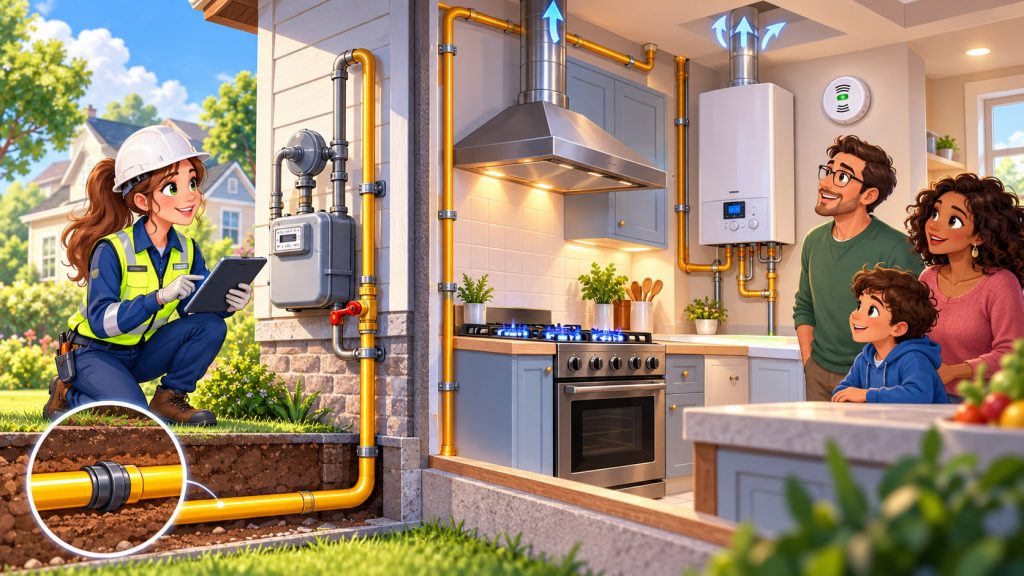
The installation usually includes several essential components:
- An underground gas connection
- A main shutoff valve
- A pressure regulator
- A gas meter
- Internal gas pipelines
- Approved gas appliances
- Appropriate ventilation and exhaust systems
The pressure regulator reduces incoming gas pressure to the level required by the household installation.
The gas meter measures consumption for billing purposes.
Equipment placement and technical requirements vary according to national regulations and local utility standards.
The Main Stages of Connecting a House to Gas
Connecting a property normally involves several stages.
First, the homeowner contacts the local gas distribution operator to determine whether a connection is technically possible.
The operator evaluates the distance to the existing network, available capacity, and connection requirements.
A qualified designer or authorized contractor then prepares the necessary technical documentation.
After approvals are obtained, professionals install the external connection and internal pipelines.
Before gas is introduced, the system must undergo appropriate inspections, including a gas tightness test.
This verifies that pipes, fittings, and connections do not leak under the specified testing conditions.
The final stage is commissioning, when authorized specialists verify the installation and place the gas system into operation.
Gas should never be introduced into a newly installed system before the required inspections and authorization are complete.
Why Professional Installation Is Essential
Gas equipment requires precise installation.
Incorrect pipe sizing, incompatible fittings, inadequate ventilation, or improper pressure settings can create dangerous conditions.
Even a small leak can become hazardous if gas accumulates inside an enclosed space.
For this reason, gas installation, modification, and repair should be performed by appropriately licensed or authorized professionals.
Homeowners should also verify that contractors provide the necessary documentation and comply with local technical requirements.
A professionally installed system is not only safer but generally easier to maintain, inspect, and insure.
Gas Boilers, Water Heaters, and Cooking Appliances
Residential gas systems can supply several types of equipment.
Gas boilers provide central heating and often produce domestic hot water.
Gas water heaters heat water directly, while cooking appliances use gas burners for food preparation.
Modern high-efficiency boilers can recover additional heat from water vapor produced during combustion.
These are commonly called condensing boilers.
Combustion is the chemical reaction between fuel and oxygen that releases heat.
However, burning gas also produces gases that must be managed safely.
Certain appliances require a dedicated flue to carry combustion products outdoors.
Correct exhaust design and adequate air supply are essential for safe operation.
Carbon Monoxide: The Invisible Danger
One of the most serious hazards associated with malfunctioning fuel-burning equipment is carbon monoxide.
This poisonous gas can form when fuel burns incompletely.
Unlike natural gas, carbon monoxide has no smell, color, or taste.
Exposure can cause headaches, dizziness, nausea, confusion, and, at high concentrations, unconsciousness or death.
A blocked exhaust system, defective burner, or insufficient combustion air can increase the risk.
Another concern is backdrafting, when combustion gases flow back into occupied rooms instead of leaving through the intended exhaust route.
Carbon monoxide alarms provide an important additional layer of protection but do not replace proper installation, ventilation, and maintenance.
Alarms should be installed according to applicable safety guidance and manufacturer instructions.
How to Recognize a Natural Gas Leak
Natural gas is naturally almost odorless.
Gas suppliers add an odorant to make leaks easier to detect.
The resulting smell is often described as resembling rotten eggs or sulfur.
Other possible warning signs include unexplained hissing near gas equipment or visible damage to exposed connections.
If a gas leak is suspected:
- Do not light matches, smoke, or create flames.
- Do not operate electrical switches or appliances.
- Leave the building immediately.
- Avoid using a telephone inside the affected area.
- Contact the gas emergency service from a safe outdoor location.
- Do not re-enter until emergency professionals confirm that it is safe.
If the main shutoff valve can be operated safely without delaying evacuation or approaching the leak, follow the gas provider’s emergency instructions.
Never attempt to locate a gas leak using an open flame or repair damaged gas piping yourself.
Ventilation and Indoor Air Quality
Gas appliances need appropriate air supply and exhaust arrangements.
Poor ventilation can allow indoor pollutants to accumulate, particularly when unvented gas cooking appliances are used.
Gas burners can produce nitrogen dioxide, a pollutant associated with respiratory irritation.
Kitchen extractor hoods that discharge outdoors can help reduce cooking-related pollutants.
Fuel-burning heaters and boilers must also have the combustion-air and exhaust arrangements specified for their design.
Homeowners should never block permanent ventilation openings or alter exhaust systems without professional assessment.
Expert Perspective on Residential Gas Safety
The U.S. Consumer Product Safety Commission emphasizes the importance of properly maintained fuel-burning appliances and carbon monoxide alarms in protecting households.
Its safety guidance reinforces a key principle: gas appliances must be installed correctly, operated according to manufacturer instructions, and inspected when necessary by qualified professionals.
Fire-safety specialists also recognize that safe gas operation depends on the entire system, not merely the quality of an individual boiler or stove.
Reliable gas safety combines professional engineering, functioning protective equipment, adequate ventilation, and responsible homeowner behavior.
How Much Does Home Gasification Cost?
The total cost of connecting a house to gas can vary substantially.
The largest expenses may include:
- Connection charges from the gas utility
- Engineering plans and required permits
- Underground excavation and pipe installation
- Internal gas distribution piping
- Boilers, water heaters, or cooking appliances
- Exhaust and ventilation equipment
- Inspections, testing, and commissioning
A property located close to an existing gas main may have lower connection costs than a remote house requiring substantial network extension.
Ongoing expenses include gas consumption, servicing, and possible fixed network charges.
Before investing, homeowners should compare gas heating with alternatives such as electric heat pumps.
Local energy prices, building insulation, equipment efficiency, and future operating costs all influence the financial decision.
Maintenance Every Gas-Connected Home Needs
A gas installation requires regular attention after it begins operating.
Boilers and other fuel-burning appliances should be serviced according to manufacturer recommendations and applicable regulations.
Professional inspections may include checking burner performance, exhaust conditions, safety controls, and gas connections.
Homeowners should keep access to shutoff valves unobstructed and regularly check that carbon monoxide alarms function correctly.
Unusual odors, damaged components, unexpected shutdowns, or persistent ignition problems should be investigated by professionals.
Natural gas is also a fossil fuel, so homeowners may wish to consider long-term energy efficiency and lower-emission heating options when planning major renovations.
Safe gasification is not a one-time construction task. It is an ongoing responsibility throughout the life of the installation.
Interesting Facts
- Natural gas consists primarily of methane, a colorless gas that is lighter than air.
- Natural gas receives its recognizable warning smell through the addition of odorizing chemicals.
- Carbon monoxide alarms and combustible gas detectors identify different hazards.
- Modern condensing gas boilers recover heat that conventional systems allow to escape with exhaust gases.
- Gas distribution pipelines can operate at different pressure levels, requiring regulation before gas enters household appliances.
- Properly designed gas systems include accessible shutoff equipment to isolate the gas supply when necessary.
- Gas appliances designed for natural gas may require different burner components when converted to LPG.
- Energy-efficient insulation can reduce household heating demand regardless of the heating system used.
Glossary
- Natural Gas — A fossil fuel composed mainly of methane, commonly used for heating, cooking, and electricity generation.
- LPG — Liquefied petroleum gas, usually propane, butane, or a mixture of both, stored under pressure.
- Service Line — The pipeline connecting a property to the local gas distribution network.
- Pressure Regulator — A device that reduces and controls gas pressure to a suitable operating level.
- Gas Meter — Equipment measuring the amount of gas consumed by a household.
- Gas Tightness Test — A controlled test used to verify that a gas installation does not leak.
- Commissioning — The inspection, testing, adjustment, and authorization process before equipment enters regular operation.
- Combustion — A chemical reaction between fuel and an oxidizing agent that releases energy, usually as heat.
- Flue — A duct or passage carrying combustion exhaust gases safely away from an appliance.
- Carbon Monoxide — A highly poisonous, odorless gas that can result from incomplete combustion.
- Backdrafting — The unwanted movement of combustion exhaust gases back into occupied spaces.
- Odorant — A substance added to otherwise nearly odorless fuel gas to help people recognize leaks.