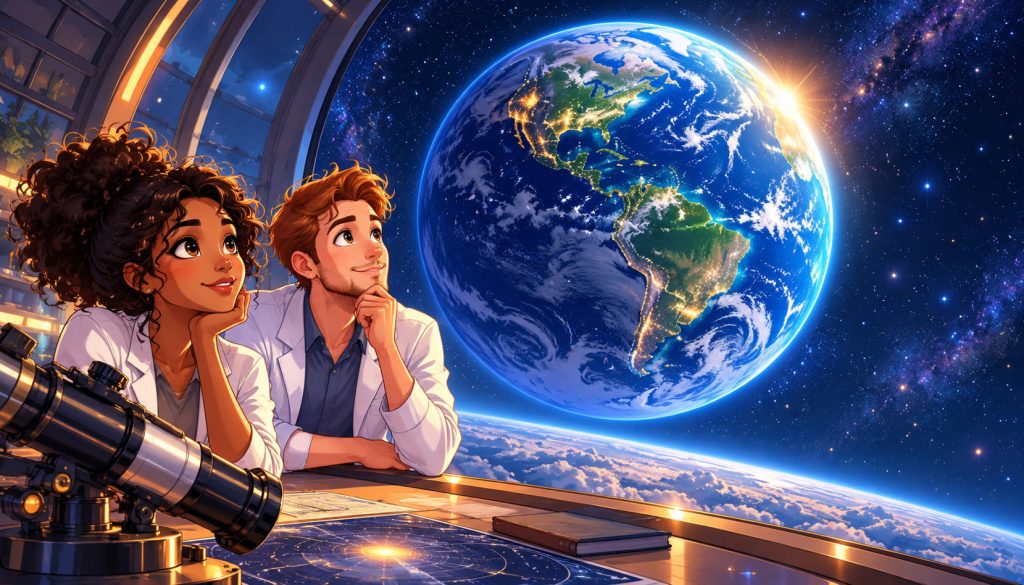
Imagine looking into the night sky and discovering that the Moon had never existed. No glowing full moons, no lunar eclipses, and no familiar lunar phases. The sky would look different, but the consequences would extend far beyond astronomy.
The Moon has helped shape Earth’s oceans, rotation, climate, and biological rhythms for billions of years. Its gravitational influence affects processes that most people rarely notice.
Without the Moon, Earth could still orbit the Sun and support liquid water. However, its environmental history might have followed a remarkably different path.
To understand what a moonless Earth would look like, we need to distinguish between two possibilities: the Moon suddenly disappearing today and our planet developing without a Moon from the beginning.
Earth’s Oceans Would Have Much Weaker Tides
One of the most noticeable differences would involve ocean tides.
Today, the Moon’s gravity creates a powerful tidal force that contributes to the regular rise and fall of seawater.
The Sun also generates tides, but its tide-producing influence is weaker because it is much farther away.
In fact, the Sun’s tide-generating force is approximately 46% as strong as the Moon’s.
Without the Moon, the solar tide would remain, meaning oceans would not become completely motionless.
However, many coastlines would experience substantially smaller tidal ranges.
The familiar combination of strong spring tides and weak neap tides, produced by interactions between lunar and solar tides, would disappear.
Coastal environments would consequently function differently.
Earth’s Days Could Have Been Much Shorter
The Moon has also influenced the length of Earth’s day.
Early in Earth’s history, the planet rotated considerably faster than it does today. Some scientific estimates suggest that days once lasted only a few hours.
Over billions of years, gravitational interactions between Earth and the Moon gradually slowed our planet’s rotation.
This process is called tidal friction.
As Earth’s oceans respond to lunar gravity, energy is transferred between Earth’s rotation and the Moon’s orbital motion.
The result is a gradual slowing of Earth’s spin.
Without the Moon throughout its history, Earth might still have a significantly shorter day, depending on its original rotation rate and other gravitational influences.
However, if the Moon disappeared today, Earth would not suddenly begin spinning faster.
Our planet would initially retain almost the same 24-hour day, although its long-term rotational evolution would change.
The Planet’s Axis Would Be Less Stable
Perhaps the most important long-term consequence involves Earth’s orientation in space.
Our planet currently rotates with an axial tilt of approximately 23.4 degrees.
This tilt is responsible for the seasons.
The Moon helps influence the stability of Earth’s obliquity, the scientific term describing the angle between the planet’s rotational axis and the perpendicular to its orbital plane.
Without lunar influence, Earth’s tilt could experience larger variations over geological timescales.
Earlier theoretical research suggested that a moonless Earth’s tilt might potentially range from nearly 0 to 85 degrees under certain conditions.
Such extreme changes could dramatically alter seasonal patterns.
However, later computer simulations indicate that many moonless Earth scenarios remain considerably more stable than those extreme possibilities suggest.
The Moon contributes to Earth’s rotational stability, but its absence would not automatically produce catastrophic climate instability.
Seasons and Climate Could Be Different
Earth’s seasons are caused by its axial tilt, not by the Moon directly.
Therefore, a moonless Earth could still experience spring, summer, autumn, and winter.
The difference would depend on how its tilt evolved.
A planet with a very small axial tilt would experience weaker seasonal contrasts.
A much larger tilt could produce stronger seasonal temperature differences, particularly at high latitudes.
Over millions of years, changes in tilt might also influence ice sheets, ocean circulation, and regional climate patterns.
The precise outcome would depend on atmospheric conditions, ocean geography, planetary rotation, and other factors.
Earth would not necessarily become permanently frozen or unbearably hot.
Instead, its long-term climate history could be substantially different from the one we know.
Nights Would Be Much Darker
Without the Moon, natural nighttime illumination would change dramatically.
A full Moon reflects enough sunlight to illuminate landscapes, create visible shadows, and assist nocturnal animals.
Without this reflected light, nights away from artificial illumination would generally be darker.
Stars, planets, airglow, and occasional auroras would still illuminate the sky.
The Milky Way would also be easier to observe without bright moonlight.
However, many animals rely on lunar brightness to navigate, hunt, reproduce, or avoid predators.
Their behavior would likely have evolved differently on a moonless planet.
Marine Ecosystems Would Develop Differently
The Moon’s influence extends into coastal habitats.
The intertidal zone is the area between high and low tide, where organisms experience alternating exposure to seawater and air.
Crabs, mussels, sea stars, and many other organisms inhabit these environments.
Weaker tides would alter the extent of these habitats and change patterns of water movement, nutrient exchange, and exposure.
The Moon also provides timing signals for certain reproductive behaviors.
For example, some reef-building corals coordinate reproduction using environmental cues associated with the lunar cycle.
This coordinated release of eggs and sperm is known as synchronous spawning.
Without lunar signals, such reproductive strategies would need to rely on different environmental cues or evolve along different pathways.
Marine life would not necessarily disappear, but coastal ecosystems could look very different.
Would Life Still Exist Without the Moon?
This question reaches into the earliest history of our planet.
The Moon formed approximately 4.5 billion years ago, probably following a collision between the young Earth and a large planetary body.
The leading explanation is known as the giant-impact hypothesis.
If this collision had never occurred, Earth’s initial rotation, composition, and internal development might also have been different.
This makes the question of life more complicated than simply removing a natural satellite.
Some theories suggest that tidal environments may have helped create conditions favorable for early chemical processes.
However, liquid water, energy sources, and suitable chemistry can exist without strong lunar tides.
There is no established scientific requirement that a planet must possess a large moon to support life.
A moonless Earth might still have developed living organisms, although their evolutionary history could have been very different.
What Do Planetary Scientists Think?
Planetary scientist Jack Lissauer and his colleagues investigated how Earth’s axial tilt might behave without the Moon.
Their numerical simulations found that moonless planets could experience larger variations in tilt than modern Earth.
However, many modeled scenarios remained within a more limited range than earlier theoretical estimates suggested.
This research challenged the assumption that a large moon is always essential for maintaining a habitable climate.
The broader scientific lesson is important: planetary habitability depends on multiple interacting factors, including rotation, atmosphere, orbit, oceans, and stellar energy.
The Moon is an influential part of Earth’s history, but it is not the only factor responsible for our planet’s favorable environment.
Would Earth Survive If the Moon Suddenly Disappeared?
If the Moon vanished instantly without physically disturbing Earth, our planet would not explode or leave its orbit around the Sun.
Earth’s gravitational relationship with the Sun would remain overwhelmingly dominant.
However, ocean tides would begin adjusting to the absence of lunar gravity.
The Moon’s influence on Earth’s rotational axis would also disappear, potentially affecting its orientation over much longer periods.
Animals dependent on moonlight or lunar timing would face environmental changes.
Humans would lose lunar eclipses, natural moonlight, and the Moon’s role in traditional calendars.
But Earth would remain a planet with oceans, an atmosphere, and the potential to support life.
Its long-term future would simply follow a different evolutionary path.
Interesting Facts
- The Moon is approximately 384,400 kilometers from Earth on average.
- The Moon’s mass is about 1.2% of Earth’s mass.
- The Sun produces roughly 46% of the Moon’s tide-generating force.
- Earth’s axial tilt currently varies between approximately 22.1 and 24.5 degrees over long astronomical cycles.
- The Moon is gradually moving away from Earth at approximately 3.8 centimeters per year.
- Some coral species coordinate mass spawning events using lunar and seasonal signals.
- Without the Moon, neither lunar eclipses nor Moon-caused solar eclipses would occur.
- A planet does not necessarily need a large natural satellite to maintain liquid oceans.
Glossary
- Tidal force — The difference in gravitational attraction across a body that produces tidal effects.
- Solar tide — A tide generated by the gravitational influence of the Sun.
- Tidal friction — The process through which tidal deformation dissipates energy and affects planetary rotation.
- Axial tilt — The angle between a planet’s rotational axis and the perpendicular to its orbital plane.
- Obliquity — The scientific term for axial tilt, which influences seasonal climate patterns.
- Intertidal zone — The coastal area alternately submerged and exposed as tides rise and fall.
- Lunar cycle — The recurring sequence of lunar phases observed from Earth.
- Synchronous spawning — Coordinated reproductive behavior in which multiple organisms release reproductive cells around the same time.
- Giant-impact hypothesis — The leading scientific explanation proposing that the Moon formed from debris produced by a massive collision involving early Earth.