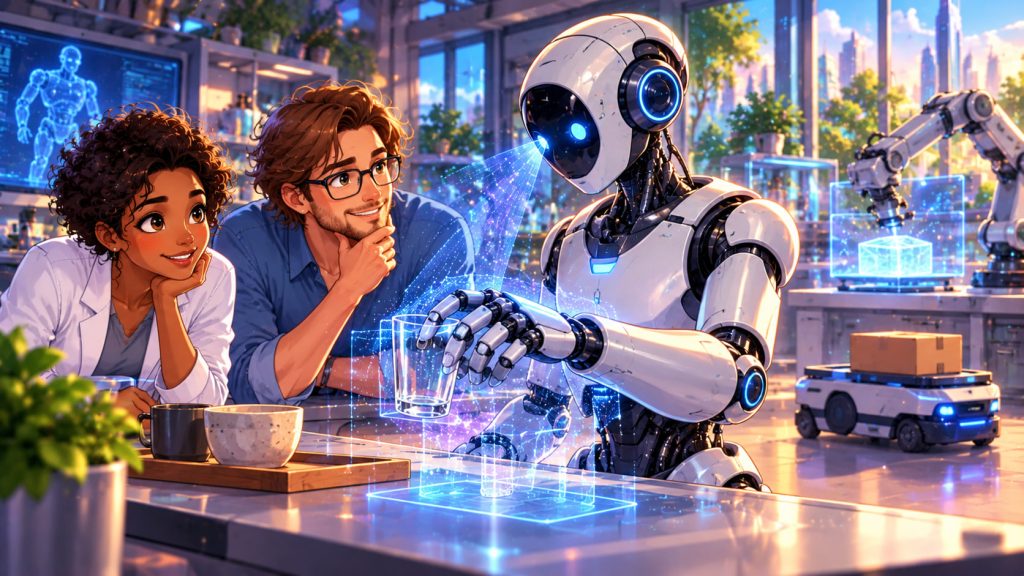
Artificial intelligence has already transformed how people write, search, create images, and analyze information. But another technological revolution is emerging, one that could have an even greater impact on the physical world.
It is called Physical AI, and its goal is to bring artificial intelligence beyond computer screens and into machines that can interact with real environments.
Imagine robots that understand spoken instructions, warehouse machines that adapt to unexpected obstacles, and autonomous vehicles that make decisions in constantly changing traffic conditions.
These are examples of a future in which AI does not simply generate information. It perceives its surroundings, makes decisions, and performs physical actions.
What Is Physical AI?
Physical AI refers to artificial intelligence systems capable of understanding and interacting with the physical world through sensors, control systems, and mechanical devices.
Traditional AI usually processes digital information such as text, images, numbers, or audio.
Physical AI must also consider gravity, movement, distance, friction, objects, and unpredictable environmental conditions.
This requires embodied intelligence, meaning intelligence connected to a physical system that interacts with its surroundings.
For example, a chatbot can explain how to pick up a glass.
A robot powered by Physical AI must identify the glass, calculate its position, move its arm, apply appropriate pressure, and avoid dropping it.
Understanding an action and successfully performing it are fundamentally different challenges.
How Physical AI Actually Works
Physical AI combines several technologies that operate together.
First, a machine must observe its surroundings through cameras, microphones, depth sensors, or other instruments.
This process is called perception.
The system then interprets the incoming information and determines what action is appropriate.
Finally, motors and mechanical components known as actuators execute the chosen movement.
Consider a robot sorting packages inside a warehouse.
It must recognize objects of different shapes, determine where they belong, and move them without causing damage.
If an unexpected object blocks its path, the robot must update its plan.
Advanced systems repeatedly observe, decide, act, and evaluate the results.
This continuous interaction makes Physical AI very different from software that produces a single response.
Why Physical AI Is Different From Traditional Robots
Industrial robots have existed for decades.
Most traditional industrial machines perform carefully programmed movements within controlled environments.
A robotic arm assembling vehicles may repeat the same operation thousands of times with remarkable precision.
However, unexpected changes can interrupt its workflow.
Physical AI aims to make robots more adaptable.
Instead of requiring detailed programming for every possible situation, intelligent machines can use learned models to interpret unfamiliar conditions.
For example, a conventional robot might struggle when an object appears in an unexpected position.
An AI-enabled robot may recognize the change and adjust its movements.
The major advancement is not simply faster automation, but greater flexibility in unpredictable environments.
The Role of AI Models That Understand Actions
One important development is the vision-language-action model.
These systems connect visual information and language instructions with physical movements.
A robot could receive an instruction such as placing a specific object into a container.
The AI analyzes the request, identifies the relevant object, and generates commands for the robot’s motors.
In March 2025, Google DeepMind introduced Gemini Robotics, designed to connect multimodal AI capabilities with robotic actions.
Later developments expanded the ability of these systems to plan and perform more complex tasks.
These technologies remain under active development, but they demonstrate how language-based AI can become a practical control system for physical machines.
Robots Can Learn Through Virtual Worlds
Training intelligent robots exclusively in the real world can be expensive and risky.
Machines may fall, collide with objects, damage equipment, or require extensive human supervision.
Researchers therefore use simulation to create virtual training environments.
Within these environments, AI systems can practice movements and explore different situations without risking physical equipment.
A robot might learn to navigate a warehouse or manipulate objects through repeated virtual experiments.
Engineers also use digital twins, virtual representations of physical machines or environments, to test behavior and evaluate performance.
However, simulated conditions never perfectly reproduce reality.
Differences between virtual training and real-world performance are known as the sim-to-real gap.
Reducing this gap is one of the central challenges of modern robotics.
Can Physical AI Learn From Experience?
Some Physical AI systems use reinforcement learning.
This training approach allows an AI model to improve its behavior using feedback related to its actions.
For example, a simulated robot learning to walk may receive positive feedback for maintaining balance and moving toward a destination.
Unsuccessful movements provide information that helps the training process.
Over many attempts, the system can discover strategies that are difficult to specify through traditional programming.
Researchers have used related techniques to develop robotic movement, manipulation, and control.
Yet successful training does not guarantee reliable performance in every unfamiliar situation.
Physical safety still requires extensive testing and carefully designed safeguards.
Where Physical AI Is Already Being Used
Physical AI is relevant to several major industries.
In manufacturing, intelligent robotic systems can assist with inspection, assembly, and object handling.
In logistics, an autonomous mobile robot can navigate facilities and transport materials between locations.
Agricultural machines increasingly use computer vision and automation to identify crops, guide equipment, and perform selected farming tasks.
Autonomous vehicle developers use AI to interpret road conditions, identify obstacles, and support driving decisions.
Healthcare researchers are also investigating intelligent robotic assistance, including technologies for rehabilitation and patient support.
The scale of robotics adoption is already considerable.
According to the International Federation of Robotics, approximately 542,000 industrial robots were installed worldwide in 2024, while around 4.66 million were operating globally.
Not all these machines use advanced Physical AI, but the figures illustrate the industrial foundation supporting more intelligent automation.
Humanoid Robots and the Future of Physical Work
Humanoid robots attract particular attention because their bodies resemble the human form.
A machine equipped with arms, legs, and hands could potentially operate in environments originally designed for people.
This might include carrying objects, opening doors, or handling equipment.
However, humanoid robots face difficult engineering challenges.
Walking efficiently, maintaining balance, manipulating fragile objects, and operating safely around people require sophisticated coordination.
Human-shaped machines are also not always the best engineering solution.
Wheeled robots or specialized robotic arms can be more efficient for many industrial tasks.
The future of Physical AI will likely include many different machine designs rather than humanoid robots alone.
Expert Perspective: What Makes a Robot Truly Useful?
Researchers at Google DeepMind have emphasized three important qualities for general-purpose robotic intelligence: generality, interactivity, and dexterity.
Generality involves adapting to different tasks and situations.
Interactivity means responding appropriately to instructions and environmental changes.
Dexterity involves performing precise physical movements, especially when manipulating objects.
Together, these capabilities help explain why building a useful robot requires much more than connecting a language model to a mechanical body.
A robot must translate information into reliable physical behavior while adapting to uncertainty.
The Biggest Challenges Facing Physical AI
Despite significant progress, Physical AI still faces important limitations.
- Safety: Machines must operate without harming people or damaging their surroundings.
- Reliability: Robots need consistent performance outside controlled demonstrations.
- Energy consumption: Mobile robots require efficient batteries and power management.
- Training data: Physical interactions are more difficult to collect than digital information.
- Cost: Advanced sensors, processors, and mechanical systems remain expensive.
- Human oversight: Complex decisions require appropriate supervision and accountability.
Unlike a digital mistake, an incorrect physical action can have immediate real-world consequences.
This makes testing, monitoring, and emergency controls particularly important.
How Physical AI Could Transform Everyday Life
The long-term possibilities extend beyond industrial automation.
Future household robots may assist with cleaning, carrying groceries, or performing selected repetitive chores.
Intelligent mobility devices could provide more personalized assistance to people with disabilities.
Agricultural machines may help improve precision while reducing unnecessary resource use.
Infrastructure inspection robots could examine hazardous locations without exposing workers to the same risks.
However, progress will probably occur gradually, with specialized systems becoming dependable before fully general-purpose machines.
Physical AI represents a shift from artificial intelligence that primarily processes information to intelligence that can influence the material world.
Its greatest impact may come not from robots replacing every human activity, but from machines performing useful physical tasks safely, reliably, and alongside people.
Interesting Facts
- Industrial robots have been used commercially since the early 1960s.
- The world’s operational stock of industrial robots exceeded 4.6 million units in 2024.
- Some robotic AI models connect visual observations and natural-language instructions directly to motor commands.
- Simulated robots can practice large numbers of movements without physically wearing out real equipment.
- Physical AI applications extend beyond humanoid robots to include vehicles, drones, robotic arms, and mobile machines.
- Advanced robotic control systems may process information locally to reduce communication delays.
- Researchers use virtual environments to test difficult or dangerous situations before real-world deployment.
Glossary
- Embodied Intelligence — Artificial intelligence connected to a physical system that interacts with its environment.
- Perception — The process of collecting and interpreting information from sensors.
- Actuators — Mechanical or electrical components that convert control commands into physical movement.
- Vision-Language-Action Model — An AI model that connects visual information and language instructions to physical actions.
- Simulation — A computer-generated environment used to model and test real-world behavior.
- Digital Twins — Virtual representations of physical objects, machines, or environments.
- Sim-to-Real Gap — The difference between how a system performs in simulation and how it behaves in reality.
- Reinforcement Learning — A machine-learning technique that improves behavior through feedback on actions.
- Autonomous Mobile Robot — A robot capable of navigating and performing tasks within an environment with some degree of independence.