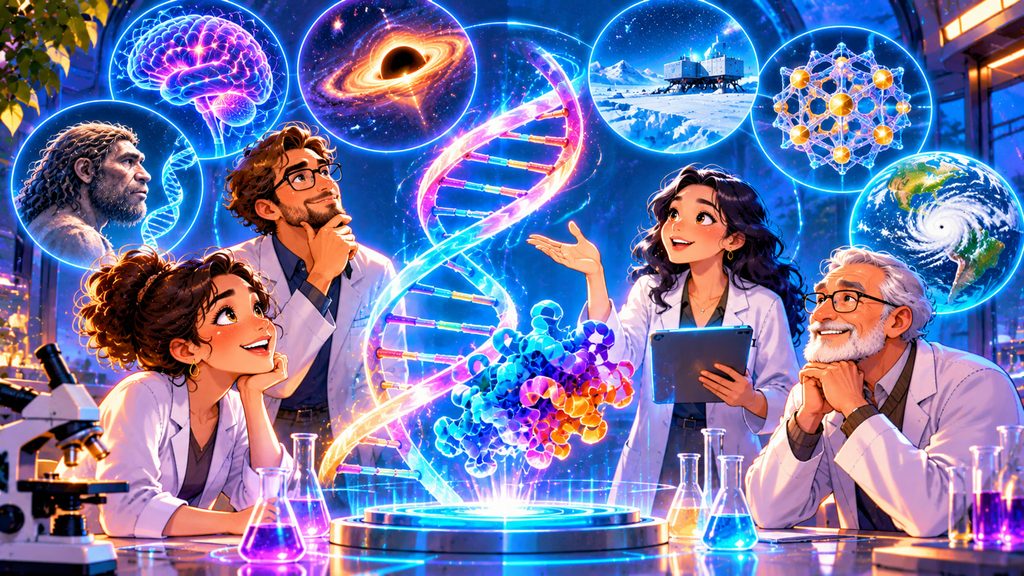
A scientist studies ancient bones and discovers a lost branch of humanity. Another turns the Antarctic ice sheet into a telescope, while a third finds a way to edit the instructions inside living cells. Their work takes place in different laboratories, yet each discovery changes what humans can understand or accomplish. Today’s most influential scientists are not simply answering old questions; they are creating entirely new possibilities.
There is no objective ranking of scientific greatness. Some breakthroughs save lives directly, while others reveal fundamental truths that may take decades to find practical uses. The following researchers represent remarkable achievements across biology, medicine, physics, computing, mathematics, and climate science. Their stories also show why modern discoveries rarely belong to one individual alone.
Jennifer Doudna and Emmanuelle Charpentier: Rewriting DNA
The 2020 Nobel Prize in Chemistry recognized Jennifer Doudna and Emmanuelle Charpentier for developing a powerful method of genome editing. Their work transformed a bacterial defense mechanism into the CRISPR-Cas9 system, which can cut DNA at targeted locations. Researchers can use this tool to investigate genes, develop crops, and explore treatments for inherited diseases. In 2023, US regulators approved the first CRISPR-based sickle cell treatment, an important milestone in genetic medicine.
Editing DNA also carries responsibilities. Doudna has emphasized the importance of ethical oversight. The same precision that makes CRISPR powerful makes careful consideration of its applications essential. Her work illustrates how a discovery about bacteria can transform medicine.
Katalin Karikó and Drew Weissman: Making mRNA Medicine Possible
Before the COVID-19 pandemic, Katalin Karikó and Drew Weissman spent years investigating messenger RNA (mRNA), molecules that carry instructions for producing proteins. They discovered that modifying certain RNA building blocks could reduce unwanted immune responses and improve the technology’s usefulness. Their findings helped enable the rapid development of effective mRNA vaccines and earned the 2023 Nobel Prize in Physiology or Medicine. The approach is now being studied for other vaccines and therapies. Their story shows how years of basic research can become vital during an unexpected global crisis.
Karl Deisseroth, Peter Hegemann, and Georg Nagel: Controlling Neurons with Light
The 2026 Nobel Prize in Physiology or Medicine recognized pioneers of optogenetics, a method for controlling selected cells using light. Peter Hegemann and Georg Nagel helped uncover light-sensitive proteins in algae, while Karl Deisseroth and collaborators developed ways to use them in neurons. Pulses of light reveal how nerve cells contribute to movement, memory, and behavior. The technique has transformed experimental neuroscience, while potential medical applications remain under investigation.
Demis Hassabis, John Jumper, and David Baker: Decoding Proteins
A protein’s three-dimensional shape strongly influences what it does inside a cell. Predicting that shape from its amino-acid sequence challenged scientists for decades. Demis Hassabis and John Jumper developed AlphaFold, an artificial intelligence system that enabled large-scale protein structure prediction. David Baker pioneered computational protein design, creating novel protein structures and functions.
The three shared the 2024 Nobel Prize in Chemistry. Their tools support disease research and novel enzyme design. Artificial intelligence is becoming more than an assistant to science: it can expand the questions researchers are able to investigate. The achievements also demonstrate the extraordinary possibilities created when computer science and biology work together.
Geoffrey Hinton and John Hopfield: The Foundations of Modern AI
Long before today’s widely used AI systems, Geoffrey Hinton and John Hopfield investigated how interconnected computational units could learn from data. Hopfield developed a model of associative memory, while Hinton advanced techniques that helped artificial neural networks discover patterns. Their foundational contributions earned the 2024 Nobel Prize in Physics. These ideas helped shape technologies used for image recognition, language processing, and scientific analysis.
Hinton has also raised concerns about the challenges posed by increasingly powerful AI systems. His career illustrates that responsible innovation involves considering both what technology can achieve and how it might affect society.
Andrea Ghez and Francis Halzen: Revealing the Invisible Universe
Astronomer Andrea Ghez and her research team tracked stars orbiting an unseen object near the Milky Way’s center. Their measurements provided compelling evidence for a supermassive black hole, contributing to her 2020 Nobel Prize in Physics. They inferred its extraordinary mass from nearby stellar orbits. Gravity revealed what light could not.
Physicist Francis Halzen pursued another way of exploring the cosmos. His work helped establish the IceCube observatory, which detects elusive neutrinos using sensors embedded deep in Antarctic ice. Awarded the 2026 Nobel Prize in Physics, Halzen helped open a new field of astronomy that studies energetic cosmic events using particles rather than light. Together, these discoveries demonstrate how scientists can investigate objects that traditional telescopes cannot observe directly.
Svante Pääbo: Reading the DNA of Extinct Humans
For generations, ancient bones seemed to offer only fragmentary clues about human ancestors. Svante Pääbo developed methods for recovering and analyzing ancient DNA despite contamination and extensive molecular damage. His team sequenced the Neanderthal genome and revealed the Denisovans, a previously unrecognized group of ancient humans. These discoveries earned him the 2022 Nobel Prize in Physiology or Medicine. He also showed that modern human ancestors interbred with extinct groups, adding genetic evidence to the fossil record.
Friederike Otto: Connecting Climate Change to Extreme Weather
When a severe heatwave or flood occurs, a pressing question arises: did human-caused climate change influence it? Climate scientist Friederike Otto helped establish World Weather Attribution, which combines observations and models to answer that question. The method, called climate attribution, compares today’s climate with a modeled world without the same degree of human-caused warming. It can estimate how warming changes the likelihood or intensity of certain extreme events. The findings help communities plan for changing risks without assigning every disaster a single cause.
Maryna Viazovska and Omar Yaghi: Mathematics and Molecular Architecture
Mathematician Maryna Viazovska solved a famous sphere packing problem in eight dimensions, showing how identical mathematical spheres can be arranged with maximum density. Her elegant proof earned the 2022 Fields Medal, one of mathematics’ highest honors. Related mathematics helps underpin communications and coding theory. Her achievement demonstrates that abstract reasoning can reveal unexpected structure.
Chemist Omar Yaghi helped develop metal-organic frameworks, crystalline materials containing exceptionally large networks of microscopic pores. He shared the 2025 Chemistry Nobel with Susumu Kitagawa and Richard Robson. Researchers are exploring their use in carbon capture, gas storage, and water harvesting. These materials illustrate how control over molecular architecture could help address practical environmental challenges.
What Makes a Scientist Truly Influential?
These achievements cannot be compared using a single measure. Some required decades of perseverance, while others depended on new instruments or close collaboration across fields. Many essential contributors remain publicly unrecognized. The defining achievement is not fame but the creation of reliable knowledge that others can build upon.
Future challenges include disease, climate, energy, and AI. Their stories show how curiosity becomes progress. Scientific discovery will continue to depend on creativity, collaboration, and the willingness to explore difficult questions. Which scientific discovery of our time do you believe will have the greatest influence on future generations? Share your thoughts in the comments.
Interesting Facts
- CRISPR-based therapy for sickle cell disease received its first US regulatory approval in 2023.
- Modified mRNA research helped enable rapid vaccine development during the COVID-19 pandemic.
- Optogenetics uses light-sensitive proteins to control selected nerve cells.
- AlphaFold made protein structure predictions available at an unprecedented scale.
- IceCube uses sensors buried deep in Antarctic ice to detect rare neutrino interactions.
- Neanderthal and Denisovan DNA can still be found in the genomes of many living people.
- The 2025 Chemistry Nobel recognized porous materials with potential applications in water harvesting.
Glossary
- Genome Editing — Deliberately changing DNA sequences in living cells.
- CRISPR-Cas9 — A molecular system used to cut DNA at targeted locations.
- Messenger RNA (mRNA) — RNA carrying instructions for making proteins.
- Optogenetics — Using genetically introduced light-sensitive proteins to control cell activity.
- Protein Structure Prediction — Determining a protein’s likely three-dimensional shape from its sequence.
- Computational Protein Design — Using calculations to create proteins with desired structures and functions.
- Artificial Neural Networks — Computing systems of connected units trained to recognize patterns.
- Supermassive Black Hole — An extremely massive black hole, often found at a galaxy’s center.
- Neutrinos — Very light, electrically neutral particles that interact weakly with matter.
- Ancient DNA — Genetic material recovered from organisms that lived in the distant past.
- Climate Attribution — Estimating how climate change influences the likelihood or intensity of events.
- Sphere Packing — The mathematical study of arranging spheres as densely as possible.
- Metal-Organic Frameworks — Porous crystalline materials formed from metal centers and organic linkers.