Bio-oil is a dark, energy-rich liquid produced when plant material and other forms of biomass are rapidly heated with little or no oxygen. It is also known as pyrolysis oil, fast-pyrolysis bio-oil, or sometimes bio-crude.
Scientific discoveries require more than brilliant ideas. Researchers need laboratories, equipment, computing power, materials, fieldwork, skilled employees, and enough time to investigate questions whose answers may remain uncertain for years.
Personal stories are memorable because they involve real people, emotions, and visible outcomes. They can inspire useful research questions, but an anecdote cannot reliably prove that a product, treatment, diet, or habit caused the result.
Scientific journals are the main channels through which researchers share experiments, clinical studies, theories, datasets, and new discoveries. Before most papers are published, they pass through peer review, a process in which other specialists evaluate the manuscript.
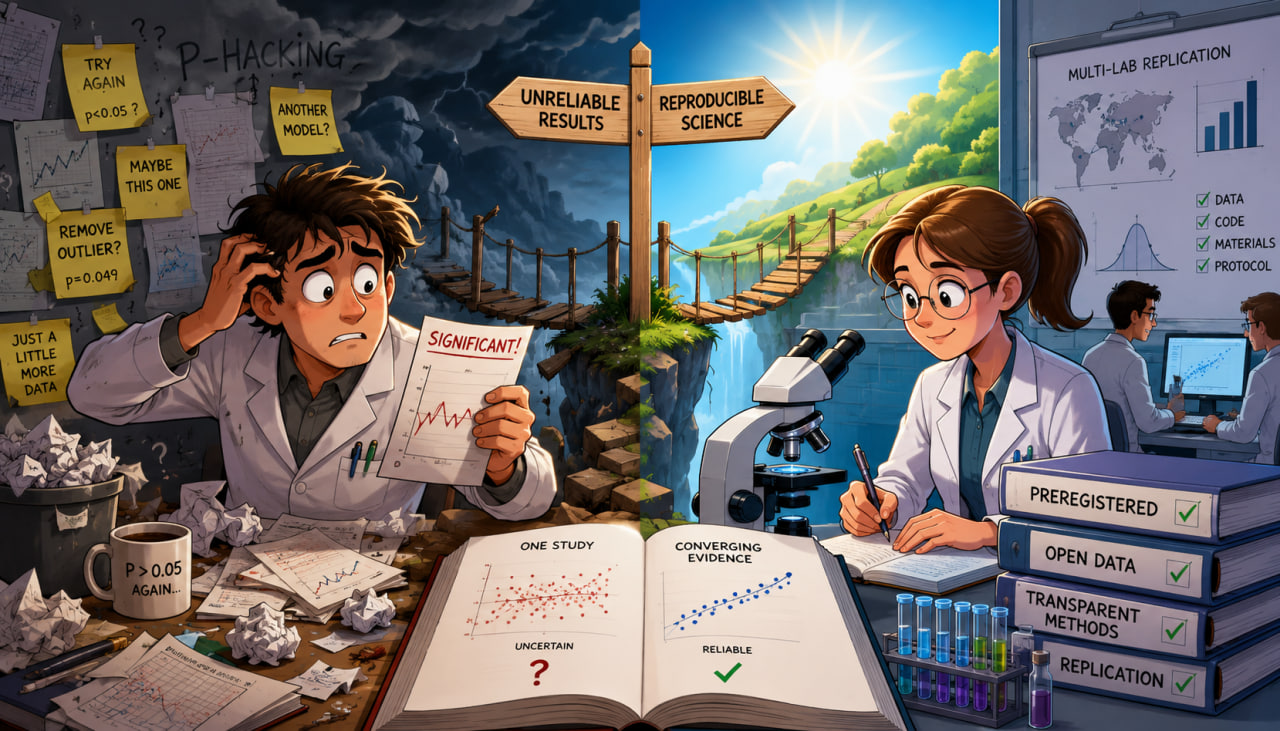
Scientific articles often appear definitive. They contain statistics, technical language, graphs, expert authors, and peer review. Yet publication does not guarantee that a finding is correct, universal, or independently repeatable.
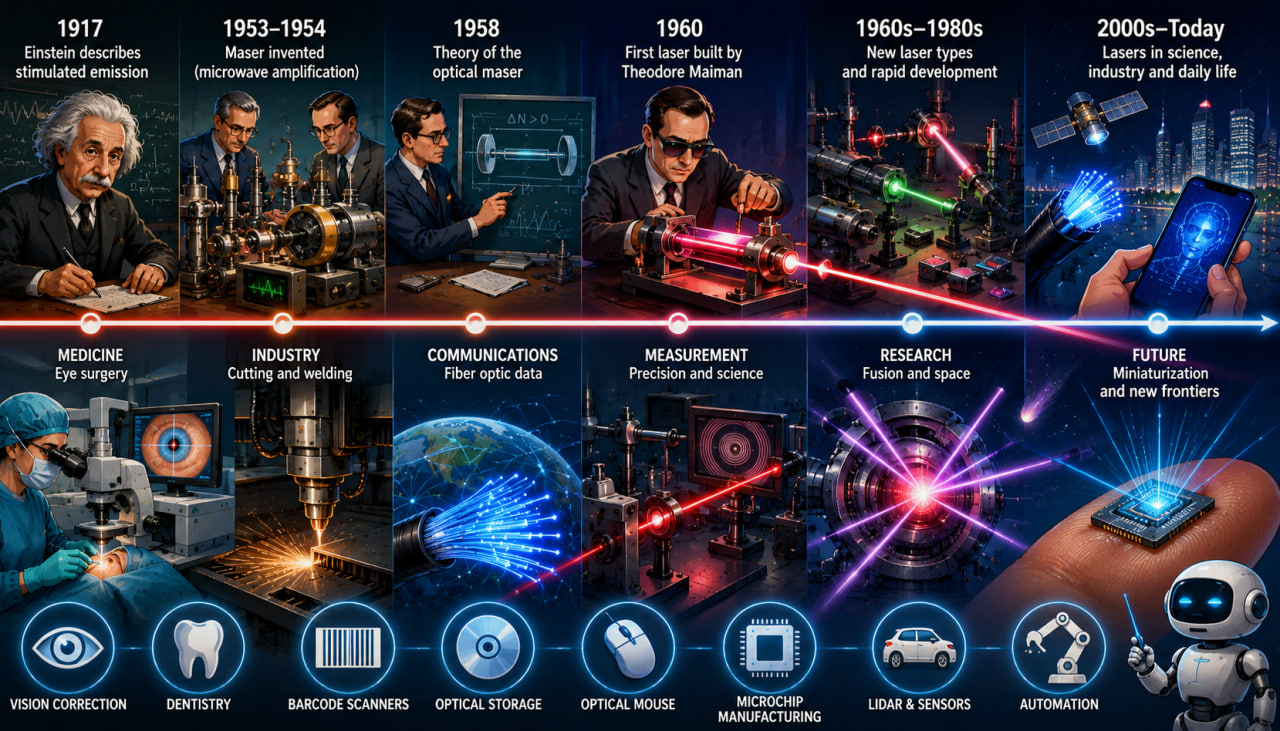
Laser technology in 2026 is moving far beyond familiar applications such as barcode scanners, eye surgery, and industrial cutting. Researchers are now building lasers directly onto photonic chips, creating ultrastable systems for quantum devices, improving high-repetition lasers for fusion energy, and using precisely controlled light to manufacture structures at the nanoscale.
The laser is one of the most influential inventions of the modern era. It can cut steel, correct vision, transmit internet data, measure microscopic distances, scan barcodes, manufacture computer chips, analyse distant planets, and support experiments in nuclear fusion.
Wireless charging feels like a small everyday miracle. You place your phone, earbuds, or smartwatch on a pad, and the battery starts filling without plugging in a cable. No exposed connector, no worn charging port, no searching for the right wire in the dark. Just contact, alignment, and invisible energy transfer.
Transcendental numbers are among the most fascinating objects in mathematics. They are real or complex numbers that cannot be produced as solutions to any polynomial equation with integer coefficients. That sounds technical at first, but the idea is surprisingly powerful: some numbers are so mathematically “wild” that no finite algebraic equation can capture them. Famous numbers such as π and e are transcendental. They appear everywhere in mathematics, physics, engineering, geometry, probability, and calculus. Yet they do not behave like ordinary whole numbers, fractions, square roots, or even many irrational numbers. Transcendental numbers reveal that the number system is far richer than everyday arithmetic suggests. They also show that infinity is not just a philosophical idea, but a precise mathematical landscape filled with hidden structure.
In everyday life, a coffee cup and a donut are clearly different objects. One holds tea or coffee, the other is something you eat. They have different materials, functions, colors, and sizes. But in topology, one of the most fascinating branches of mathematics, they can be considered the same kind of shape. This strange idea comes from the way topology studies objects. Instead of focusing on exact measurements, angles, distances, or rigid geometry, topology asks what remains unchanged when a shape is stretched, bent, twisted, or smoothly deformed. If one object can be transformed into another without cutting, tearing, gluing, or creating new holes, topologists may treat them as equivalent. That is why a cup with one handle and a donut are mathematically similar: both have exactly one hole. This simple example opens the door to a completely different way of thinking about space, form, continuity, and hidden structure.