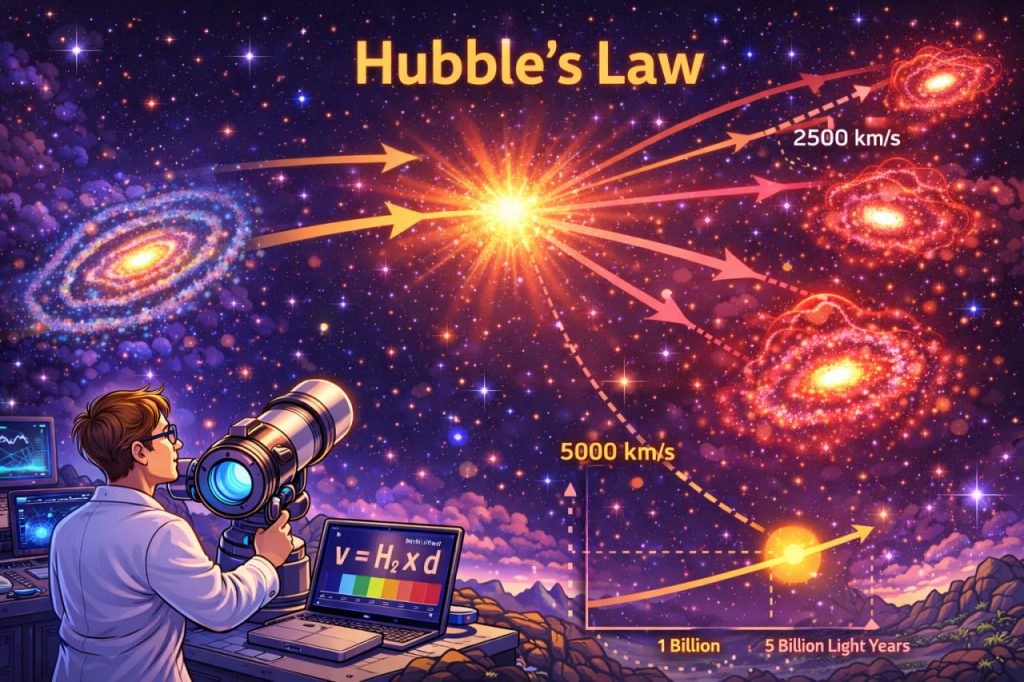
Hubble’s Law is one of the most important discoveries in modern astronomy, revealing that the universe is continuously expanding. It describes the relationship between the distance of galaxies and the speed at which they move away from us. Simply put, the farther a galaxy is, the faster it recedes. This discovery transformed our understanding of the cosmos, showing that the universe is not static but dynamic and evolving. It also provided strong evidence for the Big Bang theory, suggesting that the universe began from a single, dense point and has been expanding ever since. Today, Hubble’s Law remains a cornerstone of cosmology, helping scientists measure distances across vast regions of space and understand the large-scale structure of the universe.
The Discovery Behind the Law
In the 1920s, astronomer Edwin Hubble observed distant galaxies and noticed that their light exhibited redshift, indicating they were moving away from Earth. By comparing redshift data with distance measurements, he found a clear pattern: galaxies farther away had greater redshift and were receding faster. This relationship became known as Hubble’s Law. According to astrophysicist Dr. Karen Lewis:
“Hubble’s discovery changed our place in the universe —
it showed that everything is moving apart, and the cosmos is still unfolding.”
This breakthrough marked the beginning of modern cosmology.
Understanding the Formula
Hubble’s Law is often expressed with a simple equation: v = H₀ × d, where v is the velocity of a galaxy, d is its distance, and H₀ is the Hubble constant. This constant represents the rate of expansion of the universe. Although its exact value is still being refined, it provides a way to estimate cosmic distances and expansion speed. The equation shows that expansion is uniform on large scales, meaning space itself is stretching everywhere.
The Role of Redshift
Redshift is a key component of Hubble’s Law because it allows scientists to measure how fast galaxies are moving away. As light travels through expanding space, its wavelength stretches, shifting toward the red end of the spectrum. The greater the redshift, the faster the galaxy is receding. This connection between redshift and velocity made it possible to confirm that the universe is expanding rather than galaxies simply moving through static space.
Implications for the Universe
Hubble’s Law has profound implications for our understanding of the universe. It suggests that if we trace the expansion backward in time, all matter was once concentrated in a single point, supporting the idea of the Big Bang. It also helps scientists estimate the age of the universe and study how expansion has changed over time. Modern observations indicate that this expansion is accelerating, likely due to dark energy.
Modern Research and Challenges
Despite its importance, measuring the Hubble constant remains one of the biggest challenges in cosmology. Different methods yield slightly different values, leading to what scientists call the “Hubble tension.” Resolving this discrepancy could lead to new discoveries about the fundamental nature of the universe. Ongoing research continues to refine measurements and improve our understanding of cosmic expansion.
Interesting Facts
- Hubble’s Law was discovered in 1929.
- The universe is expanding in all directions simultaneously.
- The Hubble constant helps estimate the age of the universe.
- Observations suggest the expansion of the universe is accelerating.
- The concept applies only on large cosmic scales, not within galaxies.
Glossary
- Hubble’s Law — the relationship between a galaxy’s distance and its speed of recession.
- Redshift — the stretching of light as objects move away or space expands.
- Hubble Constant (H₀) — the rate at which the universe expands.
- Big Bang — the theory describing the origin of the universe.
- Dark Energy — a mysterious force driving the acceleration of cosmic expansion.