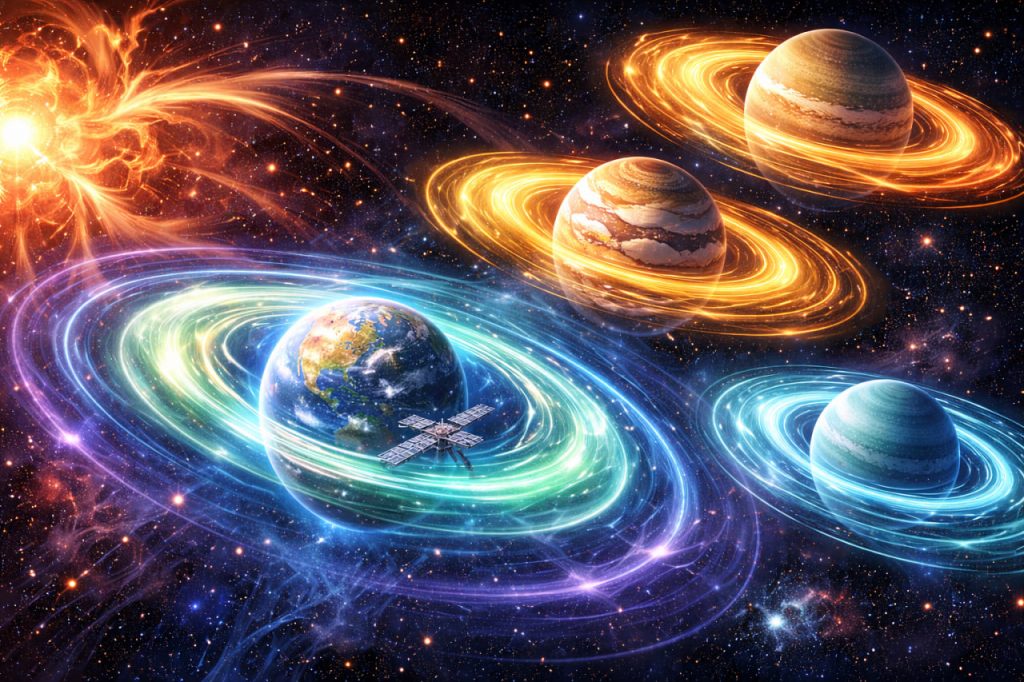
Radiation belts are regions surrounding planets where charged particles are trapped by magnetic fields, forming invisible yet powerful zones of energy. The most well-known example is Earth’s Van Allen radiation belts, but similar structures exist around other planets such as Jupiter and Saturn. These belts are created when particles from the solar wind become captured and accelerated by a planet’s magnetosphere. While they can act as a form of protection by deflecting harmful radiation, they also pose serious risks to spacecraft and astronauts. Understanding radiation belts is essential for space exploration and for studying how planetary magnetic fields interact with their environment.
How Radiation Belts Form
Radiation belts form when a planet has a strong magnetic field, or magnetosphere. Charged particles from the Sun are guided along magnetic field lines and become trapped, spiraling back and forth between the planet’s poles. Over time, these particles accumulate and form dense regions of high-energy radiation. According to space physicist Dr. Laura Chen:
“Radiation belts are dynamic systems, shaped by solar activity and the strength of a planet’s magnetic field.”
This means their intensity can change depending on solar storms and space weather conditions.
Earth’s Van Allen Belts
Earth has two main radiation belts, known as the inner and outer Van Allen belts. The inner belt contains high-energy protons, while the outer belt is dominated by energetic electrons. These belts protect Earth by absorbing and deflecting harmful solar radiation, preventing much of it from reaching the surface. However, they can also interfere with satellites and communication systems.
Radiation Belts on Other Planets
Other planets with strong magnetic fields also have radiation belts, often much more intense than Earth’s. Jupiter, for example, has extremely powerful radiation belts that are considered among the most dangerous in the solar system. Spacecraft exploring Jupiter must be specially shielded to survive these conditions. Saturn and Uranus also possess radiation belts, though they vary in structure and intensity.
Challenges for Space Exploration
Radiation belts present significant challenges for missions beyond Earth. High-energy particles can damage electronics, degrade materials, and pose health risks to astronauts. Space missions must carefully plan trajectories and use shielding to minimize exposure. Understanding these belts is crucial for the safety and success of long-term space travel.
Why Radiation Belts Matter
Studying radiation belts helps scientists understand space weather, planetary protection, and magnetic field dynamics. These regions provide valuable information about how planets interact with solar radiation and how environments in space can affect technology and life. As humanity moves toward deeper space exploration, knowledge of radiation belts becomes increasingly important.
Interesting Facts
- Earth’s radiation belts were discovered in 1958.
- Jupiter’s radiation belts are far more intense than Earth’s.
- Radiation belts can change in response to solar storms.
- They can damage satellites and spacecraft electronics.
- Not all planets have radiation belts—only those with strong magnetic fields.
Glossary
- Radiation Belts — regions of trapped charged particles around a planet.
- Magnetosphere — the area around a planet dominated by its magnetic field.
- Solar Wind — a stream of charged particles emitted by the Sun.
- Van Allen Belts — Earth’s radiation belts.
- Space Weather — environmental conditions in space influenced by solar activity.