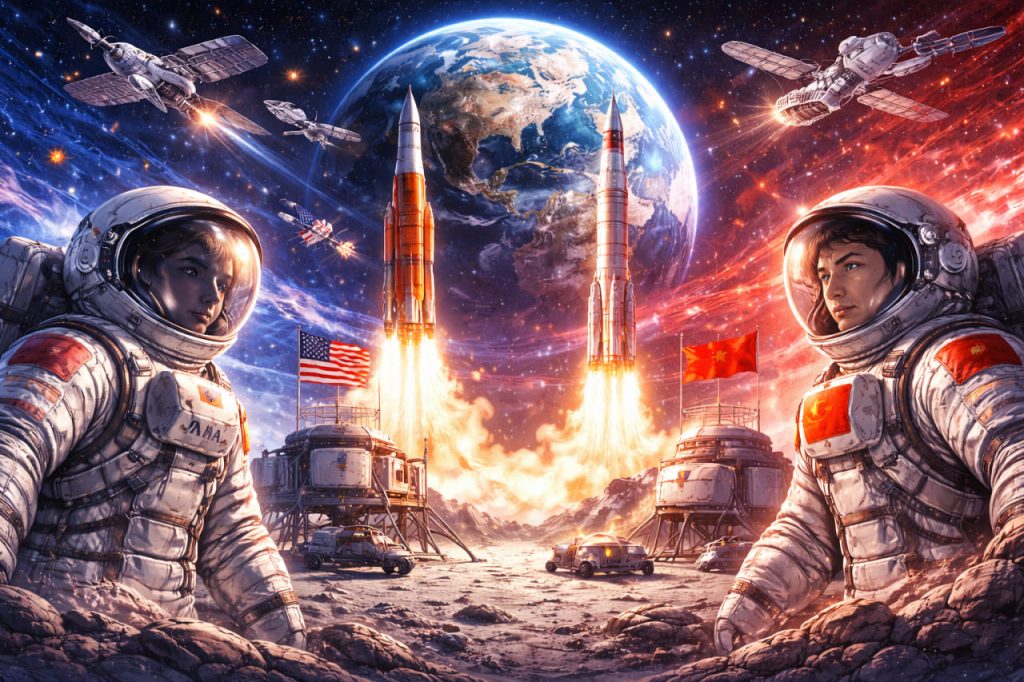
A new era of space exploration is unfolding, often described as a modern space race between China and the United States. Unlike the Cold War competition, today’s rivalry is more complex, combining elements of competition, technological advancement, and strategic influence. Both China and NASA are pursuing ambitious goals, including Moon bases, Mars exploration, and deep space missions. This new race is not only about prestige but also about leadership in science, innovation, and future space infrastructure. As both sides push forward, the outcome could shape humanity’s presence beyond Earth for decades to come.
China’s Rapid Rise in Space
China has made remarkable progress in space exploration over the past two decades. Its space program has successfully launched lunar missions, Mars probes, and its own space station. The Chang’e missions have explored the Moon, including landing on its far side—an achievement that marked a major milestone. China’s approach emphasizes steady, long-term development and increasing independence in space technology.
According to space policy expert Dr. Andrew Collins:
“China’s space program has evolved from catching up to setting its own ambitious pace,
becoming a major force in global space exploration.”
NASA’s Strategy and Experience
NASA, with decades of experience, continues to lead in many areas of space exploration. Programs like Artemis aim to return humans to the Moon and establish a sustainable presence. NASA also collaborates with private companies and international partners, creating a broad and flexible exploration network. Its long history provides a strong foundation for tackling complex missions.
The Moon as a Strategic Target
Both China and the United States are focusing heavily on the Moon, particularly the lunar south pole, where water ice may exist. Establishing a presence there could enable long-term missions and serve as a base for future exploration of Mars. This shared focus has turned the Moon into a key arena in the new space race.
Competition and Cooperation
While often framed as a rivalry, the situation also includes elements of cooperation and parallel progress. Different nations and organizations contribute to a broader global effort in space exploration. However, technological leadership and strategic positioning remain important factors driving competition.
What This Means for the Future
The renewed space race is accelerating innovation and expanding humanity’s capabilities in space. Advances in propulsion, robotics, and life-support systems are emerging from this competition. Ultimately, this race could lead to permanent human presence on the Moon and pave the way for missions to Mars and beyond.
Interesting Facts
- China operates its own space station, Tiangong.
- NASA’s Artemis program aims for long-term lunar exploration.
- The Moon’s south pole is a key target due to possible water ice.
- Private companies play a major role in modern space missions.
- Both nations are planning future Mars missions.
Glossary
- Space Race — competition between nations in space exploration.
- Artemis Program — NASA’s initiative to return humans to the Moon.
- Tiangong — China’s modular space station.
- Lunar South Pole — a region of the Moon with potential water resources.
- Deep Space Exploration — missions beyond Earth’s immediate orbit.